BepiColombo reaches Mercury orbit, and ESA says a software problem cut its thruster burn short
BepiColombo went into orbit around Mercury on 21 November. A software problem cut its thruster burn short, but the craft is safe, the European Space Agency said, Reuters reported.
Based so far on 2 official sources and 3 news outlets. 1 point is not yet confirmed.
BepiColombo went into orbit around Mercury on 21 November, the Associated Press (AP), Reuters and Space.com reported. A day later the European Space Agency (ESA) said a software problem had stopped the thruster burn early as the craft arrived. ESA said the spacecraft was safe and its team was looking into it, Reuters and Space.com reported. The mission, shared with Japan's space agency, was launched in October 2018 and needed nine planetary flybys to slow down.
Key facts
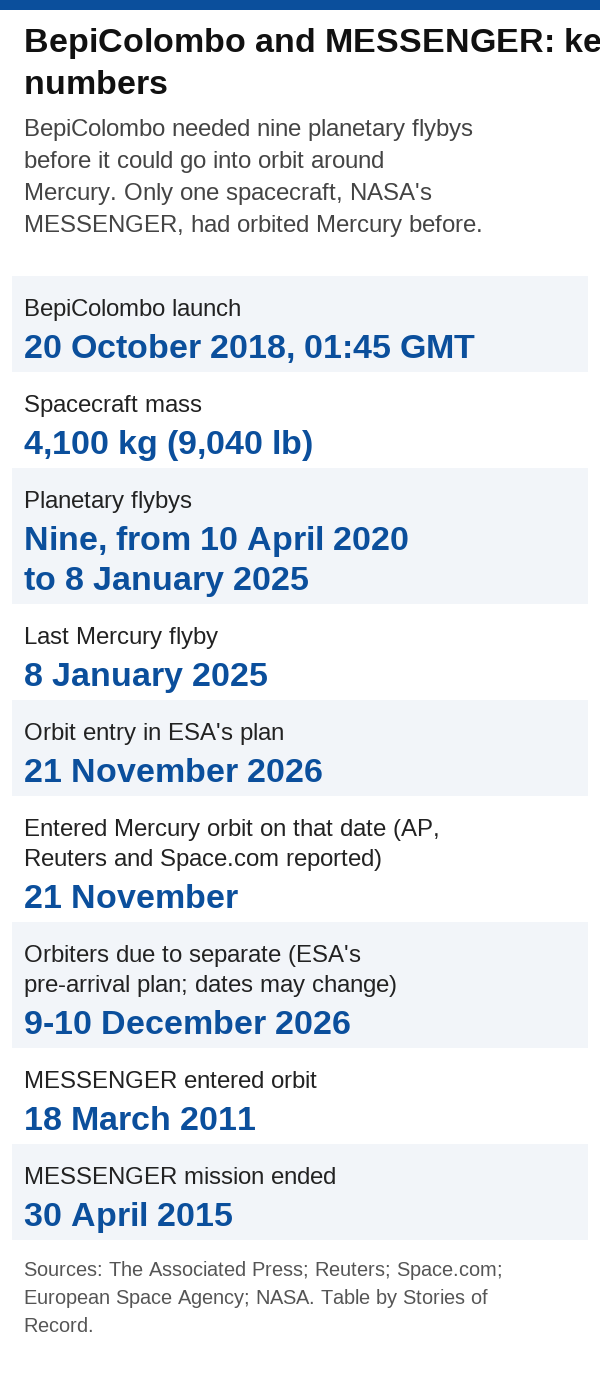
- BepiColombo's two joined orbiters, one European and one Japanese, went into orbit around Mercury on 21 November after eight years of flying there together, AP reported. Reuters and Space.com also reported the arrival in orbit. [1] [2] [3]
- NASA's part in the mission is Strofio, a sensor on the European orbiter. NASA funds it through its Discovery Program, and Southwest Research Institute (SwRI) built it and manages it. It is part of an instrument package called SERENA. [6]
- NASA's MESSENGER became the first spacecraft to orbit Mercury when it entered orbit at 00:45 UT on 18 March 2011, almost seven years after its launch. [8]
Timeline
- ESA said on 22 November that a software problem had stopped BepiColombo's thruster burn early as the craft went into orbit the day before, according to Reuters and Space.com. ESA said the spacecraft was safe and its operations team was looking into the problem. ESA had not posted this on its own website when we checked. [2] [3]
- On 15 September all the European orbiter's instruments were switched on together for the first time since that separation, and ESA said first checks showed them in good health. [5]
- The sixth and last Mercury flyby came on 8 January 2025. [7]
- It flew past Mercury for the first time on 1 October 2021. [7]
- BepiColombo swung past Earth on 10 April 2020. [7]
- NASA's MESSENGER became the first spacecraft to orbit Mercury when it entered orbit at 00:45 UT on 18 March 2011, almost seven years after its launch. [8]
What we know
- The arrival date matched ESA's plan, which set 21 November 2026 as the day the two orbiters, still stacked on top of each other, would be captured into a polar orbit around Mercury. ESA notes its dates can shift for operational reasons. [4] [5]
- BepiColombo is led by ESA with the Japan Aerospace Exploration Agency (JAXA). It is the first mission to orbit Mercury with two spacecraft at once: ESA's Mercury Planetary Orbiter (MPO) and JAXA's Mercury Magnetospheric Orbiter, called Mio. [5]
- Strofio is about the size of a basketball, NASA says. Its job is to study Mercury's exosphere, the very thin layer of gas around the planet. [6]
- BepiColombo was launched on an Ariane 5 rocket from Kourou, French Guiana, at 01:45 GMT on 20 October 2018. [7] [6]
- The full BepiColombo spacecraft has a mass of 4,100 kilograms (9,040 pounds), according to NASA's mission page. [6]
- To lose speed on the way in, the craft made nine flybys of planets: one of Earth, two of Venus and six of Mercury, ESA's timeline shows. [7]
- BepiColombo swung past Earth on 10 April 2020. [7]
- It flew past Mercury for the first time on 1 October 2021. [7]
- The sixth and last Mercury flyby came on 8 January 2025. [7]
- On 3 September 2026 the transfer module that had pushed the craft for years separated from the two orbiters, ESA confirmed through its deep-space antennas in Spain and Argentina. The European orbiter then took over steering. [5] [4]
- On 15 September all the European orbiter's instruments were switched on together for the first time since that separation, and ESA said first checks showed them in good health. [5]
- MESSENGER orbited Mercury for more than four years and ended its mission on 30 April 2015 by crashing into the planet after it ran out of propellant, NASA says. AP also named it as the last mission to orbit Mercury before BepiColombo. [8] [1]
- This is Europe's and Japan's first mission to Mercury. Before it, only two spacecraft had visited the planet, both from NASA: Mariner 10 and MESSENGER. [6]
What we don't know yet
- ESA said on 22 November that a software problem had stopped BepiColombo's thruster burn early as the craft went into orbit the day before, according to Reuters and Space.com. ESA said the spacecraft was safe and its operations team was looking into the problem. ESA had not posted this on its own website when we checked. [2] [3]
Why it matters
Mercury is the least explored rocky planet. Only one spacecraft has orbited it before: NASA's MESSENGER, which arrived in 2011 and crashed into the planet in 2015 when its fuel ran out. BepiColombo is the first mission to put two orbiters around Mercury at once, one European and one Japanese. The United States has a stake too: NASA paid for Strofio, a small sensor that will sample the thin layer of gas around the planet.
Questions
Did BepiColombo really reach Mercury orbit?
Yes. AP, Reuters and Space.com reported that it entered orbit on 21 November, the day ESA had planned. ESA's own arrival page had not yet posted the news when this record was written; we will add it when it appears.
What went wrong during the arrival?
ESA said on 22 November that a software problem stopped the thruster burn early as BepiColombo went into orbit, Reuters reported. ESA said the spacecraft was safe and its team was looking into it. The reports do not give a cause.
What is the American part of the mission?
Strofio, a sensor about the size of a basketball on the European orbiter. NASA funds it, and Southwest Research Institute built and manages it. It will study the thin layer of gas around Mercury.
Has anything orbited Mercury before?
Yes, once. NASA's MESSENGER entered orbit on 18 March 2011 and orbited for more than four years before crashing into the planet on 30 April 2015.
Why did the trip take so long?
The craft had to shed speed to be caught by Mercury's gravity. It did that with nine planetary flybys between 2020 and 2025.
When does the science start?
ESA's timeline sets the science phase to begin on 6 April 2027, after the two orbiters separate in December and the European one reaches its final orbit on 10 March 2027. ESA says these dates can change, and the reports on the burn problem do not say whether they will.
Updates
- First published.
Every version of this story, as first published.
Sources
- The Associated Press News organizationPublished: 22 November 2026Reported by The Associated Press; credited as reported, not opened by us
- Reuters News organizationPublished: 22 November 2026Reported by Reuters; credited as reported, not opened by us
- Space.com News organizationSpace.com: BepiColombo is safe in Mercury orbit after a software problem cut its thruster burn shortPublished: 22 November 2026Reported by Space.com; credited as reported, not opened by us
- European Space Agency Official (government)Retrieved: 22 November 2026
- European Space Agency Official (government)Retrieved: 22 November 2026
- NASA Official (government)Published: 1 December 2017Retrieved: 22 November 2026
- NASA Official (government)Published: 21 December 2017Retrieved: 22 November 2026
About the picture: this is a stock photo from Storyblocks. It does not show the people, places or events in this story.
People, places and organizations
- Product
- BepiColombo
- Organization
- European Space Agency
- Organization
- Japan Aerospace Exploration Agency
- Organization
- NASA
- Organization
- Southwest Research Institute
- Product
- MESSENGER
- Place
- Mercury
Follow us on Facebook
We post new records on our Facebook Page.
Follow on Facebook