New US rules on AI chip exports: what changes and which countries they cover
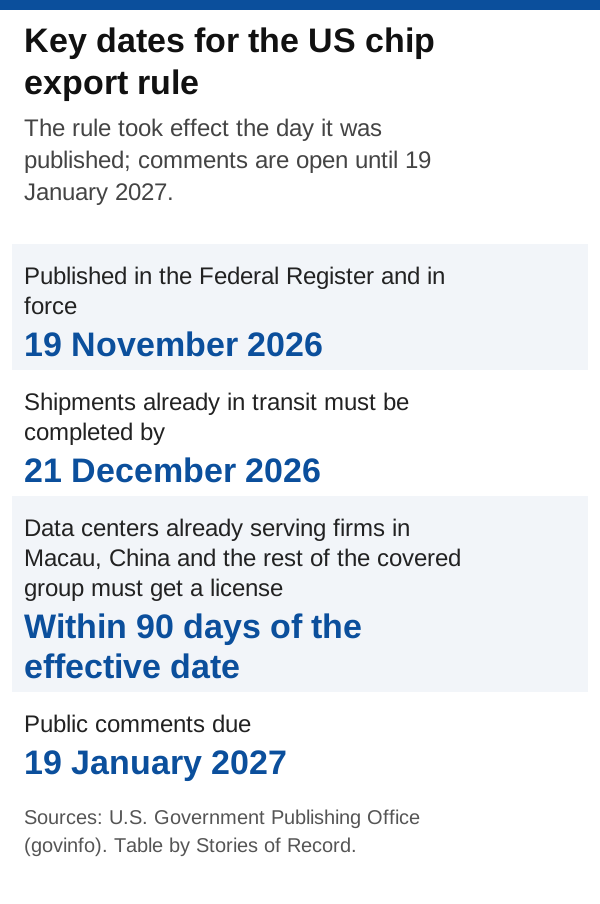
The rule took effect on 19 November 2026, and the Commerce Department is taking comments until 19 January 2027.

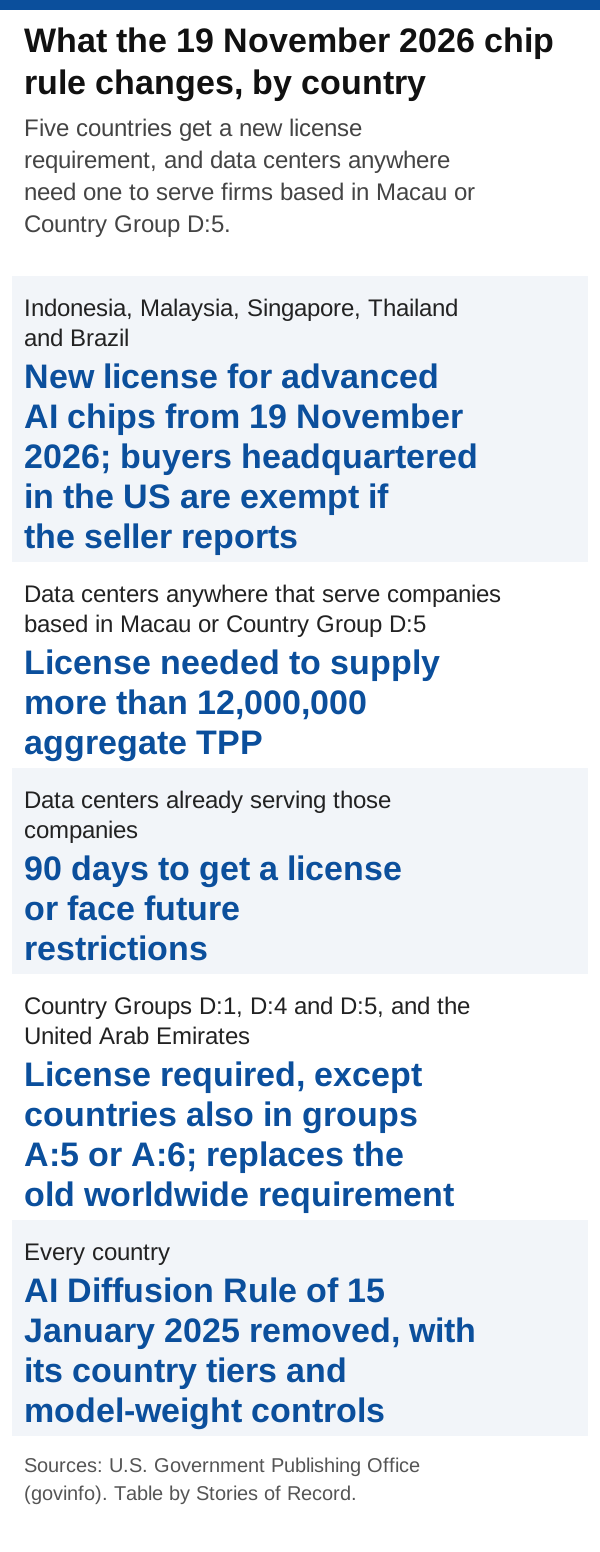
Shipping advanced artificial intelligence (AI) chips to Indonesia, Malaysia, Singapore, Thailand or Brazil now needs a US license. Data centers anywhere also need one to sell large amounts of computing power to companies based in Macau or Country Group D:5, a group of countries in US export rules that includes China. The Commerce Department's Bureau of Industry and Security (BIS) put both rules in force on 19 November 2026. Comments are open until 19 January 2027.
Latest
We added who is not affected by the new limits on chip designers. Designers that are approved or authorized under the rule can still clear their chips with a datasheet or other written statement.
Key facts
- BIS published the interim final rule, Addressing Remote Access to Advanced Semiconductors, in the Federal Register on 19 November 2026. It took effect the same day. [1]
- Since 19 November 2026, exporters need a license to send advanced AI chips to, or move them within, Indonesia, Malaysia, Singapore, Thailand and Brazil. The rule says these five countries carry a higher than usual risk that chips end up where they should not. [1]
- A data center anywhere in the world now needs a license to use advanced US chips to give companies based in Macau or Country Group D:5 access to more than 12,000,000 units of aggregate total processing performance (TPP), at one site or across linked sites. [1]
Timeline
- BIS published the interim final rule, Addressing Remote Access to Advanced Semiconductors, in the Federal Register on 19 November 2026. It took effect the same day. [1]
- On 14 July 2026, Commerce published a final rule giving the United Arab Emirates more favorable treatment under US export rules. [1]
- On 31 May 2026, BIS issued guidance on enforcing license rules for advanced computing items bound for companies based in Country Group D:5 and Macau. [1]
- The AI Diffusion Rule, the Framework for Artificial Intelligence Diffusion, was published on 15 January 2025. [1]
What we know
- The five-country license is not needed when the buyer, or the company that ultimately owns it, has its headquarters in the United States, as long as the seller sends BIS the required reports. [1]
- The Secretary of Commerce can add more countries to that list after consulting the Secretary of State or the President's national security adviser. [1]
- The rule names the People's Republic of China (PRC) alongside Macau and other Country Group D:5 places whose companies might set up cloud servers in third countries to keep training AI models. [1]
- Data centers that already supplied large amounts of computing power to such companies before the rule came out have 90 days from the effective date to get a license if they want to carry on, or they face future export restrictions. [1]
- The data center license does not cover computing power used only for commercial recommender systems, the tools shops and social media sites use to rank and suggest items. Any system that generates text, images, audio, video or software does not count as one. [1]
- Data centers, foreign chip factories and chip exporters must check their customers closely, including whether people in Country Group D:5 or Macau own or control them, directly or through others. [1]
- The old license requirement covering every destination is replaced. A license is now needed for countries in Country Groups D:1, D:4 and D:5, leaving out any that are also in groups A:5 or A:6, and for the United Arab Emirates where a July 2026 rule requires one. [1]
- A license is still needed to send these chips anywhere when the buyer is a company based in Country Group D:5 or Macau. [1]
- Chip designers based in, or owned from, Country Groups D:1, D:4 or D:5, or the five newly listed countries, lose some of the ways they had to show contract chip makers that their advanced logic chips fall outside the tightest control. [1]
- The rule formally scraps the AI Diffusion Rule of 15 January 2025, from the Biden era, including its tiers of countries and its controls on AI model weights. Commerce says that rule was never enforced. [1]
- The AI Diffusion Rule, the Framework for Artificial Intelligence Diffusion, was published on 15 January 2025. [1]
- In May 2025, BIS announced it would drop the AI Diffusion Rule. [1]
- On 31 May 2026, BIS issued guidance on enforcing license rules for advanced computing items bound for companies based in Country Group D:5 and Macau. [1]
- On 14 July 2026, Commerce published a final rule giving the United Arab Emirates more favorable treatment under US export rules. [1]
- The rule calls these chips and models Super Intelligence (SI) rather than AI, following Executive Order 14434. [1]
- Shipments already on their way on 19 November 2026 under the old rules may go ahead, provided the export is completed by 21 December 2026. [1]
- As an interim final rule, it took effect without first taking public comment, which the Export Control Reform Act of 2018 allows. [1]
- Comments go through regulations.gov under the ID BIS-2026-0628 and must reach BIS by 19 January 2027. [1]
- Chip designers that are approved or authorized under the rule keep a way through. A datasheet or other written statement from such a designer, showing the chip falls outside the tightest control, still clears the contract chip maker. The tighter limits are for designers that are not "Authorized or Approved IC designers", the rule says. [1]
What we don't know yet
- Commerce says chips sent to the five countries are being diverted to entities and countries of concern without permission. This is the department's assessment; the rule text we read names no cases. [1]
- Commerce says it will watch for countries that tolerate evasion and may answer with import limits, new license rules, a lower export-control status or Entity List listings. No such step has been announced in the rule. [1]
Why it matters
If your business ships advanced AI chips, or uses them in a data center to rent out computing power, you may now need a US license before you sell. The data center rule applies wherever the data center is. For buyers in the five countries, a deal may now wait for a license, unless the buyer or its parent company is based in the United States and the seller files the reports the rule asks for. You can tell the Commerce Department what you think of the rule. It took effect before comments were taken, and the comment window is still open.
Questions
Which countries need a new license for advanced AI chips?
Indonesia, Malaysia, Singapore, Thailand and Brazil. The Secretary of Commerce can add more countries later.
Does the rule cover China?
Yes. Companies based in Macau or Country Group D:5, a US export-control group the rule says includes the People's Republic of China (PRC), still need a license to buy these chips anywhere. Data centers abroad also need one to rent them large amounts of computing power.
Are US companies in those five countries affected?
Not if the buyer, or its ultimate parent company, is headquartered in the United States and the seller files the reports BIS asks for.
What about data centers that already serve these companies?
They have 90 days from the effective date to get a license if they want to keep providing that computing power, or they face future export restrictions.
What happened to the AI Diffusion Rule?
This rule formally removes it, including its tiers of countries and its controls on model weights. Commerce says it was never enforced.
How can I comment on the rule?
Through regulations.gov, using the ID BIS-2026-0628. Comments must reach BIS by 19 January 2027.
Updates
- Adds that chip designers approved or authorized under the rule can still clear their chips, from Note 1 to 3A090.a of the rule. The chip-designers line now says they lose some routes, not all.
- First published.
What earlier versions said
- RevisedRead that version
Before: Chip designers based in, or owned from, Country Groups D:1, D:4 or D:5, or the five newly listed countries, lose the ways they had to show contract chip makers that their advanced logic chips fall outside the tightest control.
Now: Chip designers based in, or owned from, Country Groups D:1, D:4 or D:5, or the five newly listed countries, lose some of the ways they had to show contract chip makers that their advanced logic chips fall outside the tightest control.
Every version of this story, as first published.
Sources
- U.S. Government Publishing Office (govinfo) Original documentRetrieved: 20 November 2026
About the picture: this is an illustration made for this story with an AI image tool and checked against it. It is not a picture of the real people, places or events.
People, places and organizations
- Organization
- Bureau of Industry and Security
- Organization
- United States Department of Commerce
- Place
- Indonesia
- Place
- Malaysia
- Place
- Singapore
- Place
- Thailand
- Place
- Brazil
Follow us on Facebook
We post new records on our Facebook Page.
Follow on Facebook