EU Entry/Exit System (EES): every date from the 2016 proposal to full operation in April 2026
The Entry/Exit System has been fully operational since 10 April 2026 and has replaced passport stamping; the summer option to partly pause it ended in September 2026.

The EU's Entry/Exit System (EES) has been fully operational since 10 April 2026, replacing passport stamps for non-EU short-stay visitors at the external border of 29 countries. It went live on 12 October 2025 and was phased in over six months. Travellers give passport details, fingerprints and a facial image at their first crossing; later crossings need only a quick check. After full operation, countries could pause biometric registration for up to 6 hours where waits became excessive, for 90 days plus a 60-day extension; by our count that option ended on 6 September 2026. By 6 August 2026 the Commission reported over 150 million entries and exits registered.
Check your 90/180-day stay
This calculator has not been re-verified recently, so it is switched off rather than risk showing an old rule. Use the European Commission's short-stay calculator.
| Entered | Left |
|---|
Counts every day you were in any Schengen country, including the days you arrived and left, over the 180 days ending on each day of your stay. It does not apply if you hold an EU residence permit or long-stay visa; with a short-stay visa, the stay printed on the visa sticker applies. Rule from the European Commission and the Schengen Borders Code cited on this page; values from version 3 of this record, last verified 8 October 2026. Check your result with the Commission's own calculator. Information, not legal advice.
Latest
Correction: This version adds the roll-out steps and the summer pause rules from the text of Regulation (EU) 2025/1534. It also confirms the 12 October 2025 launch and adds the Commission's dated figures on crossings and refusals and the full list of exemptions.
Key facts
- It stores the traveller's name, passport details, fingerprints, a facial image, and the date and place of each entry and exit. It also logs refusals of entry. [1]
- The system has been fully operational since 10 April 2026 and has replaced passport stamping, so overstayers are now detected automatically. [1]
- The phased start began on 12 October 2025 in 29 countries and ran for six months, until full operation on 10 April 2026. [6] [1]
- After full operation, countries could partly pause biometric registration for up to 6 hours at crossings with excessive waits, for 90 days, extended by 60 days if under 80 % of roll-out files held biometric data, until September. [4] [9]
- Short-stay visitors may spend up to 90 days in any 180-day period in the Schengen area. On each day of a stay, count back 180 days: the days spent there must not add up to more than 90. The EES now detects overstays automatically. [13] [1]
Timeline
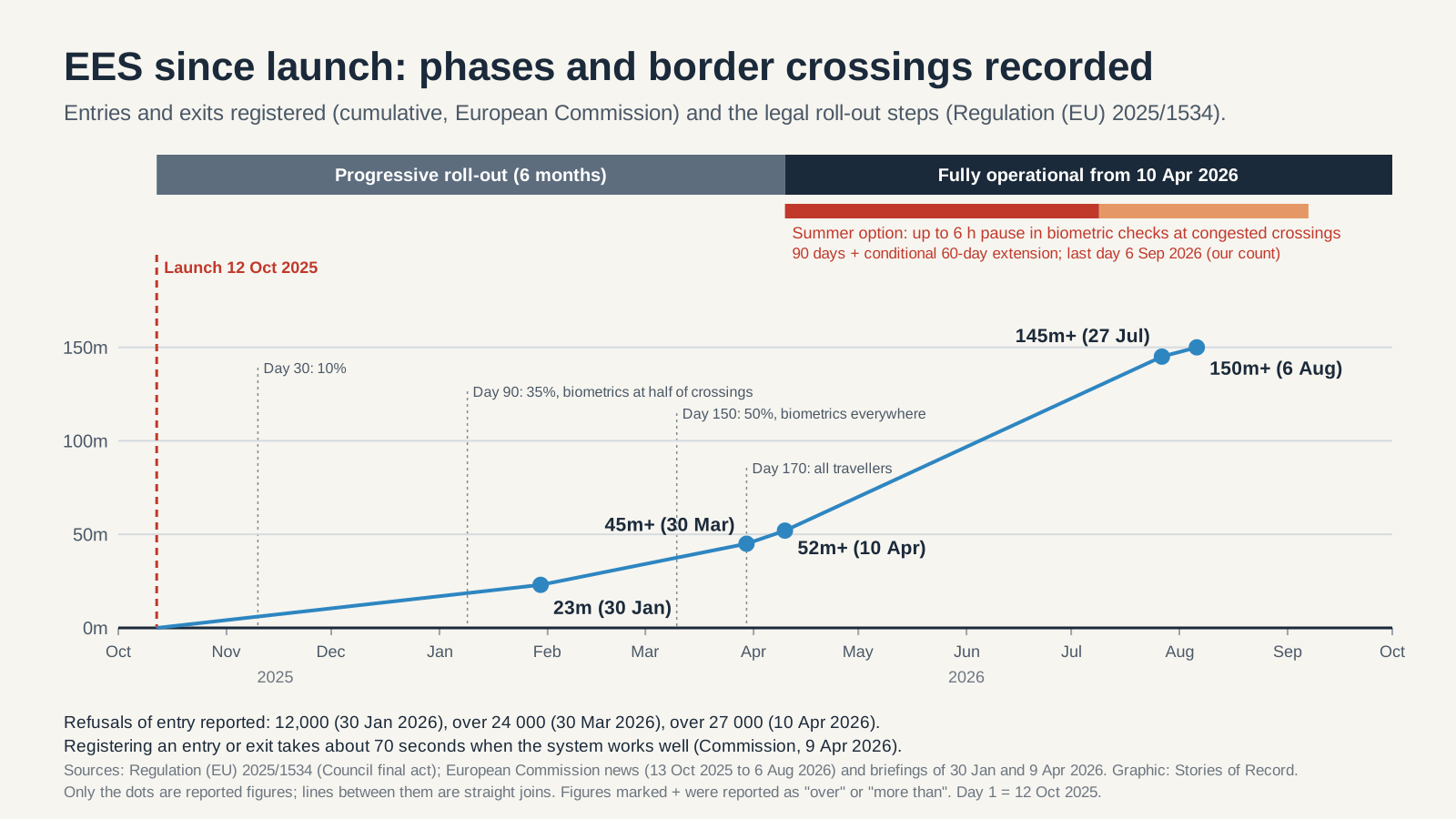
- The Commission reported over 150 million entries and exits registered since launch. [12]
- The Commission reported over 145 million entries and exits and published who is exempt from registration. [11]
- The system has been fully operational since 10 April 2026 and has replaced passport stamping, so overstayers are now detected automatically. [1]
- The Commission said that after full operation, countries could partly suspend the system in case of excessive waiting times, an option that existed until September. [9]
- The Commission reported over 45 million border crossings and over 24 000 refusals of entry since launch. [8]
- A Commission spokesperson reported 23 million entries and exits, all major airports connected and 12,000 refusals, and said countries could prolong the gradual roll-out until September if needed. [7]
- The phased start was set to begin on 12 October 2025, about six months before full operation. [1]Correction: Corrected on 8 October 2026: this entry said only that the phased start was set for 12 October 2025. The Commission confirmed on 13 October 2025 that it began that day; see the entry below.
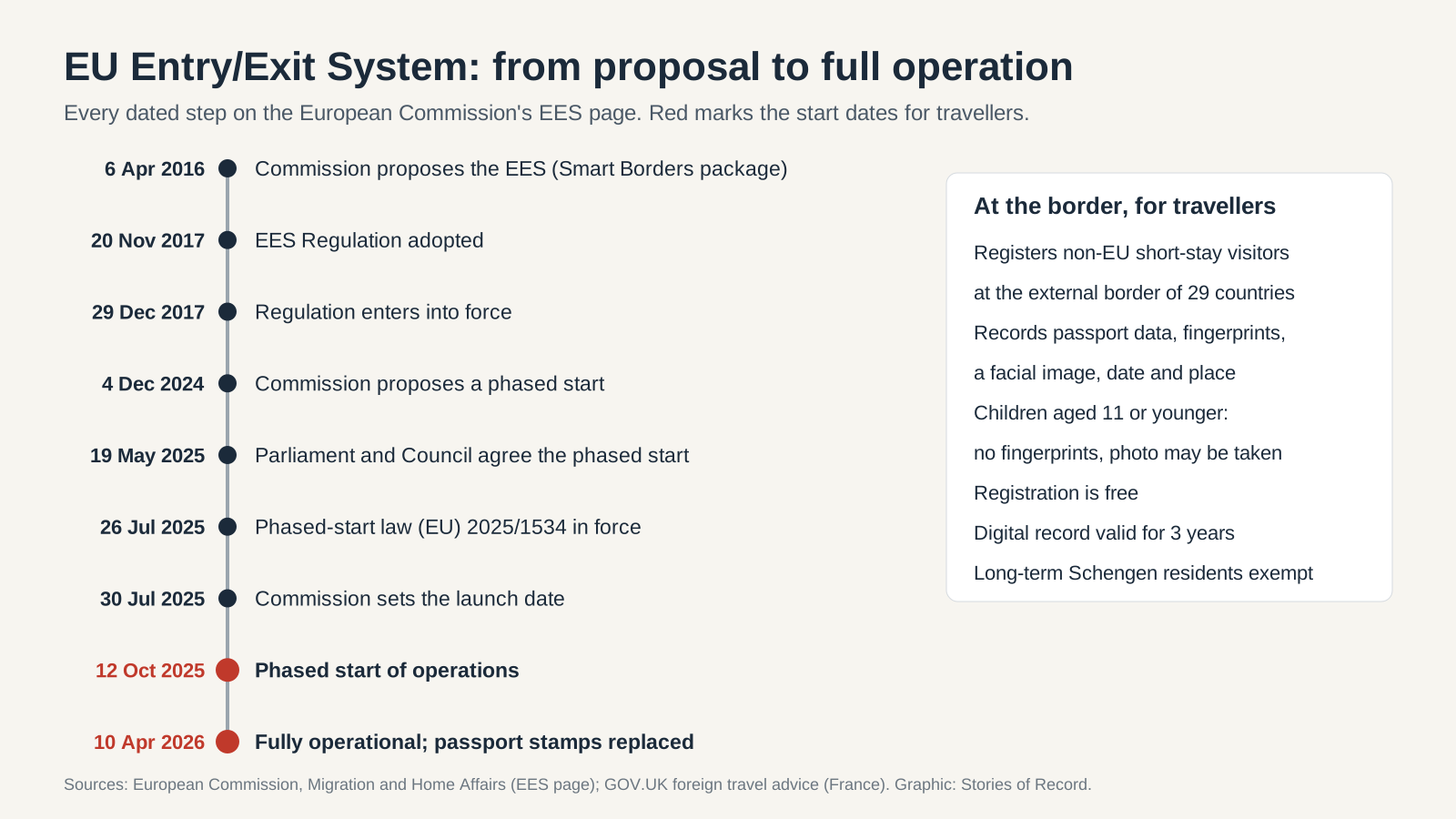
- The system went live on 12 October 2025, when 29 European countries began introducing it at their external borders. [6]
- On 30 July 2025 the Commission fixed 12 October 2025 as the date the phased start would begin. [1]
- The phased-start law, Regulation (EU) 2025/1534, was adopted on 18 July 2025 and took effect on 26 July 2025. [1]
- The phased-start law was published in the Official Journal on 23 July 2025. [5]
- The European Parliament approved the phased-start law at first reading on 8 July 2025. [5]
- Parliament and the Council agreed the phased start on 19 May 2025. [1]
- On 4 December 2024 the Commission proposed starting the system gradually rather than all at once. [1]
- The regulation entered into force on 29 December 2017, years before the system itself started. [1]
- The EES Regulation was adopted on 20 November 2017, together with a targeted change to the Schengen Borders Code. [1]
- The European Commission first proposed the system on 6 April 2016, in a revised package of border measures known as Smart Borders. [1]
What we know
- The Entry/Exit System electronically logs non-EU visitors on short stays every time they cross the external border of one of the 29 European countries that use it. [1]
- The European Commission first proposed the system on 6 April 2016, in a revised package of border measures known as Smart Borders. [1]
- The EES Regulation was adopted on 20 November 2017, together with a targeted change to the Schengen Borders Code. [1]
- The regulation entered into force on 29 December 2017, years before the system itself started. [1]
- On 4 December 2024 the Commission proposed starting the system gradually rather than all at once. [1]
- Parliament and the Council agreed the phased start on 19 May 2025. [1]
- The phased-start law, Regulation (EU) 2025/1534, was adopted on 18 July 2025 and took effect on 26 July 2025. [1]
- On 30 July 2025 the Commission fixed 12 October 2025 as the date the phased start would begin. [1]
- The system went live on 12 October 2025, when 29 European countries began introducing it at their external borders. [6]
- Travellers give passport details, a facial image and fingerprints at their first entry or exit; later crossings need only a quick check. [6]
- By 30 January 2026, 23 million entries and exits had been registered, all major airports were connected and 12,000 people had been refused entry, a Commission spokesperson said. [7]
- On 30 January 2026 the Commission spokesperson said countries could, if needed, prolong the gradual roll-out period until September. [7]
- The law set roll-out steps: biometrics optional for the first 60 days; at least 10 % of crossings registered by day 30; 35 % and biometrics at half of crossing points by day 90. [4]
- By day 150 countries had to use biometrics at all crossing points and register at least 50 % of crossings, and by day 170 register every traveller covered. [4]
- Counting 12 October 2025 as day 1, the 90th day, when the 35 % and half-of-crossing-points step applied, fell in January 2026. [6] [4] [7]
- By 30 March 2026 the system had recorded over 45 million border crossings and over 24 000 refusals of entry. [8]
- On 9 April 2026 the Commission said the rules let countries partly suspend the system in case of excessive waiting times, and that this possibility existed until September. [9]
- The law let countries partly suspend the system for up to 6 hours at a crossing where waits became excessive, during 90 days after the roll-out ended; biometric registration was then not required. [4]
- That 90-day period was extended automatically by 60 days if under 80 % of files from the roll-out held biometric data. [4]
- The law switches this option off 330 days after the system started on 12 October 2025. By our count its last day was 6 September 2026, which matches the Commission's 'until September'. [4] [6] [9]
- When the system works well, registering an entry or exit takes about 70 seconds on average, according to the Commission. [9]
- At full operation on 10 April 2026 the system was deployed at all Schengen external crossing points and had registered more than 52 million entries and exits. [10]
- By 6 August 2026 the Commission reported over 150 million entries and exits registered, up from over 145 million on 27 July. [12] [11]
- Nationals of EU countries, Iceland, Liechtenstein, Norway and Switzerland are not registered, nor are nationals of Andorra, Monaco and San Marino or holders of a Vatican passport. [11]
- Non-EU nationals with a long-stay visa or residence permit from a country using the system are not registered; permits from Cyprus or Ireland do not exempt the holder. [11]
- Non-EU family members of EU citizens are exempt if they hold a residence card or permit, and are registered if they do not. [11]
- The EU agency eu-LISA built the system and runs it. [1]
- Registering in the EES costs nothing, according to the UK Foreign Office. [2]
- Children aged 11 or younger do not give fingerprints, but may have their photo taken. [2]
- A traveller's EES record stays valid for 3 years, so later crossings can be quicker. [2]
- Travellers may be asked for fingerprints or a photo when leaving the Schengen area too, and the UK advises allowing extra time at departure. [2]
- Long-term residents of a Schengen country are exempt from the EES in every Schengen country. [2]
- ETIAS is a different scheme: a travel authorisation for visa-exempt visitors. The Commission says it is not yet in operation and is not taking applications. [3]
- The rule comes from the Schengen Borders Code: stays of no more than 90 days in any 180-day period, looking at the 180 days before each day of stay. [14]
- The day you enter and the day you leave both count as days of stay. [14]
- The 90 days are counted as one period across all the countries that operate the EES, so days in any of them add up. For a country that does not operate the EES, the period is counted separately. [14]
- Holders of an EU residence permit or long-stay visa are not subject to the 90/180-day rule. A short-stay visa can allow fewer days: the authorised stay printed on the visa sticker applies. [13] [14]
- GOV.UK tells British travellers that visits to any Schengen country in the previous 180 days count, and that overstaying can lead to a ban from Schengen countries of up to 3 years. [2]
Why it matters
Non-EU visitors, including UK travellers, give fingerprints and a facial image at their first crossing, and overstays are detected automatically instead of from passport stamps. Registration is free, but the checks can add time at the border on the way in and out.
Questions
When did the EES start?
It went live on 12 October 2025 with a six-month phased start, and became fully operational on 10 April 2026, when it replaced passport stamping.
What happens at the border now?
At your first entry or exit you give passport details, fingerprints and a facial image. Later crossings need only a quick verification. Registration takes about 70 seconds when the system works well, the Commission says.
Could countries pause the EES over the summer of 2026?
Partly. For 90 days after the roll-out, extended automatically by 60 days if under 80 % of roll-out files held biometrics, a country could stop biometric registration at a crossing for up to 6 hours when waits became excessive.
When did the summer option end?
The law switches it off 330 days after the 12 October 2025 start, so by our count its last day was 6 September 2026. The Commission had said it existed until September.
What applies after September 2026?
Under the law, the 6-hour partial pause for long queues no longer applies, so the full rules apply at every crossing. We found no official decision extending it on the Commission or Parliament pages we checked on 8 October 2026.
What were the roll-out steps?
At least 10 % of crossings registered by day 30; 35 % and biometrics at half of crossing points by day 90, which fell in January 2026; 50 % and biometrics everywhere by day 150; every traveller by day 170.
Who does not have to register?
EU, Icelandic, Liechtenstein, Norwegian and Swiss nationals; nationals of Andorra, Monaco and San Marino; holders of a Vatican passport; and non-EU nationals with a long-stay visa or residence permit from a country using the system. Permits from Cyprus or Ireland do not exempt you.
Are non-EU family members of EU citizens registered?
Not if they hold a residence card or residence permit. Without one, they are registered.
How many crossings has the EES recorded?
The Commission reported over 150 million entries and exits by 6 August 2026, up from 23 million on 30 January 2026.
Does the EES cost anything?
No. The UK Foreign Office says there is no cost for EES registration.
Do children give fingerprints?
Children aged 11 or younger are not fingerprinted but can be asked for a photo.
How long is an EES record kept valid?
The UK Foreign Office says a traveller's digital EES record is valid for 3 years.
Is the EES the same as ETIAS?
No. The EES registers you at the border. ETIAS is a separate travel authorisation for visa-exempt visitors; the Commission says it is not yet in operation.
How many days can I stay in the Schengen area?
Up to 90 days in any 180-day period, unless you have a residence permit or long-stay visa. On each day of your stay, count back 180 days; the days you spent in any Schengen country, counting the days you arrived and left, must not add up to more than 90. Since the EES stores every entry and exit, overstays are detected automatically. The calculator on this page does the count for your trips.
Updates
- Corrected: the record said the phased start was only set for 12 October 2025 and left out the roll-out steps and the summer 2026 option to pause biometric checks, which ended in September; all are now added from the law's text.
- First published.
What earlier versions said
- CorrectedRead that version
Before: The phased start was set to begin on 12 October 2025, about six months before full operation.
Correction: Corrected on 8 October 2026: this entry said only that the phased start was set for 12 October 2025. The Commission confirmed on 13 October 2025 that it began that day; see the entry below.
- RevisedRead that version
Before: The phased start was set to begin on 12 October 2025, about six months before full operation.
Now: The phased start began on 12 October 2025 in 29 countries and ran for six months, until full operation on 10 April 2026.
- RevisedRead that version
Before: ETIAS is a different scheme: a travel authorisation that visa-exempt visitors will need before travelling to Europe, separate from the border registration the EES carries out.
Now: ETIAS is a different scheme: a travel authorisation for visa-exempt visitors. The Commission says it is not yet in operation and is not taking applications.
Every version of this story, as first published.
Sources
- European Commission (incl. Travel to Europe: ETIAS and EES) Official (government)Published: 10 April 2026Retrieved: 8 October 2026
- European Commission (incl. Travel to Europe: ETIAS and EES) Official (government)Published: 6 October 2025Retrieved: 8 October 2026
- Council of the European Union Original documentPublished: 18 July 2025Retrieved: 8 October 2026
- European Parliament (Legislative Observatory) Official (government)Retrieved: 8 October 2026
- European Commission (incl. Travel to Europe: ETIAS and EES) Official (government)Published: 13 October 2025Retrieved: 8 October 2026
- European Commission (incl. Travel to Europe: ETIAS and EES) Official (government)Published: 30 January 2026Retrieved: 8 October 2026
- European Commission (incl. Travel to Europe: ETIAS and EES) Official (government)Published: 30 March 2026Retrieved: 8 October 2026
- European Commission (incl. Travel to Europe: ETIAS and EES) Official (government)Published: 9 April 2026Retrieved: 8 October 2026
- European Commission (incl. Travel to Europe: ETIAS and EES) Official (government)Published: 10 April 2026Retrieved: 8 October 2026
- European Commission (incl. Travel to Europe: ETIAS and EES) Official (government)Published: 27 July 2026Retrieved: 8 October 2026
- European Commission (incl. Travel to Europe: ETIAS and EES) Official (government)Published: 6 August 2026Retrieved: 8 October 2026
- European Commission Official (government)Published: 27 October 2025Retrieved: 8 October 2026
- Publications Office of the European Union Original documentPublished: 10 July 2024Retrieved: 8 October 2026
About the picture: this is a stock photo from Storyblocks. It does not show the people, places or events in this story.
People, places and organizations
- Organization
- European Commission
- Organization
- eu-LISA
Related stories
- ETIAS: no confirmed start date yet, a €20 fee, and every official date we found
- UK ETA: £20 since 8 April 2026, with every date, fee and country change since 2023
- UK passport fees: £102 online, £115.50 by post since 8 April 2026, and every rise since 2023
Follow us on Facebook
We post new records on our Facebook Page.
Follow on Facebook