Countries give Geneva talks on autonomous weapons two more years
Countries meeting in Geneva will spend two more years working on possible rules for weapons that can pick and strike targets without a person deciding, AP and Reuters reported.
Based so far on 1 official source and 2 news outlets. 1 point is not yet confirmed.
Government delegates in Geneva agreed on 21 November to keep working for two more years on possible international rules for autonomous weapons, the Associated Press (AP) and Reuters reported. The United States and Russia had pushed back against calls for tougher limits, both news agencies said. The deal does not settle whether any future rules would be binding on the countries that take part.
Key facts
- Government delegates meeting in Geneva agreed on 21 November to keep working for two more years on possible international rules for autonomous weapons, AP and Reuters reported. [1] [2]
- The United States and Russia had pushed back against calls for tougher limits on these weapons, according to AP and Reuters. [1] [2]
- The deal does not decide whether rules that come out of the talks would be legally binding on the countries involved, AP and Reuters reported. [1] [2]
Timeline
- Guterres and the ICRC renewed their appeal, urging governments to start negotiating a legally binding instrument and asking for two kinds of autonomous weapons to be banned: those whose effects cannot be predicted and those that target people, UN News reported. [4]
- Guterres and Mirjana Spoljaric, president of the International Committee of the Red Cross (ICRC), called on world leaders to negotiate a legally binding instrument on autonomous weapons and to conclude it by 2026, UN News reported. [7]
- Guterres told the convention's expert group on lethal autonomous weapons to push on with its work, and said machines that can take lives without human involvement should be banned under international law, UN News reported. [5]
- The UN held its first meeting of diplomats on lethal autonomous weapons in 2014, at the Palais des Nations in Geneva, UN News reported. [6]
- The 1980 convention, which bans or limits weapons seen as causing needless suffering or harming civilians without distinction, entered into force on 2 December 1983, according to UN News. [5]
What we know
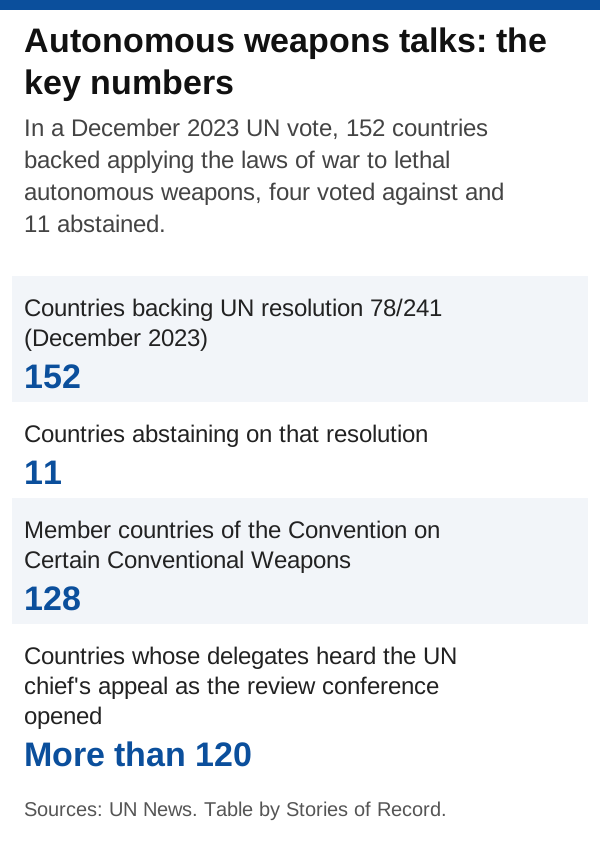
- When the Convention on Certain Conventional Weapons (CCW) opened its seventh review conference in Geneva, UN Secretary-General António Guterres urged delegates from more than 120 countries to move towards negotiating a legally binding instrument with clear bans and limits, UN News reported. [3] [4]
- As the conference began, UN News reported that countries had not agreed on what form a new instrument should take, binding or not, or on a timetable for it. [3]
- UN human rights chief Volker Türk called for a ban on autonomous weapons that target people, and on weapons whose effects human operators cannot fully understand or control, UN News reported. [3]
- A UN General Assembly resolution from December 2023, numbered 78/241, says lethal autonomous weapons must respect the laws of war. It was backed by 152 countries, with four voting against and 11 abstaining, according to UN News. [3]
- The convention has 128 member countries, which it calls High Contracting Parties, UN News reported. [3]
- The 1980 convention, which bans or limits weapons seen as causing needless suffering or harming civilians without distinction, entered into force on 2 December 1983, according to UN News. [5]
- The UN held its first meeting of diplomats on lethal autonomous weapons in 2014, at the Palais des Nations in Geneva, UN News reported. [6]
- Guterres told the convention's expert group on lethal autonomous weapons to push on with its work, and said machines that can take lives without human involvement should be banned under international law, UN News reported. [5]
- Guterres and Mirjana Spoljaric, president of the International Committee of the Red Cross (ICRC), called on world leaders to negotiate a legally binding instrument on autonomous weapons and to conclude it by 2026, UN News reported. [7]
- Guterres and the ICRC renewed their appeal, urging governments to start negotiating a legally binding instrument and asking for two kinds of autonomous weapons to be banned: those whose effects cannot be predicted and those that target people, UN News reported. [4]
What we don't know yet
- Reports that fully autonomous drones guided by artificial intelligence (AI) are already being used in fighting had not been confirmed when the UN and the Red Cross renewed their appeal, UN News said. [4]
Why it matters
Autonomous weapons are systems that choose a target and use force without a person approving each attack. The United Nations (UN) and the International Committee of the Red Cross (ICRC) have asked countries since 2023 to agree a binding treaty with clear bans and limits, and to finish it by 2026. Instead, AP and Reuters reported, delegates agreed to keep talking for two more years, and left open whether any rules would bind the countries involved. The United States was one of the two countries the agencies named as resisting stronger restrictions.
Questions
What did countries agree in Geneva?
To keep working for two more years on possible international rules for autonomous weapons, AP and Reuters reported. The decision came on 21 November.
What is an autonomous weapon?
The UN and the Red Cross describe autonomous weapons as systems that select targets and use force without a person stepping in. Armed drones that can find and strike targets on their own are one example raised in the debate.
Which countries resisted stronger limits?
The United States and Russia, according to AP and Reuters. Their reasons are not in the reports we cite.
Will any new rules be legally binding?
That is still open. AP and Reuters reported that the agreement does not decide whether any future rules will bind the countries taking part.
What had the UN asked for?
UN Secretary-General António Guterres urged delegates to move towards negotiating a legally binding instrument with clear bans and limits, UN News reported. In 2023 he and the Red Cross set 2026 as the year to conclude such a treaty.
What is the Convention on Certain Conventional Weapons?
A 1980 treaty that bans or limits weapons seen as causing needless suffering or harming civilians without distinction. It has 128 member countries, UN News reported.
Updates
- First published.
Every version of this story, as first published.
Sources
- The Associated Press News organizationPublished: 21 November 2026Reported by The Associated Press; credited as reported, not opened by us
- Reuters News organizationPublished: 21 November 2026Reported by Reuters; credited as reported, not opened by us
- UN News Official (government)Published: 16 November 2026Retrieved: 21 November 2026
- UN News Official (government)Published: 25 August 2026Retrieved: 21 November 2026
- UN News Official (government)Published: 25 March 2019Retrieved: 21 November 2026
- UN News Official (government)Published: 1 June 2025Retrieved: 21 November 2026
- UN News Official (government)Published: 5 October 2023Retrieved: 21 November 2026
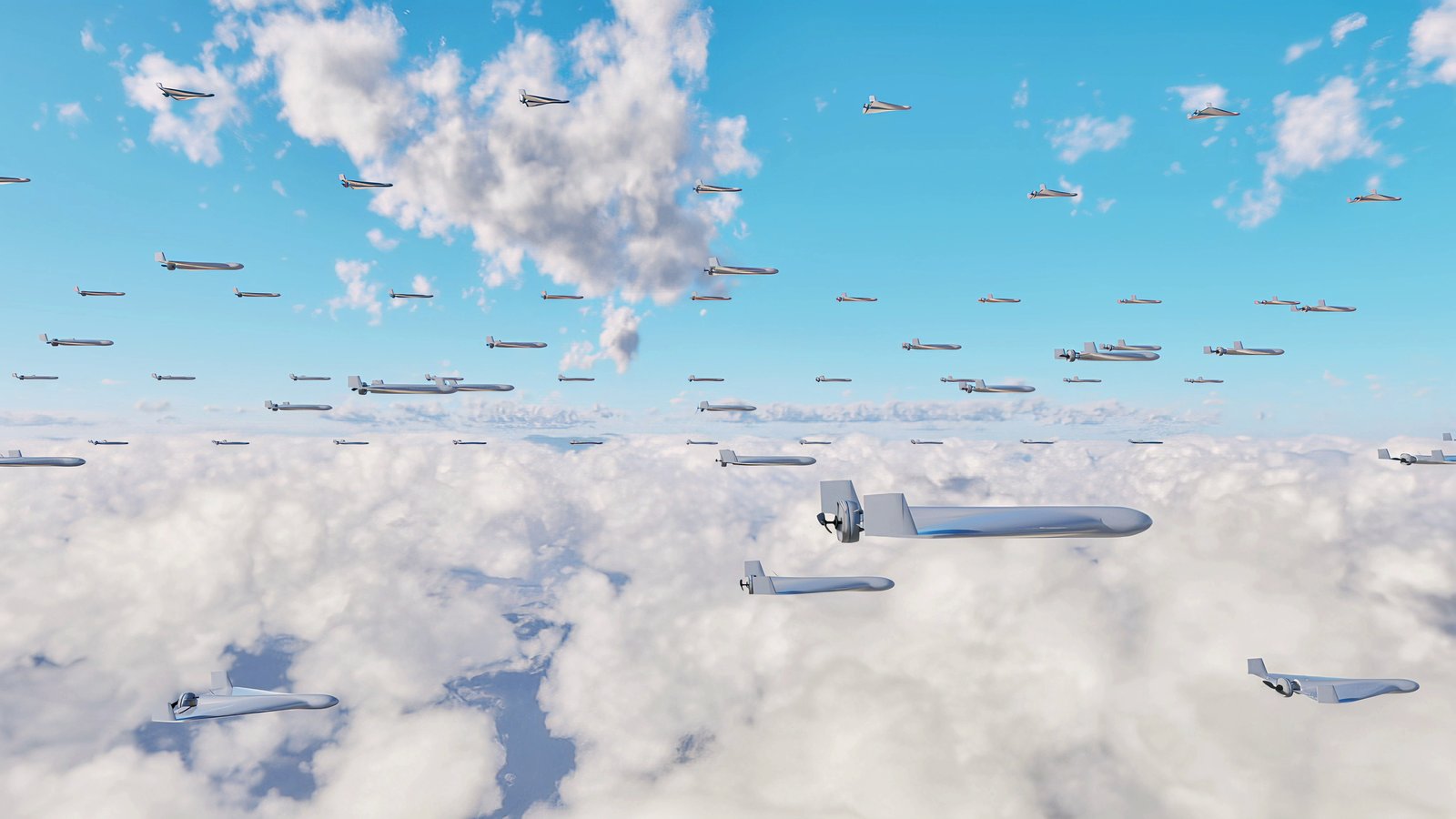
About the picture: this is a stock photo from Storyblocks. It does not show the people, places or events in this story.
People, places and organizations
- Organization
- United Nations
- Organization
- Convention on Certain Conventional Weapons
- Organization
- International Committee of the Red Cross
- Person
- António Guterres
- Person
- Volker Türk
Follow us on Facebook
We post new records on our Facebook Page.
Follow on Facebook