Medicare's negotiated drug prices for 2028: the 13 drugs, the new prices and the savings
Medicare has agreed lower prices for 13 high-cost drugs, starting on 1 January 2028.

Medicare has agreed lower prices for 13 high-cost prescription drugs, starting on 1 January 2028. The Centers for Medicare & Medicaid Services (CMS) says the prices would have cut Medicare's net spending on these drugs by about $9.2 billion, or 45%, had they applied in 2025. This third round of talks brings the number of drugs with negotiated prices to 37.
Key facts
- On 23 November 2026 the Centers for Medicare & Medicaid Services (CMS) published the prices it agreed with drug companies for 13 high-cost drugs covered by Medicare Part B and Part D. The new prices start on 1 January 2028. Reuters also reported the announcement. [1] [2]
- CMS estimates that if these prices had applied in 2025, Medicare would have spent about $9.2 billion less on these drugs, after rebates. That is roughly 45% lower net spending. [3] [2]
- This is the third round of talks. With it, 37 drugs have negotiated Medicare prices: 10 from the first round, 15 from the second and these 13. [1]
Timeline
- The negotiation period closed on 1 November 2026 with prices agreed for 13 drugs. [3]
- For the four drugs still without a deal after the meetings, CMS sent written final offers by 30 September 2026. [3]
- The companies answered with counteroffers by 1 July 2026. [3]
- CMS sent each drug company its first price offer, with a short justification, by 1 June 2026. [3]
- Negotiated prices for the first 10 drugs took effect on 1 January 2026. [1]
What we know
- That estimate leaves out what drug companies already pay through the Part D Manufacturer Discount Program. Counting it, CMS puts the saving at about $5.5 billion, or about 33%. [3]
- Negotiated prices for the first 10 drugs took effect on 1 January 2026. [1]
- CMS picked 15 drugs for this round in January 2026: 14 for a first negotiation and one, Tradjenta, to negotiate again. For the first time the list included drugs paid under Part B, the part of Medicare that covers drugs given at a doctor's office, as well as Part D drugs. [1]
- CMS sent each drug company its first price offer, with a short justification, by 1 June 2026. [3]
- The companies answered with counteroffers by 1 July 2026. [3]
- For the four drugs still without a deal after the meetings, CMS sent written final offers by 30 September 2026. [3]
- The negotiation period closed on 1 November 2026 with prices agreed for 13 drugs. [3]
- Nine prices were settled in meetings or later price exchanges, and in five of those CMS took the company's revised counteroffer. In the other four cases the company accepted CMS's written final offer. [3]
- In 2025 about 1.4 million of the 59 million people with Part D drug coverage were given these 13 drugs. Medicare's gross Part D cost for them was $22.3 billion, about 6% of all Part D drug costs, and enrollees paid $522 million out of pocket. [3]
- Four of the drugs are paid under Part B. About 120,000 of the 67 million people with Part B received them in 2025, at a cost of $3.3 billion, about 2% of Part B drug costs. Those patients paid $785 million out of pocket. [3]
- Once the prices apply in 2028, CMS estimates people with Part D will save about $69 million in out-of-pocket costs under the standard benefit, and people with Part B about $395 million. [3]
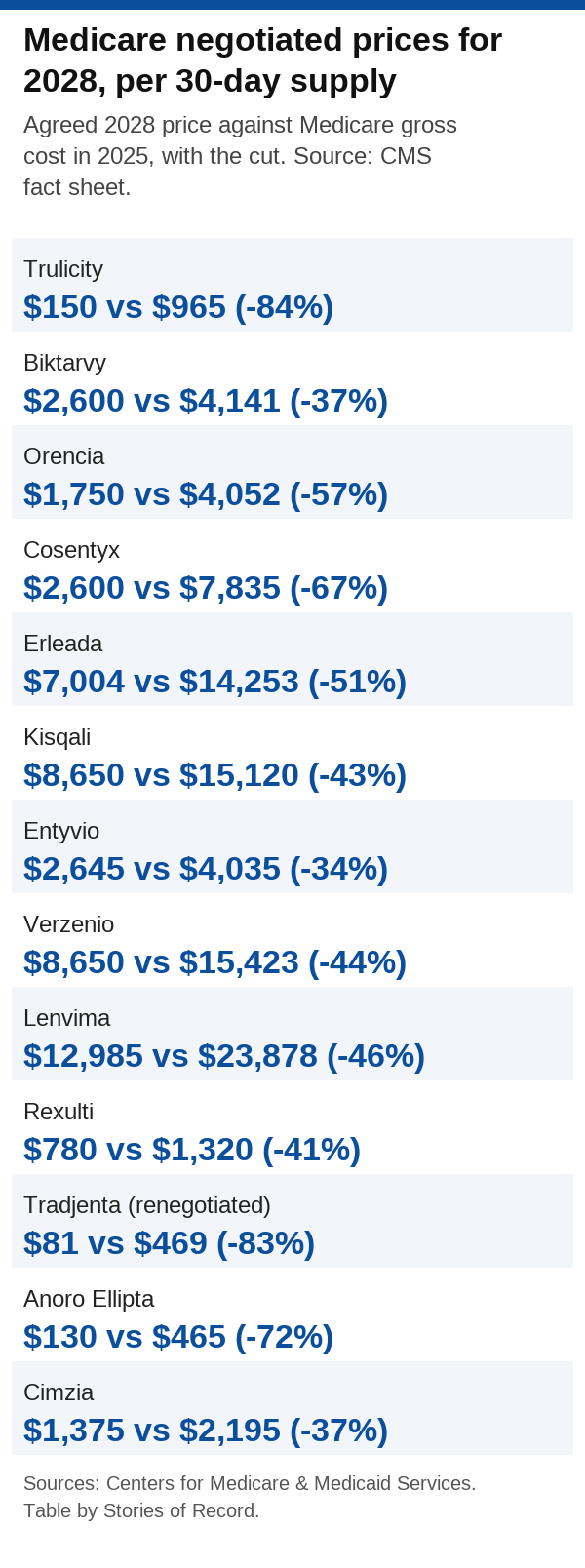
- The CMS fact sheet lists each of the 13 prices for a 30-day supply in 2028 next to Medicare's gross cost for the same supply in 2025. The cuts range from 34% for Entyvio to 84% for Trulicity. [3]
- No negotiated price will apply to Xeljanz and Xolair, because a generic version of Xeljanz and a biosimilar of Xolair are now approved and on sale. Botox is not being treated as a selected drug while a court order in the case AbbVie v. HHS is in force. CMS says that case is still going on. [1] [3]
- By law, Medicare drug plans, including Medicare Advantage plans with drug cover, must include these drugs on their lists of covered drugs. Drug companies must make the price available to pharmacies and to doctors and hospitals that give the drugs. [3]
- After the first year, each price rises every year in line with consumer price inflation, until the drug drops out of the program, for example when a generic or biosimilar competitor goes on sale. [3]
- CMS says it ran the talks under the Inflation Reduction Act of 2022, weighing the factors that law sets out, such as research costs, production costs and the prices of other drugs used for the same conditions. [3]
- Separately, CMS notes that in 2027 everyone with Medicare drug coverage will have yearly out-of-pocket drug costs capped at $2,400. [4]
What we don't know yet
- CMS says millions of older Americans who use some of the most common and costly drugs will pay less for them in 2028. It has not published what each person will pay. [1]
- CMS says it expects the program to save Medicare billions of dollars. [4]
Why it matters
About 1.4 million people with Medicare drug coverage (Part D) used these drugs in 2025, and about 120,000 people with Part B used the four that Part B pays for. If you are one of them, the lower price applies from 2028. CMS estimates that people with Part D will save about $69 million in out-of-pocket costs, and people with Part B about $395 million. It has not said what each person will pay, which depends on their coverage. CMS estimates the prices will cut what Medicare spends. Counting discounts drug companies already give, CMS puts the saving at about $5.5 billion rather than $9.2 billion.
Questions
When do the new prices start?
On 1 January 2028. Prices for the 15 drugs from the previous round start on 1 January 2027, and the first 10 have applied since 1 January 2026.
Which drugs are on the 2028 list?
Trulicity, Biktarvy, Orencia, Cosentyx, Erleada, Kisqali, Entyvio, Verzenio, Lenvima, Rexulti, Tradjenta, Anoro Ellipta and Cimzia. Tradjenta was negotiated again after an earlier round.
Will I pay the listed price?
CMS has not said what each person will pay. The listed price is for a 30-day supply. CMS estimates overall out-of-pocket savings of about $69 million for people with Part D and $395 million for people with Part B.
Why are Xeljanz, Xolair and Botox missing?
A generic version of Xeljanz and a biosimilar of Xolair are now approved and on sale, so no negotiated price applies to them. Botox is not being treated as a selected drug while a court order in the case AbbVie v. HHS is in force.
Can the prices change later?
Yes. After the first year each price rises every year with consumer price inflation, and a price stops applying when the drug leaves the program, for example once a generic competitor is on sale.
Who confirms these figures?
CMS, in its 23 November 2026 press release and fact sheet. Reuters also reported the announcement.
Updates
- First published.
Every version of this story, as first published.
Sources
- Centers for Medicare & Medicaid Services Official (government)Retrieved: 24 November 2026
- Reuters News organizationPublished: 23 November 2026Reported by Reuters; credited as reported, not opened by us
- Centers for Medicare & Medicaid Services Official (government)Retrieved: 24 November 2026
- Centers for Medicare & Medicaid Services Official (government)Retrieved: 24 November 2026
About the picture: this is a stock photo from Storyblocks. It does not show the people, places or events in this story.
People, places and organizations
- Organization
- Centers for Medicare & Medicaid Services
- Topic
- Medicare
- Topic
- Inflation Reduction Act of 2022
Related stories
- Medicare Advantage and Part D 2028 proposed rule: what CMS wants to change and how to comment
- Medicare Part B premium by year: $209.40 a month in 2027
Follow us on Facebook
We post new records on our Facebook Page.
Follow on Facebook