California regulators let PG&E collect up to $456 million more from 1 January 2027, before its rate case ends
California's utility regulator voted on 19 November 2026 to let PG&E collect up to $456 million more from 1 January 2027, subject to refund.

Pacific Gas and Electric Company (PG&E) can collect up to $456 million more from customers from 1 January 2027, the California Public Utilities Commission (CPUC) decided on 19 November 2026. All five commissioners voted yes. The money is temporary. It lasts until the final decision on the utility's 2027 general rate case, the review that sets what it may charge. If that decision allows less, the extra is refunded with interest.
Key facts
- The CPUC approved PG&E's interim rate recovery at its meeting on 19 November 2026, as decision D.26-11-034. All five commissioners voted yes. [1] [2]
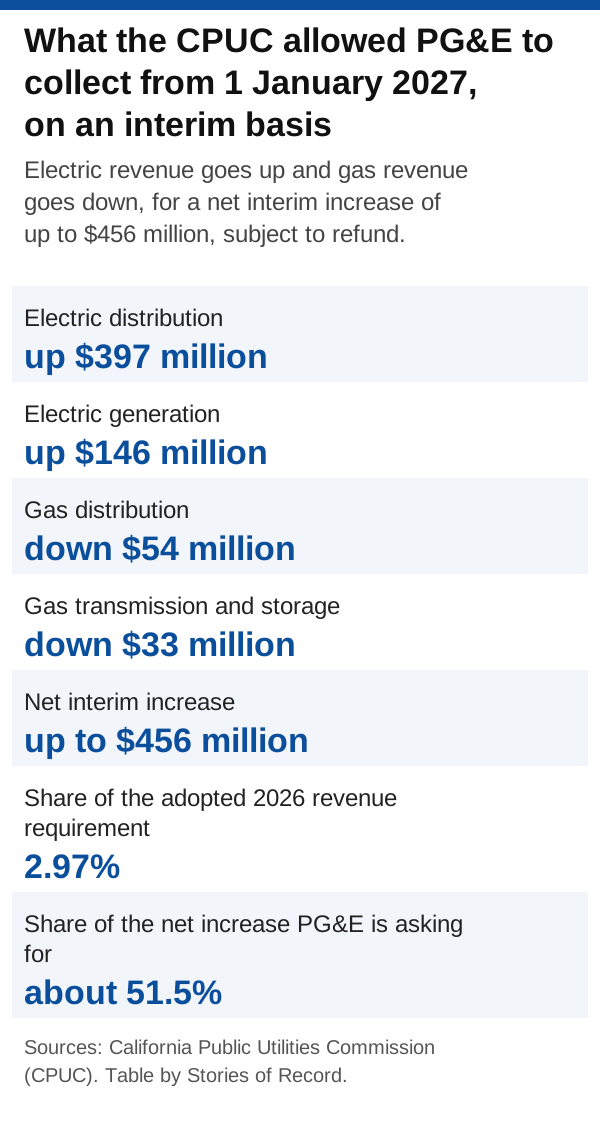
- The decision lets PG&E recover up to $456 million in revenue requirement on an interim basis, starting 1 January 2027 and lasting until the final rate case decision is put into rates. [3] [2]
- The $456 million is a net figure. Electric distribution goes up $397 million and electric generation $146 million, while gas distribution goes down $54 million and gas transmission and storage $33 million. [3]
Timeline
- At its 29 October 2026 meeting, the commission held the item for further review and moved it to 19 November. [4]
- The opposing parties filed comments on the proposed decision on 13 October 2026, and PG&E replied on 19 October. The commission says it made no changes after reading them. [3]
- An administrative law judge's proposed decision on the request was mailed to the parties on 22 September 2026. [3]
- On 2 July 2026, PG&E presented an updated, lower revenue requirement request in the rate case. The commission recalculated the interim options on that lower figure. [3]
- On 1 June 2026, three sets of parties filed responses opposing PG&E's request: the commission's own Public Advocates Office, the consumer group The Utility Reform Network (TURN), and a group of large energy users. [3]
- PG&E asked for interim recovery on 7 May 2026. Its motion offered three options: about $653.70 million, $891.40 million or $1,010.26 million, which were 55%, 75% or 85% of the increase it was then requesting. [3]
- PG&E filed its general rate case for test year 2027 on 15 May 2025, asking to raise the revenue it collects for gas and electric service from 1 January 2027. [3]
What we know
- The commission says the $456 million equals 2.97% of PG&E's adopted 2026 revenue requirement and about 51.5% of the net increase PG&E is now asking for. It is also below $487 million, which is what PG&E's 55% option comes to when recalculated on the company's lowered request. [3]
- PG&E asked for interim recovery on 7 May 2026. Its motion offered three options: about $653.70 million, $891.40 million or $1,010.26 million, which were 55%, 75% or 85% of the increase it was then requesting. [3]
- PG&E filed its general rate case for test year 2027 on 15 May 2025, asking to raise the revenue it collects for gas and electric service from 1 January 2027. [3]
- On 1 June 2026, three sets of parties filed responses opposing PG&E's request: the commission's own Public Advocates Office, the consumer group The Utility Reform Network (TURN), and a group of large energy users. [3]
- An administrative law judge's proposed decision on the request was mailed to the parties on 22 September 2026. [3]
- The opposing parties filed comments on the proposed decision on 13 October 2026, and PG&E replied on 19 October. The commission says it made no changes after reading them. [3]
- At its 29 October 2026 meeting, the commission held the item for further review and moved it to 19 November. [4]
- The interim money can be taken back. If the final rate case decision allows less than PG&E has already collected, PG&E must return the extra to customers with interest. [3]
- The decision gives no estimate of what a typical household will pay. It says PG&E's bill illustrations are not a forecast of customer bills, because they came before PG&E cut its request and leave out other rate changes. [3]
- The commission chose a smaller share of PG&E's requested electric increases to limit the risk of refunds, and a larger share of its proposed gas decreases so customers get those cuts sooner. [3]
- On 2 July 2026, PG&E presented an updated, lower revenue requirement request in the rate case. The commission recalculated the interim options on that lower figure. [3]
What we don't know yet
- PG&E estimated that starting interim recovery on 1 January 2027 would save customers about $13.6 million, $18.5 million or $21.0 million in interest under its 55%, 75% or 85% options. That is the company's own estimate, recorded in the decision; none of those options is the amount approved. [3]
Why it matters
If you get gas or electricity from this utility, the revenue the commission allows is what your rates are built to collect. The interim money raises the electric side and lowers the gas side. The commission gave no figure for a typical household bill, and it said the company's own bill estimates are not a forecast. The final decision, expected in May 2027, sets the real amount. Anything collected above it comes back with interest.
Questions
How much will my PG&E bill go up?
The CPUC decision does not say. It gives no figure for a typical household, and it says PG&E's own bill illustrations are not a forecast of customer bills. What it does say is that electric revenue goes up and gas revenue goes down. Your actual bill also depends on other rate changes that are not part of this decision.
Is the $456 million final?
No. It is an interim amount that lasts until the final decision on PG&E's 2027 rate case is put into rates, expected in May 2027. If that decision allows less, PG&E must refund the extra with interest.
Did PG&E get what it asked for?
Not all of it. Its May 2026 motion asked for about $653.70 million, $891.40 million or $1,010.26 million. PG&E later lowered its overall request, and the commission approved up to $456 million, which it says is about 51.5% of PG&E's requested net increase.
Why does gas go down while electric goes up?
PG&E itself proposed lower gas revenue and higher electric revenue for 2027. The commission passed on a larger share of the gas cuts so customers see them sooner, and a smaller share of the electric increases to limit later refunds.
Who opposed it?
The CPUC's Public Advocates Office, the consumer group TURN and a group of large energy users all filed responses opposing PG&E's request on 1 June 2026.
Updates
- First published.
Every version of this story, as first published.
Sources
- California Public Utilities Commission (CPUC) Official (government)Retrieved: 20 November 2026
- California Public Utilities Commission (CPUC) Official (government)Retrieved: 20 November 2026
- California Public Utilities Commission (CPUC) Official (government)Retrieved: 20 November 2026
- California Public Utilities Commission (CPUC) Official (government)Retrieved: 20 November 2026
About the picture: this is an illustration made for this story with an AI image tool and checked against it. It is not a picture of the real people, places or events.
People, places and organizations
- Organization
- Pacific Gas and Electric Company
- Organization
- California Public Utilities Commission
Follow us on Facebook
We post new records on our Facebook Page.
Follow on Facebook