SEC proposes taking direct control of the Consolidated Audit Trail, the market-wide trading database
The SEC has proposed taking direct control of the Consolidated Audit Trail, the database regulators use to track stock orders, and paying for it with money from Congress.
The Securities and Exchange Commission (SEC) proposed on 20 November 2026 to take direct control of the Consolidated Audit Trail (CAT), the database regulators use to follow stock orders. Today the stock exchanges and similar bodies run it together. Under the plan, they and broker-dealers would report to the SEC instead, and the SEC would pay with money from Congress. Comments are open for 60 days after the plan is published.
Key facts
- The Securities and Exchange Commission (SEC) proposed on 20 November 2026 to take direct control of the Consolidated Audit Trail, the SEC said. It says the trail would keep running with minimal disruption. [1] [2]
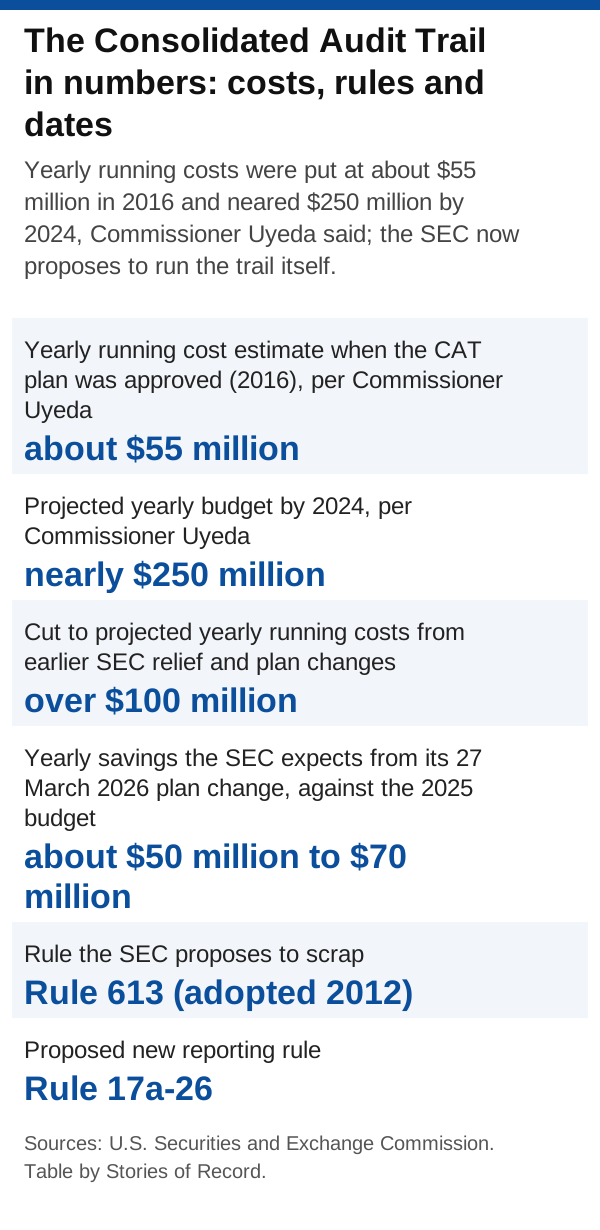
- Today the stock exchanges and national securities associations, known as self-regulatory organizations (SROs), must run the CAT together under Rule 613. The SEC proposes to scrap Rule 613. [2]
- The SEC plans to pay its CAT costs from money Congress gives it, rather than through the current funding model run by the SROs. [2]
Timeline
- On 16 April 2026 the SEC asked the public for views on the CAT, including its funding, costs, purpose, governance, design, cybersecurity and data privacy. That comment period ran for 60 days after the request was published. [7]
- On 27 March 2026 the SEC approved a CAT plan change aimed at cutting costs. Among other things, it allowed CAT data older than three years to be deleted and set a spending cap. The SEC put the yearly savings at about $50 million to $70 million against the 2025 CAT budget. [6]
- Commissioner Mark T. Uyeda said in his statement that yearly running costs were put at about $55 million when the CAT plan was approved in 2016, and that the projected yearly budget neared $250 million by 2024. [4]
What we know
- The Consolidated Audit Trail (CAT) is a huge database of stock market trading. It lets the SEC and market regulators follow each order for listed stocks and over-the-counter stocks from start to finish, across every exchange and trading venue, the SEC says. [1] [2]
- A new Rule 17a-26 would take its place. SROs and broker-dealers would keep sending largely the same trading data, but to the SEC or a body it picks, not to a system the SROs run themselves. [2]
- The SEC expects the SROs to then ask it to end the CAT plan they run and their own CAT compliance rules, its fact sheet says. [1]
- The SEC lists further steps for the handover: selling and transferring CAT assets, signing a contract with the body that would run the system, and setting up advisory groups for market feedback. [1]
- Under the new rule, SROs and broker-dealers would keep the data they report for at least three years, the first two in an easily reached place. They would need written error-correction policies, reviewed at least once a year, the SEC says. [1]
- Some clock-timing rules that now apply only to broker-dealers would also cover the SROs, according to the SEC fact sheet. [1]
- The SEC has already stopped personally identifiable information being reported to the CAT, and the proposal would keep that change, SEC Chairman Paul S. Atkins said. [2]
- Earlier exemptions and plan changes have cut the CAT’s projected yearly running costs by more than $100 million, the SEC said. [2]
- Atkins said in a statement that CAT running costs had grown to nearly $250 million a year, and that those costs end up being passed on to investors in one way or another. [3]
- Commissioner Mark T. Uyeda said in his statement that yearly running costs were put at about $55 million when the CAT plan was approved in 2016, and that the projected yearly budget neared $250 million by 2024. [4]
- Uyeda said the CAT is run by a committee of SROs with different interests, which in his view led to slow decisions, fights over governance and funding, and much higher costs. He said he supports the proposal. [4]
- The SEC adopted Rule 613 on 18 July 2012. It told the SROs to jointly build a plan to create and run the CAT. [1] [5]
- The SEC approved the CAT plan written by the SROs on 15 November 2016. [1] [5]
- On 27 March 2026 the SEC approved a CAT plan change aimed at cutting costs. Among other things, it allowed CAT data older than three years to be deleted and set a spending cap. The SEC put the yearly savings at about $50 million to $70 million against the 2025 CAT budget. [6]
- On 16 April 2026 the SEC asked the public for views on the CAT, including its funding, costs, purpose, governance, design, cybersecurity and data privacy. That comment period ran for 60 days after the request was published. [7]
- In comments on that request, investors and market participants backed the SEC taking more control over managing and paying for the CAT, the SEC said. [2]
What we don't know yet
- Not every commenter thinks the CAT is needed. Several told the SEC that older audit trails would be enough without it, the proposal says. Other commenters disputed this, and the SEC notes that some of those older trails have since been retired. [5]
Why it matters
The CAT records orders for listed and over-the-counter stocks across US markets, so the people who pay for it and run it shape how stock trading is watched. SEC Chairman Paul S. Atkins says its costs reached nearly $250 million a year and are passed on to investors one way or another. Moving the bill to the SEC budget changes who pays. If you trade stocks, nothing changes for you today: this is a proposal, and the SEC says the trail would keep running with minimal disruption. If you want a say, you can comment once the plan is published, quoting File Number S7-2026-40.
Questions
What is the Consolidated Audit Trail?
It is a central database of US stock trading. Regulators use it to follow an order from the moment it is placed until it is carried out, across every exchange and trading venue. Exchanges and broker-dealers report the data to it.
What would the SEC proposal change?
The SEC would scrap Rule 613, which makes the exchanges and other self-regulatory organizations run the CAT. A new Rule 17a-26 would have them and broker-dealers send much the same data to the SEC or a body it picks. The SEC would pay its CAT costs with money from Congress.
Does this mean the CAT is shutting down?
No. The SEC says the trail would keep running with minimal disruption. The data reported would stay largely the same. What changes is who runs the system and who pays.
Will the CAT collect my personal details?
The SEC says reporting of personally identifiable information to the CAT has already been ended for good, and Chairman Atkins says the proposal would keep that change.
Who supports the change?
Chairman Atkins and Commissioner Mark T. Uyeda each backed it in statements. The SEC says investors and market participants who commented in the spring wanted the agency to take more control. Some commenters argued the CAT is not needed at all, and others disputed that.
Is this final, and what happens next?
No. It is a proposal. Comments stay open for 60 days after it is published in the Federal Register, and the SEC has not given that date yet. The SEC also lists later steps for a handover: selling CAT assets, hiring a body to run it and setting up advisory groups.
Updates
- First published.
Every version of this story, as first published.
Sources
- U.S. Securities and Exchange Commission Official (government)Retrieved: 21 November 2026
- U.S. Securities and Exchange Commission Official (government)Retrieved: 21 November 2026
- U.S. Securities and Exchange Commission Official (government)Retrieved: 21 November 2026
- U.S. Securities and Exchange Commission Official (government)Retrieved: 21 November 2026
- U.S. Securities and Exchange Commission Official (government)Retrieved: 21 November 2026
- U.S. Securities and Exchange Commission Official (government)Retrieved: 21 November 2026
- U.S. Securities and Exchange Commission Official (government)Retrieved: 21 November 2026
About the picture: this is an illustration made for this story with an AI image tool and checked against it. It is not a picture of the real people, places or events.
People, places and organizations
- Organization
- U.S. Securities and Exchange Commission
- Product
- Consolidated Audit Trail
- Person
- Paul S. Atkins
- Person
- Mark T. Uyeda
Follow us on Facebook
We post new records on our Facebook Page.
Follow on Facebook