US weekly unemployment claims: 203,000 in the week ending 14 November
New unemployment claims were 203,000 in the week ending 14 November, up 1,000 from the revised week before.

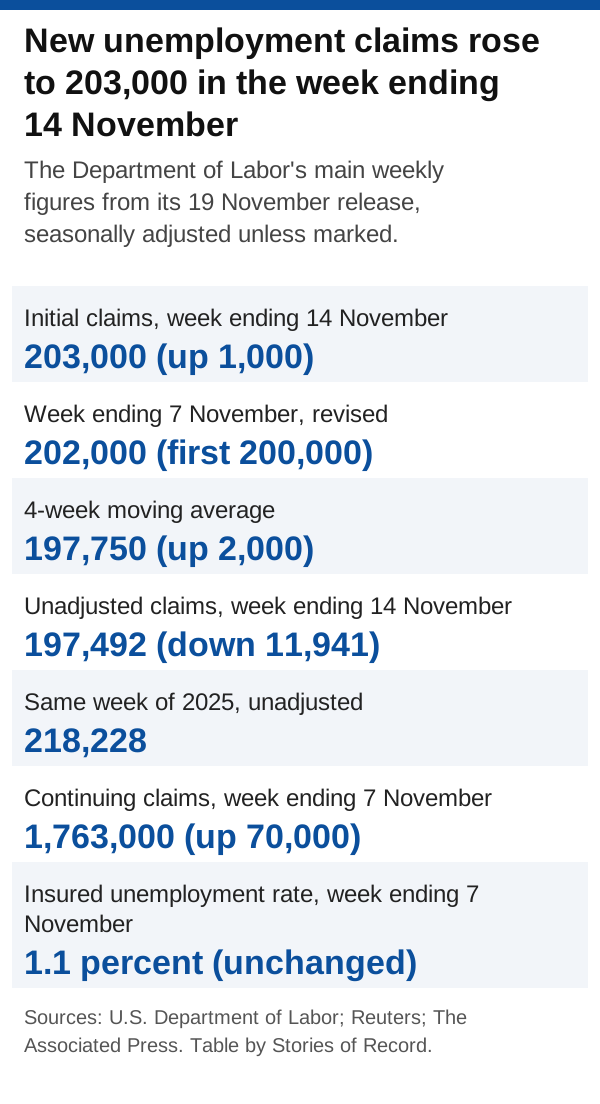
New claims for unemployment benefits in the United States were 203,000 in the week ending 14 November, the Department of Labor said on 19 November. That was 1,000 more than the week before, which was revised up to 202,000. The 4-week average, which evens out weekly swings, rose to 197,750. Continuing claims were 1,763,000 in the week ending 7 November.
Key facts
- Seasonally adjusted initial claims were 203,000 in the week ending 14 November, up 1,000 from the week before, the Department of Labor said in its 19 November release. Reuters and the Associated Press (AP) reported the same Labor Department figure, so all three count as one measurement. [1] [2] [3]
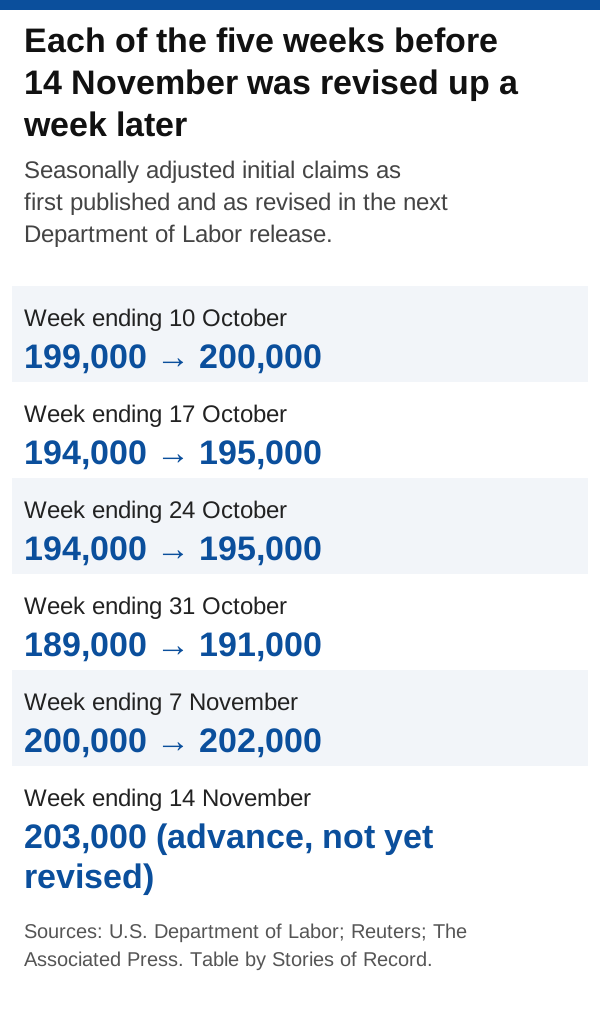
- Week ending 7 November: first reported at 200,000, then revised up by 2,000 to 202,000 in the next release. [4] [1]
- The 4-week moving average of initial claims rose by 2,000 to 197,750 in the 19 November release. [1]
Timeline
What we know
- Week ending 31 October: first reported at 189,000, then revised up to 191,000. [5] [4]
- Week ending 24 October: first reported at 194,000, then revised up to 195,000. [6] [5]
- The count for the week to 17 October began at 194,000 and was raised a week later to 195,000. [7] [6]
- Week ending 10 October: first reported at 199,000, then revised up to 200,000. [8] [7]
- Before seasonal adjustment, states counted 197,492 initial claims in the week ending 14 November, 11,941 fewer than the week before. The seasonal factors had expected a slightly bigger fall, of 12,534, which is why the adjusted figure went up. [1]
- In the same week of 2025 there were 218,228 unadjusted initial claims, more than this year's 197,492. [1]
- Insured unemployment, the seasonally adjusted count of continuing claims, was 1,763,000 in the week ending 7 November, up 70,000. The insured unemployment rate stayed at 1.1 percent. [1]
- Across all benefit programs, 1,524,631 continued weeks were claimed in the week ending 31 October, and no state had switched on the Extended Benefits program. [1]
- In the week ending 7 November, unadjusted claims rose most in California (+4,800), New Jersey (+3,679) and Missouri (+3,168), and fell most in Michigan (-2,949). [1]
- An initial claim is the first application someone makes to their state for unemployment insurance after leaving a job. The Labor Department describes the count as a leading economic indicator. [1]
- A continued claim is filed for each further week without work by someone who already made an initial claim. The department counts weeks claimed, not individual people. [1]
- Seasonal adjustment removes regular yearly patterns, such as holidays, weather and the school year, so that real changes are easier to see. The department warns that weekly claims are hard to adjust, so single weeks can jump around. [1]
- Each of the last six weekly releases came out on a Thursday at 8:30 a.m. Eastern time. [1] [4] [5] [6] [7] [8]
What we don't know yet
- States gave their own reasons for the biggest rises in the week ending 7 November: New Jersey cited layoffs in educational services and Missouri cited layoffs in manufacturing. These are the states' own explanations, which the Labor Department printed as the states supplied them. [1]
Why it matters
Initial claims count new applications for unemployment insurance from people who have just lost a job. The Labor Department describes the count as a leading economic indicator, and it is published every week. If you follow the figure, look at the 4-week average as well as the single week, and expect the first number to change. Each of the last five weeks was revised up a week later, by 1,000 or 2,000.
Questions
What are initial unemployment claims?
The number of people who filed a first claim for state unemployment insurance after losing a job. It was 203,000 in the week ending 14 November, seasonally adjusted.
What is the difference between initial and continuing claims?
An initial claim is the first application. A continuing claim is filed for each later week out of work. Seasonally adjusted continuing claims, also called insured unemployment, were 1,763,000 in the week ending 7 November. They run a week behind initial claims.
Why did the adjusted number rise when actual claims fell?
States counted 197,492 claims, 11,941 fewer than the week before. But the seasonal factors expected a fall of 12,534 at this time of year. Claims fell by less than that, so the adjusted figure went up by 1,000.
What is the 4-week average?
The average of the last four weekly figures. It smooths out one-off swings. It was 197,750 in the week ending 14 November.
Do the numbers change after they are published?
Yes. The first figure is an advance estimate and is revised the next week. Each of the last five weeks was revised up, by 1,000 or 2,000.
When does the Labor Department publish the figures?
The last six releases each came out on a Thursday at 8:30 a.m. Eastern time. This record is updated when a new release is out.
Why do Reuters and AP give the same number?
Both reported the Department of Labor's own figure. Several outlets repeating one government number is still one measurement, not separate confirmation.
How does this compare with a year ago?
Before seasonal adjustment there were 197,492 initial claims in the week ending 14 November, against 218,228 in the same week of 2025.
Updates
- First published.
Every version of this story, as first published.
Sources
- U.S. Department of Labor Official (government)Retrieved: 20 November 2026
- Reuters News organizationPublished: 19 November 2026Reported by Reuters; credited as reported, not opened by us
- The Associated Press News organizationPublished: 19 November 2026Reported by The Associated Press; credited as reported, not opened by us
- U.S. Department of Labor Official (government)Retrieved: 20 November 2026
- U.S. Department of Labor Official (government)Retrieved: 20 November 2026
- U.S. Department of Labor Official (government)Retrieved: 20 November 2026
- U.S. Department of Labor Official (government)Retrieved: 20 November 2026
- U.S. Department of Labor Official (government)Retrieved: 20 November 2026
About the picture: this is an illustration made for this story with an AI image tool and checked against it. It is not a picture of the real people, places or events.
People, places and organizations
- Organization
- U.S. Department of Labor
- Organization
- Employment and Training Administration
- Topic
- Unemployment insurance
Follow us on Facebook
We post new records on our Facebook Page.
Follow on Facebook