Voyager 1 is now one light-day from Earth, NASA says, as engineers work on a data fault
NASA says Voyager 1 reached one light-day from Earth on 18 November 2026, while engineers look into why it stopped sending data.

NASA's Voyager 1 reached one light-day from Earth on 18 November 2026. That is about 16.1 billion miles away, so its radio signal now takes 24 hours to get here. NASA confirmed the milestone a day later, when the signal arrived. The probe has sent no science or engineering data since 14 November, but its carrier signal still reaches Earth. Engineers are working on the fault.
Key facts
- Voyager 1 reached one light-day from Earth at 2:16 a.m. Pacific time on 18 November 2026, NASA said. Reuters and Space.com also reported the milestone. [1] [2] [3]
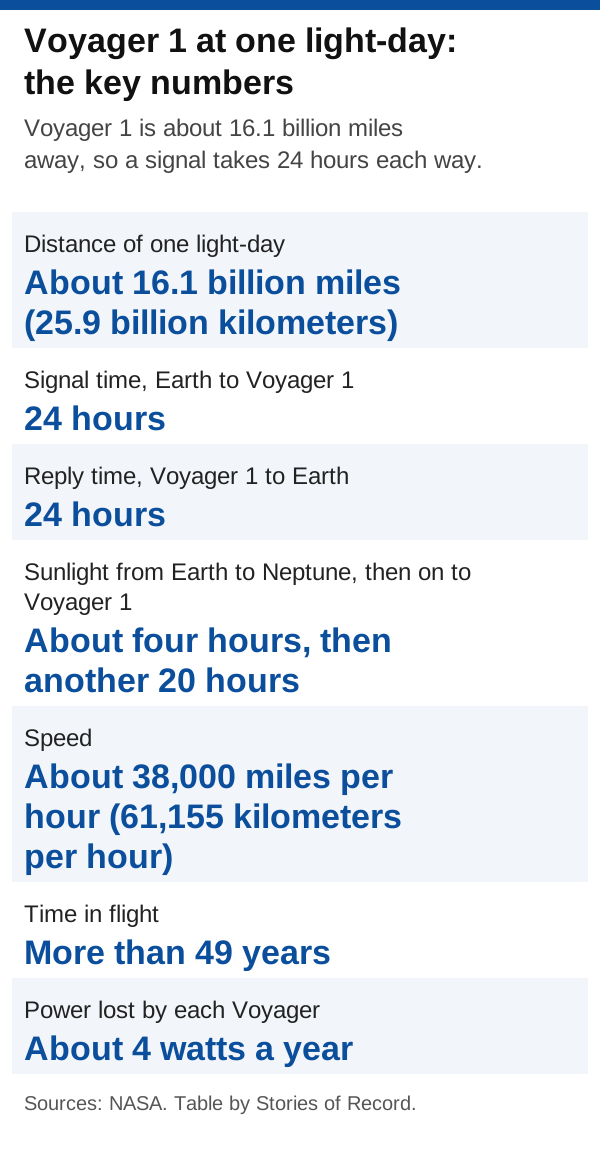
- A light-day is how far light goes in a day of 24 hours: about 16.1 billion miles, or 25.9 billion kilometers, according to NASA. [1]
- On 14 November the team learned that Voyager 1 had stopped sending science and engineering data. A NASA antenna in Canberra, Australia, still picked up its carrier signal, the radio wave that normally carries that data, NASA said. [4] [1]
Timeline
- Voyager 1 had a similar problem in 2023, sending a carrier signal but no data. One of its onboard computers caused it then, and NASA said that experience is guiding the team now. [4]
- Its twin, Voyager 2, took a different path and crossed the same boundary in 2018. [1]
- On 16 December 2004 Voyager 1 reached what NASA calls the termination shock and entered the heliosheath. [5]
- On 17 February 1998 Voyager 1 passed NASA's Pioneer 10 and became the most distant object people have ever made. [5]
- Its closest pass of Saturn came on 12 November 1980. There it found five new moons and a new ring. [5]
- It made its closest pass of Jupiter on 5 March 1979 and found a thin ring and two moons nobody had seen before, Thebe and Metis. [5]
What we know
- The Voyager team at NASA's Jet Propulsion Laboratory (JPL) in Southern California heard from the probe 24 hours after the milestone, early on Thursday. NASA announced it on Thursday, 19 November, and Reuters and Space.com reported the confirmation. [1] [4] [2] [3]
- NASA describes Voyager 1 as the spacecraft that has flown farther than any other. It has been on the move for more than 49 years. [1]
- Voyager 1 lifted off from Cape Canaveral, Florida, on 5 September 1977. NASA launched the twin probes that year to make use of a rare lining-up of the planets. [5] [1]
- It made its closest pass of Jupiter on 5 March 1979 and found a thin ring and two moons nobody had seen before, Thebe and Metis. [5]
- Its closest pass of Saturn came on 12 November 1980. There it found five new moons and a new ring. [5]
- On 17 February 1998 Voyager 1 passed NASA's Pioneer 10 and became the most distant object people have ever made. [5]
- On 16 December 2004 Voyager 1 reached what NASA calls the termination shock and entered the heliosheath. [5]
- On 25 August 2012 Voyager 1 became the first spacecraft to leave the heliosphere, the Sun's bubble of particles and magnetic fields, and enter interstellar space. [5] [1]
- Its twin, Voyager 2, took a different path and crossed the same boundary in 2018. [1]
- Voyager 1 is travelling at about 38,000 miles per hour, or 61,155 kilometers per hour, NASA said. [1]
- For scale, NASA said sunlight passing Earth reaches the Moon in about 1.3 seconds and Neptune in about four hours. It needs another 20 hours to get as far as Voyager 1. [1]
- A signal now needs 24 hours to reach Voyager 1 and another 24 hours for the reply to come back, said Suzanne Dodd, the mission's project manager at JPL. She said the team listens to the probe every day and sends it commands once a week. [1]
- Engineers confirmed the milestone from the carrier signal and their calculations of the probe's path. NASA said the probe moves at a steady speed it cannot change, so the fault could not alter when it reached the mark. [1] [4]
- NASA said the carrier signal shows that the computer keeping Voyager 1 pointed at Earth is doing its job, and that the antenna and transmitting equipment still work. [4]
- NASA said engineers are still analysing the data problem. Because every message takes 24 hours each way, it said finding the cause may take weeks or longer. [1] [4]
- In October the mission lost all contact with Voyager 1 for about 48 hours. The probe got back in touch by itself and ran normally until 14 November. NASA said the team is checking whether the two problems are linked. [4]
- Voyager 1 had a similar problem in 2023, sending a carrier signal but no data. One of its onboard computers caused it then, and NASA said that experience is guiding the team now. [4]
- The probe runs on a nuclear battery that turns heat from decaying plutonium into electricity. As the plutonium runs down, each Voyager loses about 4 watts of power a year, NASA said. [1]
What we don't know yet
- NASA's first reading is that the fault sits in the onboard computer that gathers data from the spacecraft's systems and prepares it for sending to Earth. It has not named a confirmed cause. [4]
Why it matters
No spacecraft has been this far from home. This page puts NASA's own figures in one place: how far a light-day is, how long a message takes each way, and a dated record of the probe's 49 years in flight. It also keeps the milestone apart from the data fault. On the fault, we report only what NASA has said: what still works, what it is checking, and what it has not confirmed.
Questions
What is a light-day?
It is the distance light covers in 24 hours. NASA puts it at about 16.1 billion miles, or 25.9 billion kilometers.
How long does it take to talk to Voyager 1 now?
A signal takes 24 hours to reach the probe and another 24 hours for the reply to come back, according to the mission's project manager, Suzanne Dodd. The team listens every day and sends commands once a week.
Is Voyager 1 still working?
Partly, by NASA's account. It has sent no science or engineering data since 14 November, but its carrier signal still arrives. NASA said that shows the probe is still pointed at Earth and its antenna and transmitter work. The cause of the data problem has not been confirmed.
How could NASA confirm the milestone without data?
Engineers used the carrier signal and their calculations of the probe's path. NASA said Voyager 1 moves at a steady speed it cannot change, so the fault could not change when it reached the mark.
Has this happened before?
Yes. In 2023 Voyager 1 also sent a carrier signal with no data, a fault traced to one of its onboard computers. In October it went silent for about 48 hours, then came back by itself. NASA is checking whether that gap is linked to the current problem.
When did Voyager 1 launch, and when did it reach interstellar space?
It launched on 5 September 1977 and left the heliosphere, the Sun's bubble of particles and magnetic fields, on 25 August 2012.
Updates
- First published.
Every version of this story, as first published.
Sources
- NASA Official (government)Retrieved: 20 November 2026
- Reuters News organizationPublished: 19 November 2026Reported by Reuters; credited as reported, not opened by us
- Space.com News organizationPublished: 19 November 2026Reported by Space.com; credited as reported, not opened by us
- NASA Official (government)Published: 19 November 2026Retrieved: 20 November 2026
- NASA Official (government)Published: 7 December 2017Retrieved: 20 November 2026
About the picture: this is a stock photo from Storyblocks. It does not show the people, places or events in this story.
People, places and organizations
- Product
- Voyager 1
- Organization
- NASA
- Organization
- Jet Propulsion Laboratory
Follow us on Facebook
We post new records on our Facebook Page.
Follow on Facebook