Penny law signed: the US stops making pennies for circulation and cash totals may round to 5 cents
The Common Cents Act became law on 20 November 2026. The Treasury must stop making pennies for general use, and cash totals may be rounded to the nearest 5 cents.
Based so far on 1 official source and 1 news outlet. 4 points are not yet confirmed.

President Donald Trump signed the Common Cents Act into law on 20 November 2026, the White House said. The law tells the Treasury to stop making pennies for everyday use, though it may still make them for collectors. Pennies you already have are still legal money. When a store cannot give exact change in a cash sale, it may round the total to the nearest 5 cents. Card, check and other non-cash payments are not covered by the rounding rules.
Key facts
- President Donald Trump signed H.R. 10167, the Common Cents Act, into law on 20 November 2026, the White House said. [1] [2]
- The law tells the Treasury Secretary to stop producing one-cent coins for general circulation. The Treasury may still make pennies to sell to coin collectors. [3] [4]
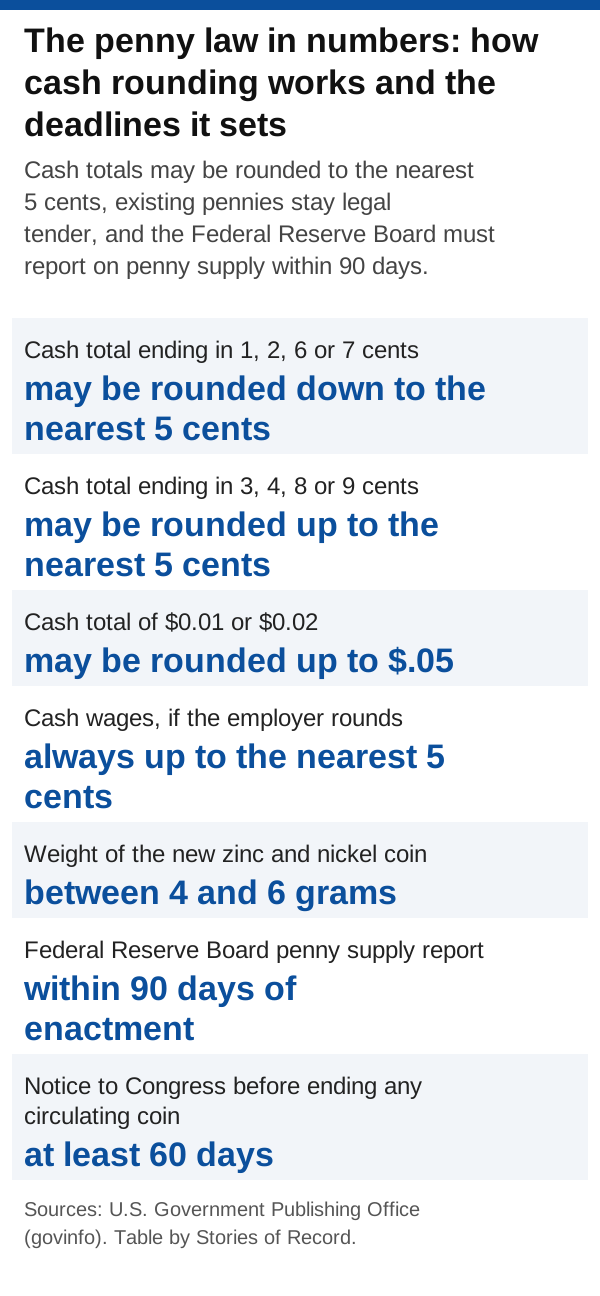
- In a cash sale where exact change cannot be given, a total ending in 1, 2, 6 or 7 cents may be rounded down to the nearest 5 cents. A total ending in 3, 4, 8 or 9 cents may be rounded up. [3]
Timeline
- The United States Mint had already stopped making pennies in November 2025, after 232 years, Fox News reported. The new law makes that stop part of federal law. [6]
What we know
- Pennies made before the law took hold stay legal tender. You can still use them to pay debts, public charges, taxes and dues. [3]
- A cash total of $0.01 or $0.02 may be rounded up to a nickel. [3]
- Rounding is optional. The law says nothing in it requires anyone to round a payment. [3]
- A business or bank may always round in the customer's favour: up when it pays the customer in cash, and down when the customer pays it in cash. [3]
- An employer who pays wages in cash and chooses to round must round the cents up, never down, to the nearest 5 cents. [3]
- The rounding rules do not apply to payments by card, check, electronic transfer, gift card or money order. [3]
- The amount that may be rounded is the full total including tax, or the change owed when a customer hands over more cash than the total. [3]
- A seller who follows the rounding rules does not break federal, state or tribal rules by doing so. The law also says it excuses no one from minimum wage, overtime or paid leave laws. [3]
- The nickel may now have a zinc core with a nickel coating, and may weigh between 4 and 6 grams. The Treasury may choose the mix once testing shows it makes the coin cheaper to produce and, as far as practical, causes few problems for coin machines. [3]
- From now on, the Treasury can stop minting any circulating coin only after giving the House Financial Services Committee and the Senate Banking Committee notice at least 60 days ahead, with its reasons and a phase-out plan. It must brief them within 30 days of that notice. [3]
- Representative Lisa McClain of Michigan introduced the bill in the House on 27 August 2026, with Representative Robert Garcia of California. It went to the House Financial Services Committee. [5] [6] [7]
- The House of Representatives passed the bill on 14 September 2026. Fox News reported that the vote was unanimous. [8] [6] [9]
- The Senate received the bill on 15 September 2026 and sent it to its Banking, Housing, and Urban Affairs Committee. [10] [11]
- Within 90 days of the law's enactment, the Federal Reserve Board must publish a plan for taking penny orders and deposits at commercial coin terminals, to limit disruption to the penny supply. Progress reports follow 6, 18 and 30 months after that. [3]
- The Treasury must assess how disruptions in penny supply and demand, and rounding when cashing checks, affect low-income communities, older consumers and people without bank accounts or with limited access to banks. It must recommend fixes to Congress, and the assessment goes to the Federal Reserve Board for its report. [3]
What we don't know yet
- The United States Mint had already stopped making pennies in November 2025, after 232 years, Fox News reported. The new law makes that stop part of federal law. [6]
- Pennies cost more than three times their face value to make as of 2025, and the Treasury estimated that stopping them would save $56 million a year straight away, Fox News reported. [6]
- Each nickel is made at a loss to taxpayers of about eight cents, Fox News reported. Representative McClain told Fox News that it costs 13 cents to make the five-cent coin. [2]
- Fox News reported in October that both the House and the Senate approved the bill unanimously. We have not yet read the Senate's own record of its vote or its date. [2]
Why it matters
If you pay with cash, your total may now be rounded to the nearest 5 cents. Totals ending in 1, 2, 6 or 7 cents may be rounded down, and totals ending in 3, 4, 8 or 9 cents may be rounded up. Rounding is allowed, not required, and only when exact change cannot be given. If you pay by card, check, electronic transfer or gift card, the rounding rules do not apply to you. The pennies in your jar keep their value: the law says they remain legal tender.
Questions
What does the new penny law do?
It tells the Treasury to stop making pennies for everyday use, keeps existing pennies as legal money, and lets cash totals be rounded to the nearest 5 cents when exact change cannot be given. It also opens the way to a cheaper nickel and sets rules for ending any other coin.
When does it take effect?
The White House says it was signed on 20 November 2026. The law text we read does not set a separate start date for the rounding rules. Its deadlines run from the date it was enacted: for example, the Federal Reserve Board's penny report is due within 90 days.
Do I have to accept a rounded total?
Rounding is allowed, not required. The law says no one must round, and it only covers cash sales where exact change cannot be given. A business may always round in your favour.
Will my card payments be rounded?
No. The rounding rules do not apply to payments by card, check, electronic transfer, gift card or money order.
Are my pennies still worth anything?
Yes. The law says pennies made before it remain legal tender for debts, taxes and other charges, so you can still spend them.
Is the nickel next?
The law does not end the nickel. It lets the Treasury make it from a cheaper zinc and nickel mix after testing. Any future decision to stop minting a circulating coin needs notice to Congress at least 60 days ahead.
Updates
- First published.
Every version of this story, as first published.
Sources
- The White House Official (government)Published: 20 November 2026Retrieved: 21 November 2026
- Fox News News organizationPublished: 7 October 2026Retrieved: 21 November 2026
- U.S. Government Publishing Office (govinfo) Original documentRetrieved: 21 November 2026
- U.S. Government Publishing Office (govinfo) Original documentRetrieved: 21 November 2026
- U.S. Government Publishing Office (govinfo) Original documentRetrieved: 21 November 2026
- Fox News News organizationPublished: 14 September 2026Retrieved: 21 November 2026
- U.S. Government Publishing Office (govinfo) Original documentRetrieved: 21 November 2026
- U.S. Government Publishing Office (govinfo) Original documentRetrieved: 21 November 2026
- U.S. Government Publishing Office (govinfo) Original documentRetrieved: 21 November 2026
- U.S. Government Publishing Office (govinfo) Original documentRetrieved: 21 November 2026
- U.S. Government Publishing Office (govinfo) Original documentRetrieved: 21 November 2026
About the picture: this is an illustration made for this story with an AI image tool and checked against it. It is not a picture of the real people, places or events.
People, places and organizations
- Topic
- Common Cents Act (H.R. 10167)
- Organization
- United States Department of the Treasury
- Organization
- United States Mint
- Organization
- Board of Governors of the Federal Reserve System
Follow us on Facebook
We post new records on our Facebook Page.
Follow on Facebook