COP31 climate talks in Antalya run past their deadline as countries split over fossil fuels
Talks in Antalya ran past their Friday deadline, and the president's draft deal, called the Antalya Pact and dated 22 November, has not been adopted.
Based so far on 1 official source and 3 news outlets. 5 points are not yet confirmed.
Negotiators at COP31, the United Nations (UN) climate conference in Antalya, Turkey, kept meeting after their Friday deadline, The Associated Press (AP) and Reuters reported. On 22 November the UN climate secretariat posted the president's draft deal, the Antalya Pact. A companion draft recalls the Dubai deal in full, warns warming is expected to pass 1.5 °C and lists a 35% electricity goal for 2035. AP reported it does not name fossil fuels. Nothing has been adopted.
Latest
The UN climate secretariat posted the COP31 President's proposal, a draft decision titled the Antalya Pact and dated 22 November. It would start a two-year work programme on mountains and urges richer countries to refill the Green Climate Fund. It is still a draft.
Key facts
- Negotiators kept meeting in Antalya on 21 November, after the conference's Friday deadline had passed, AP and Reuters reported. [1] [2]
- The draft of the summit's main political text released on 19 November dropped explicit references to moving away from fossil fuels and stressed clean energy and electrification instead, UN News reported. AP and Reuters reported that the draft left fossil fuels out and that governments were divided over how the final text should treat coal, oil and gas. [3] [1] [2]
- Panama's environment minister, Juan Carlos Navarro, said his country would formally object to any COP31 deal without fossil fuel language, UN News reported. UN climate decisions are generally taken by consensus, so one country's formal objection can stop a deal. [8]
Timeline
- Reuters reported that early on 22 November the COP31 President, Murat Kurum, said the summit's leaders had tabled a new version of the text, which he expected delegates to take up later that morning. Countries had not yet adopted it. [12]
- AP reported that the revised proposal, published in Antalya on 22 November, sets a goal for electricity to supply 35% of the world's final energy use by 2035. According to AP, the new draft does not mention fossil fuels by name, and countries at the talks still had to approve it. [13]
- A draft of the summit's main political decision, dated 22 November and posted by the UN climate secretariat (UNFCCC), recalls the United Arab Emirates Consensus "in its entirety". Carbon Brief reported that this points back to the whole deal reached at COP28 in Dubai, which called for a transition away from fossil fuels, so the new text refers to that pledge only indirectly. The document is marked as a draft text and had not been adopted. [14] [15]
- On 22 November the UN climate secretariat (UNFCCC) posted an advance copy of a draft decision titled the "Antalya Pact", put forward as a proposal by the COP31 President. A note in it says a companion draft under the Paris Agreement carries the same title. Both are marked as drafts. [16]NEW
- Reuters reported that on 21 November the European Union's climate commissioner, Wopke Hoekstra, said he would rather the talks end with no deal than accept a weak one. Reuters also reported that governments were still negotiating after the planned close. [10]
- On 20 November, the scheduled last day, a group of countries led by France and Panama said the proposed deal was not good enough and called for explicit action on fossil fuels and more climate finance, UN News reported. Negotiators were looking for a text that nearly 200 governments could accept. [8]
- Carbon Brief reported on 20 November that the second draft of the summit's main political text dropped a proposed $120 billion target for adaptation finance, money that helps developing countries cope with climate change. Reuters also reported the cut and said the figure had been in an earlier draft. The text was still being negotiated. [11] [10]
- The draft of the summit's main political text released on 19 November dropped explicit references to moving away from fossil fuels and stressed clean energy and electrification instead, UN News reported. AP and Reuters reported that the draft left fossil fuels out and that governments were divided over how the final text should treat coal, oil and gas. [3] [1] [2]
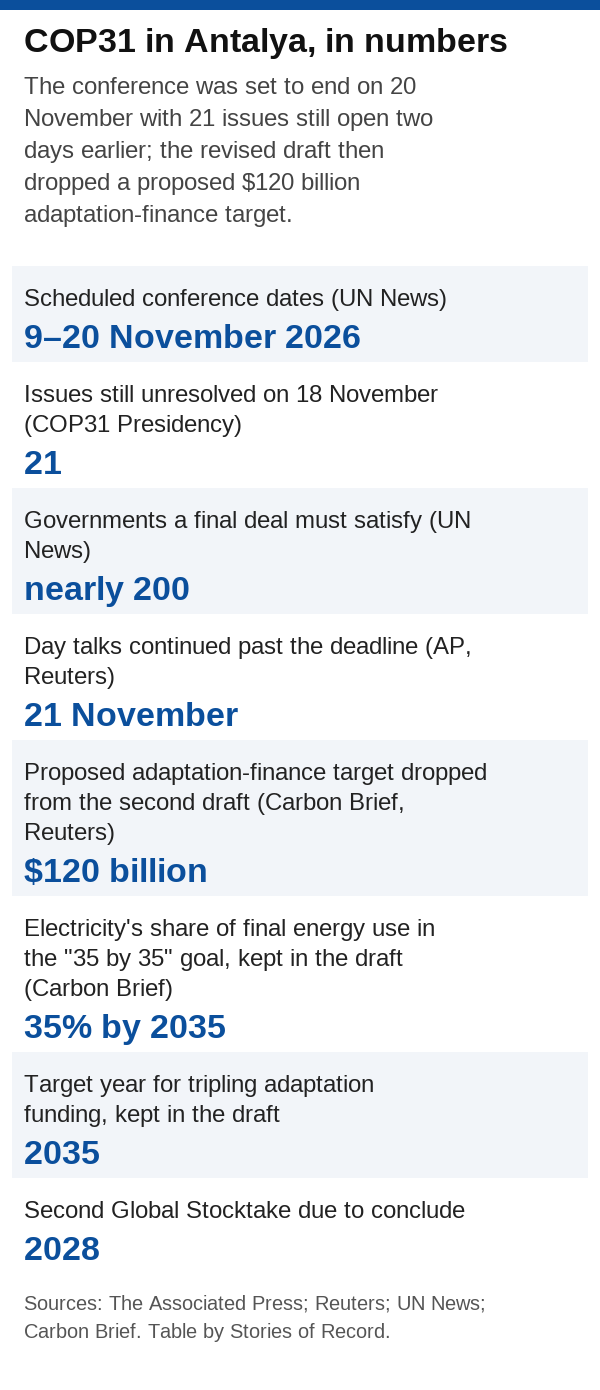
- On 18 November the COP31 Presidency told delegations that 21 issues were still open, among them adaptation, finance, cutting emissions and a fair shift for workers, UN News reported. The conference was set to close on Friday. [7]
- Australia, which co-hosts COP31 and leads the negotiations, circulated a first draft of the overall political decision on 16 November, UN News reported. Countries disagreed over its content and over whether such a decision should exist at all. [6]
- On 11 November, as world leaders arrived, UN Secretary-General António Guterres called for a new climate justice agreement and urged governments to tax fossil fuel companies to help the countries hit hardest, UN News reported. [5]
- The conference was scheduled to run in Antalya from 9 to 20 November, according to UN News. [4]
What we know
- The same draft kept the goal of tripling funding to help countries adapt to climate change by 2035, but left details such as how to measure that increase for later talks, UN News reported. [3]
- The conference was scheduled to run in Antalya from 9 to 20 November, according to UN News. [4]
- On 11 November, as world leaders arrived, UN Secretary-General António Guterres called for a new climate justice agreement and urged governments to tax fossil fuel companies to help the countries hit hardest, UN News reported. [5]
- Australia, which co-hosts COP31 and leads the negotiations, circulated a first draft of the overall political decision on 16 November, UN News reported. Countries disagreed over its content and over whether such a decision should exist at all. [6]
- On 18 November the COP31 Presidency told delegations that 21 issues were still open, among them adaptation, finance, cutting emissions and a fair shift for workers, UN News reported. The conference was set to close on Friday. [7]
- Presenting the 19 November draft, Australia's Chris Bowen, who leads the negotiations, pledged to keep consulting through the night, UN News reported. [3]
- On 20 November, the scheduled last day, a group of countries led by France and Panama said the proposed deal was not good enough and called for explicit action on fossil fuels and more climate finance, UN News reported. Negotiators were looking for a text that nearly 200 governments could accept. [8]
- UN News reported that, as of Friday afternoon, the Presidency had released no updated version of what it calls the Antalya Accord, so countries were still negotiating on the Thursday text. [8]
- The second Global Stocktake, the Paris Agreement's five-yearly check of whether countries' plans add up, began during the conference and is due to conclude in 2028, UN News reported. [7]
- Carbon Brief reported on 20 November that the second draft of the summit's main political text dropped a proposed $120 billion target for adaptation finance, money that helps developing countries cope with climate change. Reuters also reported the cut and said the figure had been in an earlier draft. The text was still being negotiated. [11] [10]
- The draft kept the hosts' "35 by 35" electrification goal, UN News and Carbon Brief reported. Carbon Brief reported that Turkey and Australia, which jointly run COP31, are pushing a pledge to raise electricity's share of final energy use to 35% by 2035, and that the draft also kept disputed wording on carbon capture and storage. [3] [11]
- A draft of the summit's main political decision, dated 22 November and posted by the UN climate secretariat (UNFCCC), recalls the United Arab Emirates Consensus "in its entirety". Carbon Brief reported that this points back to the whole deal reached at COP28 in Dubai, which called for a transition away from fossil fuels, so the new text refers to that pledge only indirectly. The document is marked as a draft text and had not been adopted. [14] [15]
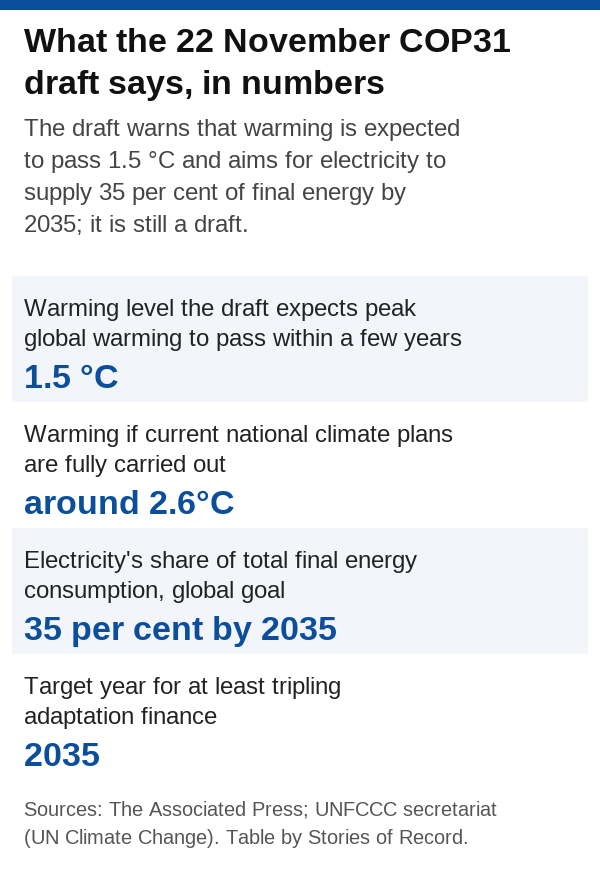
- The 22 November draft voices "deep concern" that peak global warming is expected to go above 1.5 °C over pre-industrial levels within the next few years. It also says that fully carrying out countries' current national climate plans would mean warming of around 2.6°C. [14]
- The 22 November draft calls for electricity's share of total final energy consumption to reach 35 per cent worldwide by 2035. AP reported that the draft does not name fossil fuels and that countries at the talks still had to approve it. [14] [13]
- The draft would launch an "Antalya–Addis Ababa road map" to make money for adaptation and resilience more predictable and larger. It also restates the call to at least triple adaptation finance by 2035. [14]
- On 22 November the UN climate secretariat (UNFCCC) posted an advance copy of a draft decision titled the "Antalya Pact", put forward as a proposal by the COP31 President. A note in it says a companion draft under the Paris Agreement carries the same title. Both are marked as drafts. [16]
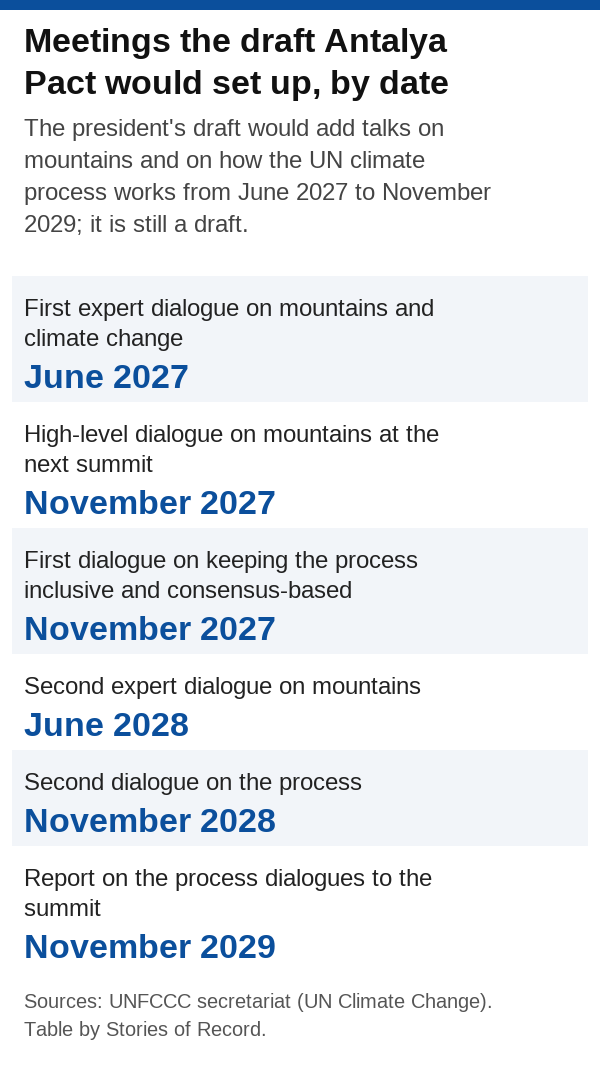
- The Antalya Pact draft would set up a two-year work programme on mountains and climate change, aimed at mountain regions and communities that depend on glaciers. Expert dialogues on mountains would follow in June 2027 and June 2028, with a high-level dialogue at the next summit in November 2027. [16]
- The draft urges developed countries to put money into the third refill of the Green Climate Fund. It notes "with concern" that less money has been set aside for the ninth round of the Global Environment Facility than for the eighth. [16]
- The draft also notes that the UN climate process has grown more complex and calls for talks on keeping it inclusive and based on consensus. Those talks would take place at meetings in November 2027 and November 2028, with a report to the summit in November 2029. [16]
- The 22 November Paris Agreement draft says countries will take different paths to keep 1.5 degrees within reach, and lists ways to get there "inter alia", meaning among others. The 35 per cent electricity goal for 2035 is one item on that list, alongside early warning systems and cleaner energy systems. [14]
What we don't know yet
- Reuters reported that the Trump administration did not send a federal delegation to COP31, and that state and local leaders from the United States attended on their own. [9]
- Reuters reported that on 21 November the European Union's climate commissioner, Wopke Hoekstra, said he would rather the talks end with no deal than accept a weak one. Reuters also reported that governments were still negotiating after the planned close. [10]
- Carbon Brief reported that at least 23 countries were unhappy that the second draft dropped any mention of fossil fuels. [11]
- Carbon Brief reported that talks on a planned "just transition mechanism" and on the global goal on adaptation had stalled, and that both draft texts were entirely in brackets, which means nothing in them was agreed. [11]
- Reuters reported that early on 22 November the COP31 President, Murat Kurum, said the summit's leaders had tabled a new version of the text, which he expected delegates to take up later that morning. Countries had not yet adopted it. [12]
Earlier reports we have updated
- Updated 22 November 2026: The UN climate secretariat has now posted the draft itself, so the electricity goal is confirmed from the text; see What we know.Earlier we wrote:
AP reported that the revised proposal, published in Antalya on 22 November, sets a goal for electricity to supply 35% of the world's final energy use by 2035. According to AP, the new draft does not mention fossil fuels by name, and countries at the talks still had to approve it.[13]
Why it matters
Negotiators are looking for a text that nearly 200 governments can accept, and they are split over what it should say about coal, oil and gas. A group of countries led by France and Panama says a deal that leaves fossil fuels out is not good enough. UN climate decisions are generally taken by consensus, so one country's formal objection can block a deal. Panama's environment minister has said his country would object to any text without fossil fuel language. For readers in the United States, Reuters reported that the Trump administration sent no federal delegation. Reuters also reported that state and local leaders attended on their own. Neither point has yet been confirmed by a second outlet or an official source.
Questions
What is COP31?
It is this year's United Nations climate change conference, held in Antalya, Turkey. UN News listed it as running from 9 to 20 November.
Why did the talks run past the deadline?
Governments were still split over the main text. AP and Reuters reported that the draft left out fossil fuels, and UN News reported that no new version had been published by Friday afternoon.
What does the draft say about fossil fuels?
According to UN News, the 19 November draft dropped explicit references to moving away from fossil fuels. The 22 November draft recalls the United Arab Emirates Consensus in full; Carbon Brief reported that this is the Dubai deal that called for a transition away from fossil fuels, so the pledge is referred to only indirectly. AP reported that the new draft does not name fossil fuels.
What is the Antalya Pact?
It is the title of the COP31 President's draft decision, posted by the UN climate secretariat on 22 November, and of a companion draft under the Paris Agreement. The president's draft would start a work programme on mountains and climate change and urges richer countries to refill the Green Climate Fund. It is a proposal, not an agreed deal.
Can one country block the deal?
UN News reported that decisions at these summits are generally taken by consensus, so a single formal objection can stop an agreement. Panama has said it would object to a text without fossil fuel language.
Did the United States send a delegation?
Reuters reported that the Trump administration sent no federal delegation, and that state and local leaders from the United States attended on their own. We have not seen this confirmed by a second outlet or an official page yet.
Could the talks end with no deal?
Reuters reported that the European Union's climate commissioner, Wopke Hoekstra, said he would rather the talks end without a deal than accept a weak one. No official source has said how the talks will end.
Is there a new text?
Yes, but only as drafts. Reuters reported that early on 22 November the COP31 President, Murat Kurum, said a revised text had been put forward. The UN climate secretariat has since posted his draft decision, titled the Antalya Pact, and a Paris Agreement draft dated that day. Among other options, the Paris Agreement draft aims for electricity to supply 35% of final energy use by 2035, and it warns that warming is expected to pass 1.5 °C. Countries had not adopted either.
When will the talks end?
No cited source gives a new closing time. This page will be updated when a final text is adopted or the talks end without one.
Updates
- Adds the COP31 President's draft Antalya Pact, posted on 22 November, with its plans for mountains, climate funds and how the talks are run.
- Adds the 22 November draft decision posted by the UN climate secretariat: it recalls the Dubai deal in full and warns warming will pass 1.5 °C.
- Adds an AP report on what the revised 22 November draft says about electricity and fossil fuels.
- Adds a Reuters report that the COP31 President put forward a revised text early on 22 November.
- Adds Carbon Brief and Reuters reports that the revised draft dropped a proposed $120 billion target for adaptation finance.
- Adds a Reuters report that the EU's climate commissioner would rather see no deal than a weak one.
- First published.
What earlier versions said
- No longer listed as an open questionRead that version
Before: AP reported that the revised proposal, published in Antalya on 22 November, sets a goal for electricity to supply 35% of the world's final energy use by 2035. According to AP, the new draft does not mention fossil fuels by name, and countries at the talks still had to approve it.
Newly confirmed in the same update: A draft of the summit's main political decision, dated 22 November and posted by the UN climate secretariat (UNFCCC), recalls the United Arab Emirates Consensus "in its entirety". Carbon Brief reported that this points back to the whole deal reached at COP28 in Dubai, which called for a transition away from fossil fuels, so the new text refers to that pledge only indirectly. The document is marked as a draft text and had not been adopted. The 22 November draft voices "deep concern" that peak global warming is expected to go above 1.5 °C over pre-industrial levels within the next few years. It also says that fully carrying out countries' current national climate plans would mean warming of around 2.6°C. The 22 November draft calls for electricity's share of total final energy consumption to reach 35 per cent worldwide by 2035. AP reported that the draft does not name fossil fuels and that countries at the talks still had to approve it. The draft would launch an "Antalya–Addis Ababa road map" to make money for adaptation and resilience more predictable and larger. It also restates the call to at least triple adaptation finance by 2035.
Every version of this story, as first published.
Sources
- The Associated Press News organizationPublished: 21 November 2026Reported by The Associated Press; credited as reported, not opened by us
- Reuters News organizationPublished: 20 November 2026Reported by Reuters; credited as reported, not opened by us
- UN News Official (government)Published: 19 November 2026Retrieved: 21 November 2026
- UN News Official (government)Published: 7 October 2026Retrieved: 21 November 2026
- UN News Official (government)Published: 11 November 2026Retrieved: 21 November 2026
- UN News Official (government)Published: 16 November 2026Retrieved: 21 November 2026
- UN News Official (government)Published: 18 November 2026Retrieved: 21 November 2026
- UN News Official (government)Published: 20 November 2026Retrieved: 21 November 2026
- Reuters News organizationPublished: 16 November 2026Reported by Reuters; credited as reported, not opened by us
- Reuters News organizationPublished: 21 November 2026Reported by Reuters; credited as reported, not opened by us
- Carbon Brief News organizationRetrieved: 21 November 2026
- Reuters News organizationPublished: 21 November 2026Reported by Reuters; credited as reported, not opened by us
- The Associated Press News organizationPublished: 22 November 2026Reported by The Associated Press; credited as reported, not opened by us
- UNFCCC secretariat (UN Climate Change) Official (government)Retrieved: 22 November 2026
- Carbon Brief News organizationPublished: 22 November 2026Reported by Carbon Brief; credited as reported, not opened by us
- UNFCCC secretariat (UN Climate Change) Official (government)Retrieved: 22 November 2026
About the picture: this is a stock photo from Storyblocks. It does not show the people, places or events in this story.
People, places and organizations
- Event
- COP31 UN Climate Change Conference
- Organization
- United Nations
- Place
- Antalya
- Place
- Panama
- Place
- France
Follow us on Facebook
We post new records on our Facebook Page.
Follow on Facebook