FCC asks for comments on Cyber Trust Mark label rules for smart-home devices by 23 December
The FCC wants comments on its proposed Cyber Trust Mark label rules by 23 December 2026, and reply comments by 7 January 2027.
The Federal Communications Commission (FCC) wants public comment on how the U.S. Cyber Trust Mark, a voluntary security label for wireless smart-home gadgets, should look and work. Comments are due by 23 December 2026 and replies by 7 January 2027. Its public safety bureau proposes rules on the label's size, the product details behind its QR (quick response) code, renewal every three years, spot checks and complaints.
Key facts
- The FCC's Public Safety and Homeland Security Bureau is asking for comment on recommendations for the Cyber Trust Mark program: the label's design and placement, how product details are shown, renewals, checks on products after sale, complaints, and what happens when a program administrator leaves. [1]
- Comments in PS Docket No. 23-239 are due by 23 December 2026 and reply comments by 7 January 2027. They can be filed online through the FCC's comment system or on paper. [1]
- Makers would renew certification every three years, not every five as the stakeholder group recommended. The bureau says five years may not keep up with fast-changing threats. [1]
Timeline
- A summary of the notice was filed with the Federal Register on 20 November 2026, as document 2026-23812. [1]
- The bureau released this request for comment, Public Notice DA 26-1162, on 27 October 2026. [1]
- On 26 October 2026 ioXt sent further recommendations, on technical requirements only. The bureau will ask for comment on those in a separate notice. [1]
- In April 2026 the bureau picked the ioXt Alliance as the new Lead Administrator after the previous one withdrew. [1]
- In June 2025 the program's Lead Administrator and a stakeholder group sent the FCC their recommendations on technical, label, renewal and checking requirements. [1]
- The rules setting up the program took effect on 29 August 2024. [2]
- The FCC created the voluntary labeling program for wireless consumer smart devices in an order released on 15 March 2024. [2]
- The FCC first proposed a voluntary security label for connected devices in a notice released on 10 August 2023. [3]
What we know
- A certified product carries the FCC's label: the Cyber Trust Mark plus a QR code that leads to plain security information about that product. The FCC oversees the program, with a Lead Administrator and approved label administrators who certify products. [1]
- Taking part is voluntary for makers, but a company that chooses to use the label must follow the program's requirements. [2]
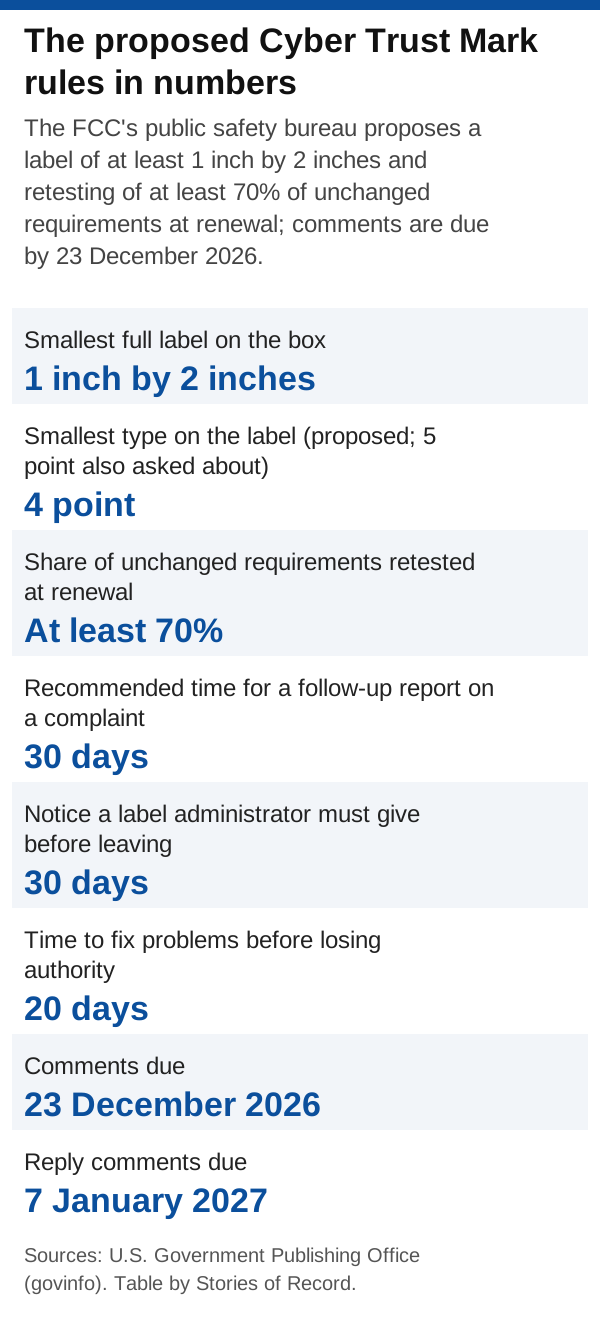
- The bureau proposes a label of at least 1 inch by 2 inches on the box, printed or as a sticker. It proposes a minimum type size of 4 point and asks whether it should be 5 point instead. [1]
- The recommendations offer three smaller options for products too small for the full label, some without a QR code. The bureau asks whether dropping the code would clash with the FCC's existing rules. [1]
- The online security summary behind the QR code, which the FCC calls a cyber nutrition label, would have to be available in English and Spanish. [1]
- The bureau proposes that makers disclose whether a product has camera or video, audio, or location sensors. [1]
- The stakeholder group preferred five years because it said a shorter period would weigh too heavily on manufacturers and could put them off joining. [1]
- At renewal, a product would be tested against any new or changed requirements and at least 70% of the rest, and against all of them if a problem turns up. [1]
- Each label administrator would check, after sale, at least three percent of the products it certified or renewed in the previous calendar year. The bureau asks whether higher-risk products, such as home security cameras and baby monitors, should be checked more often. [1]
- Under the recommendations, a complaint about a certified product could go to any label administrator, which would report back on what it did within 30 days. The bureau proposes that administrators tell the maker and the Lead Administrator, which would then inform the FCC. [1]
- A label administrator that leaves would have to give 30 days' notice to the Lead Administrator, the makers it approved and pending applicants. One that loses its authority would have 20 days to fix problems first. [1]
- Makers may not claim or suggest that the mark means the FCC or the U.S. government endorses their product. [1]
- The label design draws on an industry standard from the Consumer Technology Association. The notice records concerns from some stakeholders that joining the committee behind that standard requires a paid membership. [1]
- The FCC first proposed a voluntary security label for connected devices in a notice released on 10 August 2023. [3]
- The FCC created the voluntary labeling program for wireless consumer smart devices in an order released on 15 March 2024. [2]
- The rules setting up the program took effect on 29 August 2024. [2]
- In June 2025 the program's Lead Administrator and a stakeholder group sent the FCC their recommendations on technical, label, renewal and checking requirements. [1]
- In April 2026 the bureau picked the ioXt Alliance as the new Lead Administrator after the previous one withdrew. [1]
- On 26 October 2026 ioXt sent further recommendations, on technical requirements only. The bureau will ask for comment on those in a separate notice. [1]
- The bureau released this request for comment, Public Notice DA 26-1162, on 27 October 2026. [1]
- A summary of the notice was filed with the Federal Register on 20 November 2026, as document 2026-23812. [1]
What we don't know yet
- The security requirements a product must meet to earn the mark are not part of this notice. The bureau says it will ask for comment on ioXt's newer technical recommendations in a later notice, and it has given no date for that. [1]
- Whether the security summary behind the QR code will be hosted by the government is still open. The recommendations say it should be, to build trust, and the bureau is asking for views. [1]
Why it matters
The label is meant to help you judge, before you buy, whether a connected device for your home meets the program's security requirements. Scanning its QR code would open a short security summary for that product. Under the proposal it would be in English and Spanish, and it would say whether the device can record video or sound or tell where it is. The program is voluntary, so a device without the mark is not banned. Makers may not present the mark as an FCC or government endorsement. These are proposals, not final rules. Anyone who wants a say can file in the FCC's public docket before the deadlines.
Questions
What is the U.S. Cyber Trust Mark?
A voluntary FCC security label for wireless consumer smart devices, often called the Internet of Things. A certified product shows the mark and a QR code that leads to a short security summary for that product.
What does the FCC want to change now?
Its public safety bureau proposes rules on the label's size and placement, the security summary behind the QR code, renewal every three years instead of five, spot checks after sale, complaints, and what happens when a program administrator leaves.
How do I comment, and by when?
File in PS Docket No. 23-239 through the FCC's online comment system or on paper. Comments are due by 23 December 2026 and reply comments by 7 January 2027.
Will devices without the label be banned?
No. Taking part is voluntary, though makers that use the label must follow the program's rules.
Does the mark mean the government endorses a product?
No. Makers may not claim or suggest that the mark is an FCC or U.S. government endorsement.
How big would the label be?
At least 1 inch by 2 inches under the proposal, with three smaller options suggested for small products. The bureau asks whether the smallest type should be 4 point or 5 point.
Who runs the program?
The FCC oversees it. A Lead Administrator, the ioXt Alliance since April 2026, works with approved label administrators that certify products.
Updates
- First published.
Every version of this story, as first published.
Sources
- U.S. Government Publishing Office (govinfo) Original documentRetrieved: 21 November 2026
- U.S. Government Publishing Office (govinfo) Original documentRetrieved: 21 November 2026
- U.S. Government Publishing Office (govinfo) Original documentRetrieved: 21 November 2026
About the picture: this is an illustration made for this story with an AI image tool and checked against it. It is not a picture of the real people, places or events.
People, places and organizations
- Organization
- Federal Communications Commission
- Product
- U.S. Cyber Trust Mark
- Organization
- ioXt Alliance
Follow us on Facebook
We post new records on our Facebook Page.
Follow on Facebook