States sue to block HUD rule that could cost mixed-status families their housing aid
Twenty-one attorneys general and Pennsylvania's governor went to court on 23 November to stop a HUD rule that takes effect on 14 December.
Based so far on 1 official source and 2 news outlets. 7 points are not yet confirmed.

Twenty-one attorneys general and Pennsylvania's governor sued the Department of Housing and Urban Development (HUD) on 23 November, the Associated Press (AP) and the Los Angeles Times reported. They want to stop a rule that ends the reduced rent help a family can get today when one member lacks eligible immigration status. HUD published the rule on 12 November. It takes effect on 14 December.
Key facts
- Twenty-one attorneys general and Pennsylvania's governor sued HUD on 23 November in federal court in Massachusetts, AP and the Los Angeles Times reported. [1] [2]
- HUD published the final rule in the Federal Register on 12 November. It requires proof of US citizenship or eligible immigration status from every applicant and recipient in the covered programs, whatever their age. [3]
- The rule makes the reduced, per-member subsidy a temporary step that lasts only until every family member's status has been checked, where the law allows. [3]
Timeline
- Hours after the states filed, public housing authorities and local governments, including the city and county of Los Angeles and the city's housing agency, filed their own lawsuit against the rule, the Los Angeles Times reported. [2]
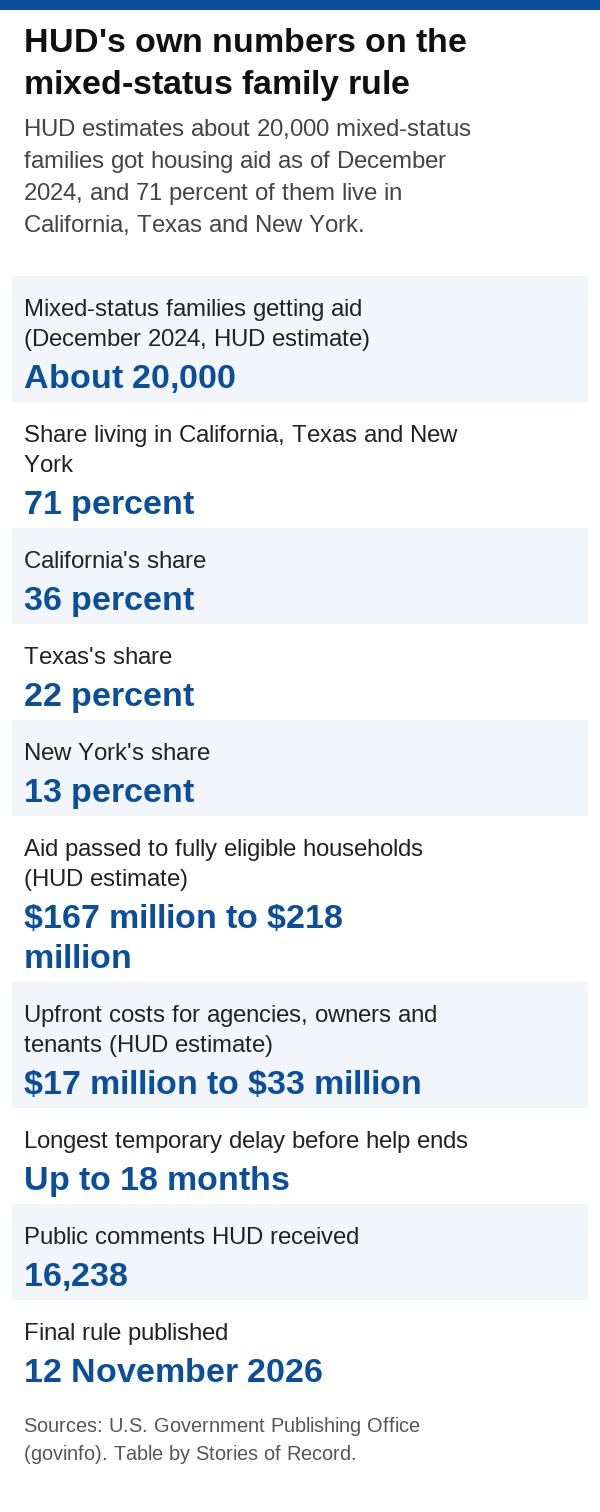
- HUD published the final rule in the Federal Register on 12 November. It requires proof of US citizenship or eligible immigration status from every applicant and recipient in the covered programs, whatever their age. [3]
- Public comments closed on 21 April 2026, and HUD received 16,238 of them. [3]
- HUD first proposed the rule on 20 February 2026. [3]
- HUD's first rule carrying out Section 214 took effect on 19 June 1995, and housing agencies have used a federal database called SAVE to check immigration status since then. [3]
What we know
- Under HUD's current rules, a family can get a reduced subsidy that covers only the members who qualify, and that reduced help could continue with no end date. [1] [3]
- HUD says the changes make its rules match the text and aim of Section 214, part of the Housing and Community Development Act of 1980, more closely. [3]
- HUD first proposed the rule on 20 February 2026. [3]
- Public comments closed on 21 April 2026, and HUD received 16,238 of them. [3]
- HUD's own impact analysis estimates that about 20,000 mixed-status families were getting housing aid as of December 2024. [3]
- HUD says 71 percent of these families live in three states: California (36 percent), Texas (22 percent) and New York (13 percent). [3]
- HUD estimates that $167 million to $218 million in housing help would pass from mixed-status families to fully eligible households on waiting lists. [3]
- HUD puts the upfront costs for housing agencies, owners and tenants at $17 million to $33 million. [3]
- Families can still ask for a temporary delay before their help ends, for up to 18 months, which HUD says is meant to reduce the risk of homelessness. [3]
- HUD's first rule carrying out Section 214 took effect on 19 June 1995, and housing agencies have used a federal database called SAVE to check immigration status since then. [3]
- Under the rule, tenants in mixed-status families who have not yet shown proof must do so within 90 days of the start date. Other tenants do it at their next annual or interim review, and HUD says most households will have a year or more. [3]
What we don't know yet
- The states argue that HUD has no power to change a law passed by Congress, the Los Angeles Times reported. [2]
- Lawyers for the states wrote that low-income families who lose their subsidized homes under the rule are likely to become homeless, the Los Angeles Times reported. [2]
- Hours after the states filed, public housing authorities and local governments, including the city and county of Los Angeles and the city's housing agency, filed their own lawsuit against the rule, the Los Angeles Times reported. [2]
- The nonprofit Public Counsel had already challenged the rule the week before, the Los Angeles Times reported. [2]
- In an emailed statement, HUD Secretary Scott Turner said the rule fully carries out the 1980 law, the Los Angeles Times reported. [2]
- HUD's own review expects most mixed-status families to leave assisted housing rather than split up, the Los Angeles Times reported. [2]
- The Housing Authority of the City of Los Angeles counts 1,869 mixed-status households in federally funded public housing in the city, the Los Angeles Times reported. [2]
Why it matters
Today a family with members of different immigration status can keep a smaller subsidy that covers only the members who qualify. HUD's rule makes that partial help temporary, until every member's status is checked. HUD's own analysis puts about 20,000 families in this position, most of them in California, Texas and New York. If you live in public housing or use a housing voucher, the rule also asks every household member to show proof of citizenship or eligible status. Your housing agency or landlord has to tell you about the new rules within 30 days of the start date. A court could block the rule before it starts on 14 December.
Questions
What is a mixed-status family?
A household where some members have US citizenship or eligible immigration status and at least one does not. Today such a family can get a reduced subsidy for the members who qualify.
When does the rule start?
HUD set 14 December 2026 as the start date. The lawsuits filed on 23 November ask courts to stop it.
How many families does HUD think are affected?
HUD's impact analysis estimates about 20,000 mixed-status families were getting help as of December 2024, with 71 percent in California, Texas and New York.
What does HUD say?
HUD says the rule brings its regulations closer to the wording and purpose of Section 214 of the 1980 housing law, and that the help freed up goes to fully eligible households on waiting lists.
Updates
- First published.
Every version of this story, as first published.
Sources
- The Associated Press News organizationPublished: 23 November 2026Reported by The Associated Press; credited as reported, not opened by us
- Los Angeles Times News organizationPublished: 23 November 2026Retrieved: 24 November 2026
- U.S. Government Publishing Office (govinfo) Original documentRetrieved: 24 November 2026
About the picture: this is a stock photo from Storyblocks. It does not show the people, places or events in this story.
People, places and organizations
- Organization
- United States Department of Housing and Urban Development
- Organization
- Housing Authority of the City of Los Angeles
- Topic
- Section 214 of the Housing and Community Development Act of 1980
Related stories
Follow us on Facebook
We post new records on our Facebook Page.
Follow on Facebook