Labor Department proposes dropping ESG wording and the 'tiebreaker' from its retirement-plan investment rule
The Labor Department has proposed rewriting its rule on how retirement plans choose investments, removing ESG wording, the 'tiebreaker' test and a provision on workers' preferences.

The Labor Department's Employee Benefits Security Administration (EBSA) has proposed changing the rule on how people who run private-sector retirement plans pick investments and vote shares. It would remove a line naming climate change and other environmental, social or governance (ESG) factors, end the "tiebreaker" test and drop a provision on workers' preferences. The department says plan managers must act only for workers' financial benefit. The public can comment for 60 days after the proposal is published.
Key facts
- The Labor Department's Employee Benefits Security Administration (EBSA) filed a proposed rule titled "Loyalty and the Exclusive Purpose Rule in Selecting Plan Investments and Exercising Shareholder Rights" for public inspection on 23 November. It is set to appear in the Federal Register on 24 November 2026. [1]
- It would delete a 2022 sentence that names climate change and other environmental, social or governance (ESG) issues as possible risk and return factors. [1]
- The proposal would scrap the "tiebreaker" test. Today that test lets a plan manager who finds two investments equally good for the plan pick one for reasons other than returns. [1]
Timeline
- The Labor Department's Employee Benefits Security Administration (EBSA) filed a proposed rule titled "Loyalty and the Exclusive Purpose Rule in Selecting Plan Investments and Exercising Shareholder Rights" for public inspection on 23 November. It is set to appear in the Federal Register on 24 November 2026. [1]
- Daniel Aronowitz, the Assistant Secretary who heads EBSA, signed the proposal in Washington on 20 November. [1]
- On 31 March 2026 the department proposed a separate rule on prudence in choosing investment options for 401(k)-type plans. The new proposal adds the loyalty side. [1]
- On 11 December 2025 President Trump issued Executive Order 14366 on proxy advisers. It told the Secretary of Labor to strengthen fiduciary rules for retirement plans. [1]
- After the Supreme Court ended Chevron deference in 2024, an appeals court sent the case back. In 2025 the Texas court again upheld the 2022 rule, including the tiebreaker. The department now says it disagrees with the court's reading. [1]
- States and private parties sued. On 21 September 2023 a federal court in northern Texas ruled for the department. [1]
- Congress passed a resolution to overturn the 2022 rule, and President Joseph R. Biden, Jr. vetoed it on 20 March 2023. [1]
- On 1 December 2022 the department published the current rule. It dropped the "pecuniary" wording, said climate and other ESG factors may be risk and return factors, restated the tiebreaker and added the worker-preferences provision. [1]
- On 16 December 2020 a second final rule added duties for proxy voting and other shareholder rights, and said plan managers need not vote every proxy. [1]
- On 13 November 2020 the department amended the rule to require plan managers to pick investments based only on "pecuniary", or financial, factors. [1]
- In June 1994 the department issued guidance that became known as the "all things being equal" or tiebreaker standard: when investments serve a plan equally, other benefits can decide the choice. [1]
- The department first adopted its Investment Duties regulation, the rule this proposal would amend, in 1979. [1]
What we know
- The proposal changes the department's rule on how people who run private-sector retirement plans, called fiduciaries, choose investments, including the default fund for workers who make no choice, and how they vote shares the plan owns. [1]
- The department says plan managers could still weigh any factor they reasonably judge relevant to an investment's risk and return. It says the change is not a ban on any type of information. [1]
- It would also remove a 2022 provision saying plan managers do not break their duty of loyalty only because they take workers' preferences into account when building a 401(k)-type investment menu. [1]
- The department says removing that provision does not mean plan managers may not listen to what workers want, but any such choice must still meet the duties of prudence and loyalty. [1]
- The rule's loyalty test would change from saying plan managers "may not subordinate" workers' interests to other goals to an affirmative duty to act "with the exclusive purpose of maximizing" workers' retirement income or financial benefits under the plan. [1]
- The proposal does not necessarily require plans to sell or drop investments they already hold, and it would apply only going forward, the department says. Plans would check existing holdings through the regular monitoring the law already requires. [1]
- The proposal would name shareholder engagement, alongside proxy voting, as an activity covered by the same fiduciary duties. [1]
- The department says the tiebreaker does not fit the best reading of the law and could be used as cover for decisions driven by a plan manager's own preferences. It says removing ESG wording would make the rule neutral, so that the law neither favors nor disfavors any investment strategy. [1]
- The department says it has been unable to document real cases where two competing investments served a plan's finances equally well. [1]
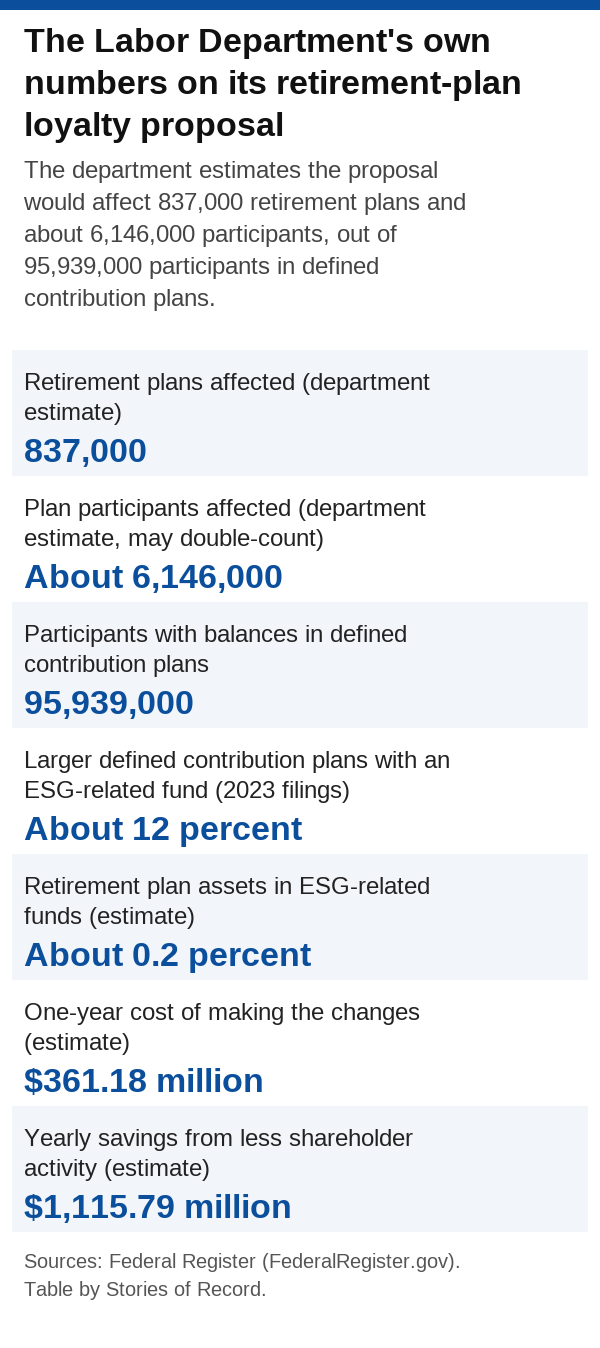
- The department estimates the proposal would affect 837,000 retirement plans and about 6,146,000 plan participants. That participant count may include people counted twice because they are in more than one plan. [1]
- For comparison, the department counts 95,939,000 participants with account balances in defined contribution plans such as 401(k)s. [1]
- The department looked at 2023 annual filings from larger defined contribution plans (100 or more participants) and found roughly 12 percent offered at least one ESG-related fund. It puts the share of retirement plan assets held in such funds at about 0.2 percent. [1]
- The department puts the one-year cost of making the changes at $361.18 million, and estimates yearly savings of $1,115.79 million from less spending on shareholder activities. [1]
- Comments can be sent online at regulations.gov or by mail to EBSA's Office of Regulations and Interpretations, citing file code 1210-AC37. Comments are posted publicly exactly as received, so the department warns people not to include personal details they do not want made public. [1]
- Daniel Aronowitz, the Assistant Secretary who heads EBSA, signed the proposal in Washington on 20 November. [1]
- The department first adopted its Investment Duties regulation, the rule this proposal would amend, in 1979. [1]
- In June 1994 the department issued guidance that became known as the "all things being equal" or tiebreaker standard: when investments serve a plan equally, other benefits can decide the choice. [1]
- On 13 November 2020 the department amended the rule to require plan managers to pick investments based only on "pecuniary", or financial, factors. [1]
- On 16 December 2020 a second final rule added duties for proxy voting and other shareholder rights, and said plan managers need not vote every proxy. [1]
- On 1 December 2022 the department published the current rule. It dropped the "pecuniary" wording, said climate and other ESG factors may be risk and return factors, restated the tiebreaker and added the worker-preferences provision. [1]
- Congress passed a resolution to overturn the 2022 rule, and President Joseph R. Biden, Jr. vetoed it on 20 March 2023. [1]
- States and private parties sued. On 21 September 2023 a federal court in northern Texas ruled for the department. [1]
- After the Supreme Court ended Chevron deference in 2024, an appeals court sent the case back. In 2025 the Texas court again upheld the 2022 rule, including the tiebreaker. The department now says it disagrees with the court's reading. [1]
- On 11 December 2025 President Trump issued Executive Order 14366 on proxy advisers. It told the Secretary of Labor to strengthen fiduciary rules for retirement plans. [1]
- On 31 March 2026 the department proposed a separate rule on prudence in choosing investment options for 401(k)-type plans. The new proposal adds the loyalty side. [1]
What we don't know yet
- The department says some plan managers may have claimed ties that did not exist, as cover for choices the law does not allow. It presents this as a concern, not as a finding about any plan. [1]
- The department estimates first-year investment returns about $15.2 million higher if some money moves out of ESG-related funds into better-performing ones. That figure rests on its own assumption of a gain of 10 basis points, and it says research findings on this are mixed. [1]
Why it matters
The rule governs the people who choose the funds on a 401(k) menu, the default fund for workers who make no choice, and how a plan votes its shares. It does not set what any single worker may buy. The department estimates about 6,146,000 participants would be affected, out of 95,939,000 in defined contribution plans. It says existing funds need not necessarily be dropped, and the rule would apply only going forward.
Questions
Does this change what I can pick in my 401(k)?
Not directly. The rule covers the plan managers who build the menu and choose the default fund. The department says they could still weigh any factor relevant to risk and return, and the proposal does not necessarily require dropping funds a plan already offers.
How many people would it affect?
The department estimates 837,000 retirement plans and about 6,146,000 participants, a count that may include people in more than one plan. About 12 percent of larger defined contribution plans had at least one ESG-related fund on their menu, it found.
When can I comment, and how?
Comments are due 60 days after the proposal is published in the Federal Register. Send them at regulations.gov or by mail, citing file code 1210-AC37. Comments are posted publicly as received.
What is the tiebreaker?
A test that lets a plan manager who finds two investments equally good for the plan choose between them for reasons other than returns. It dates back to guidance from 1994. The department says it does not fit the law and could be misused.
Has a court ruled on the current rule?
Yes. A federal court in northern Texas upheld the 2022 rule in 2023 and, after the case was sent back, again in 2025, including the tiebreaker. The department says it disagrees with the court's reading.
Is it final?
No. It is a proposal. The department will review comments before deciding on a final rule, and the proposal sets no date for one.
Updates
- First published.
Every version of this story, as first published.
Sources
- Federal Register (FederalRegister.gov) Original documentRetrieved: 24 November 2026
About the picture: this is a stock photo from Storyblocks. It does not show the people, places or events in this story.
People, places and organizations
- Organization
- United States Department of Labor
- Organization
- Employee Benefits Security Administration
- Topic
- Employee Retirement Income Security Act
Related stories
Follow us on Facebook
We post new records on our Facebook Page.
Follow on Facebook