Agriculture Department delays its 2024 horse soring rule again, to 31 December 2027
The 2024 Horse Protection rule will not take effect at the end of 2026: the Agriculture Department has moved its start date to 31 December 2027.
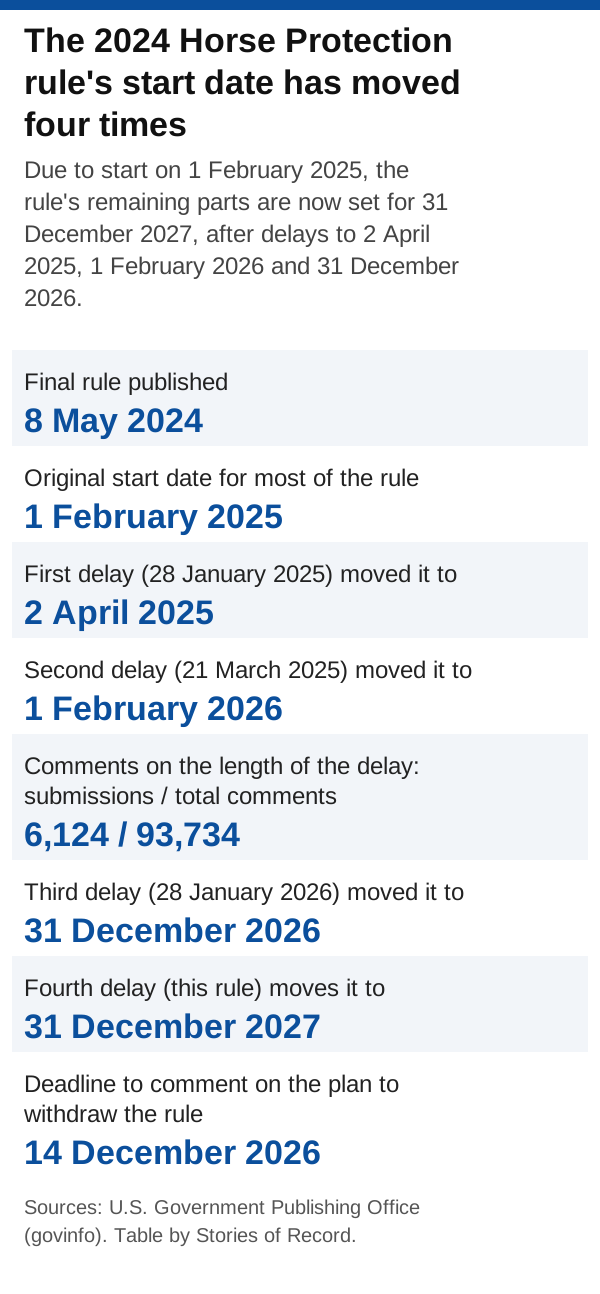
The US Department of Agriculture (USDA) has postponed its 2024 rule against horse soring for a fourth time. The parts a court left standing were due to start on 31 December 2026 and are now set for 31 December 2027. Its Animal and Plant Health Inspection Service (APHIS) says it needs the time because on 13 November 2026 it proposed withdrawing the rule. Comments on that plan close on 14 December 2026.
Key facts
- APHIS has issued a final rule, Federal Register document 2026-23818, that moves the start date of the remaining parts of the 2024 Horse Protection rule (9 CFR 11.1 through 11.18) from 31 December 2026 to 31 December 2027. It is scheduled to appear in the Federal Register on 23 November 2026. [1]
- APHIS says the comment period on its new proposal ends too close to the end of 2026 for it to read the comments and finish a replacement rule in time. Letting the partly struck-down 2024 rule start in the meantime would, it says, almost certainly be disruptive and could be costly for the industry, a swing it calls regulatory whiplash. [1]
- On 13 November 2026, APHIS proposed removing the struck-down parts of the 2024 rule, withdrawing the parts that survived, and updating the current rules instead. Comments are open for 30 days, until 14 December 2026, under docket APHIS-2026-0067. [1] [2]
Timeline
- Dudley Hoskins, the department's Under Secretary for Marketing and Regulatory Programs, signed the delay in Washington on 18 November 2026. It was filed with the Federal Register on 20 November. [1]
- On 28 August 2026, the Texas court ruled for the plaintiffs in the second case. It held that the No-Showback Rule and the scar rule exceed the department's authority and that its disqualification process lacks adequate due process. [1]
- On 28 January 2026, with that lawsuit still open, APHIS pushed the start date to 31 December 2026. It said the extra time would also let it finish reviewing a House committee report on the rule. [1]
- On 19 August 2025, the court blocked those rules for now. It found the No-Showback Rule and the scar rule likely go beyond the law, because the act requires disqualification only when a horse is sore at inspection, and that the inspection process likely lacks a chance to contest a decision first. [1]
- On 30 June 2025, a second lawsuit in the same Texas court challenged rules already in force: the No-Showback Rule, which kept a noncompliant horse out of later classes at the same show, the scar rule, and the fairness of disqualifications based on USDA inspections. [1]
- That comment period ran 60 days and closed on 20 May 2025. APHIS received 6,124 submissions representing 93,734 comments, from members of Congress, state farm agencies, equine vets, animal welfare advocacy groups, horse owners, trainers and exhibitors, and others. [1]
- On 21 March 2025, APHIS moved the start date again, to 1 February 2026, and asked the public whether the delay should be longer. It said letting the remaining parts start on 2 April 2025 would be untenable for the agency and disruptive to the industry. [1]
- On 31 January 2025, the Texas court struck down the rule's ban on action devices, pads and substances, which it said went beyond APHIS's powers. It also struck down a new skin-condition test meant to replace the scar rule, and the rule's review steps, for lacking due process. It upheld the switch from industry-licensed designated qualified persons (DQPs) to Horse Protection Inspectors (HPIs). [1]
- On 28 January 2025, APHIS made its first postponement, from 1 February 2025 to 2 April 2025, to hold things as they were while the lawsuit was pending. [1]
- On 8 May 2024, APHIS published the Horse Protection Amendments. Most of it was to start on 1 February 2025; one section, on training the new inspectors, took effect on 7 June 2024. The rule had APHIS screen, train and authorize the inspectors at every covered event, and took regulatory duties away from horse industry organizations. [1] [2]
- On 21 August 2023, APHIS proposed the rule that became the 2024 rule. It would have APHIS screen, train and authorize the inspectors at covered events and ban action devices and non-therapeutic pads on Tennessee Walking Horses and racking horses. On 31 October 2023, APHIS formally withdrew the unpublished 2017 rule. [2]
- On 13 August 2019, the Humane Society of the United States and other groups sued over that withdrawal, arguing it needed public notice and comment first. An appeals court agreed on 22 July 2022. [2]
- On 20 January 2017, a White House memo told agencies to pull back every rule still waiting to be published. APHIS withdrew a horse protection rule it had sent in nine days earlier, so it never appeared. [2]
What we know
- Dudley Hoskins, the department's Under Secretary for Marketing and Regulatory Programs, signed the delay in Washington on 18 November 2026. It was filed with the Federal Register on 20 November. [1]
- The delay takes effect at once. APHIS did not take public comment on it first, saying there was not enough time before the end of 2026 and that the need for regulatory clarity was good cause to skip that step. [1]
- The Horse Protection Act aims to end soring and to keep competition fair. Under the law, a horse is sore when a person has used a blistering agent, a cut or burn, a tack or nail, or another substance, device or practice on its limbs, so that it suffers or can be expected to suffer pain, inflammation or lameness when it moves. Care given under a licensed veterinarian is excluded. [1] [2]
- The law requires the managers of horse shows and exhibitions to disqualify any sore horse. APHIS, an agency of the Agriculture Department, enforces the law through its Animal Care program. [2] [1]
- On 20 January 2017, a White House memo told agencies to pull back every rule still waiting to be published. APHIS withdrew a horse protection rule it had sent in nine days earlier, so it never appeared. [2]
- On 13 August 2019, the Humane Society of the United States and other groups sued over that withdrawal, arguing it needed public notice and comment first. An appeals court agreed on 22 July 2022. [2]
- On 21 August 2023, APHIS proposed the rule that became the 2024 rule. It would have APHIS screen, train and authorize the inspectors at covered events and ban action devices and non-therapeutic pads on Tennessee Walking Horses and racking horses. On 31 October 2023, APHIS formally withdrew the unpublished 2017 rule. [2]
- On 8 May 2024, APHIS published the Horse Protection Amendments. Most of it was to start on 1 February 2025; one section, on training the new inspectors, took effect on 7 June 2024. The rule had APHIS screen, train and authorize the inspectors at every covered event, and took regulatory duties away from horse industry organizations. [1] [2]
- On 1 July 2024, the Tennessee Walking Horse National Celebration Association and two individuals sued over the rule in federal court in the Northern District of Texas. Their amended complaint argued the rule went beyond APHIS's legal powers and asked the court to throw it out. [2] [1]
- On 28 January 2025, APHIS made its first postponement, from 1 February 2025 to 2 April 2025, to hold things as they were while the lawsuit was pending. [1]
- On 31 January 2025, the Texas court struck down the rule's ban on action devices, pads and substances, which it said went beyond APHIS's powers. It also struck down a new skin-condition test meant to replace the scar rule, and the rule's review steps, for lacking due process. It upheld the switch from industry-licensed designated qualified persons (DQPs) to Horse Protection Inspectors (HPIs). [1]
- On 21 March 2025, APHIS moved the start date again, to 1 February 2026, and asked the public whether the delay should be longer. It said letting the remaining parts start on 2 April 2025 would be untenable for the agency and disruptive to the industry. [1]
- That comment period ran 60 days and closed on 20 May 2025. APHIS received 6,124 submissions representing 93,734 comments, from members of Congress, state farm agencies, equine vets, animal welfare advocacy groups, horse owners, trainers and exhibitors, and others. [1]
- On 30 June 2025, a second lawsuit in the same Texas court challenged rules already in force: the No-Showback Rule, which kept a noncompliant horse out of later classes at the same show, the scar rule, and the fairness of disqualifications based on USDA inspections. [1]
- On 19 August 2025, the court blocked those rules for now. It found the No-Showback Rule and the scar rule likely go beyond the law, because the act requires disqualification only when a horse is sore at inspection, and that the inspection process likely lacks a chance to contest a decision first. [1]
- On 28 January 2026, with that lawsuit still open, APHIS pushed the start date to 31 December 2026. It said the extra time would also let it finish reviewing a House committee report on the rule. [1]
- In its report on the 2026 farm spending bill (H.R. Rep. 118-583), the House Appropriations Committee told APHIS to withdraw the 2024 rule. The committee said the rule exceeds the agency's authority and underestimates its effect on the 20,000 jobs it says the Tennessee Walking Horse industry supports. [1]
- On 28 August 2026, the Texas court ruled for the plaintiffs in the second case. It held that the No-Showback Rule and the scar rule exceed the department's authority and that its disqualification process lacks adequate due process. [1]
- The proposal would keep inspectors licensed through industry groups but make them renew their license every 5 years, repeating 14 hours of training. Two APHIS vets would have to agree before a horse is found noncompliant, individuals who are responsible for a horse could appeal at once to a neutral official at the event, the scar rule would go, and masking agents such as sedatives or topical numbing agents would be banned. A sore horse would miss only the class where it was inspected, not the whole event. [2]
- Shows would need at least two of these inspectors once more than 100 horses are entered, down from more than 150 now. [2]
- The proposal also records past criticism of the industry inspectors. A 2021 National Academies study it quotes warned that conflicts of interest may sway their decisions on whether a horse complies, a concern the USDA Office of Inspector General had also raised. APHIS says its stricter training and conduct rules are meant to answer those concerns. [2]
- APHIS had estimated that the 2024 rule could raise its own costs by up to $3.2 million a year. It now expects withdrawing the rule to have a negligible economic impact, mainly because APHIS, not the industry, was to pay for the rule's main new costs. [2]
What we don't know yet
- Whether APHIS will adopt its proposal, and when, is not yet known. It says the delay gives it time to review the comments and, if appropriate, issue a final rule. [1]
Why it matters
Soring is the deliberate hurting of a horse's legs or hooves, with chemicals, cuts, devices or other methods, so that the horse is in pain, inflamed or lame when it moves. Federal law bans it and bars sore horses from shows, exhibitions, sales and auctions. APHIS, the part of the Agriculture Department that enforces that law, sets the inspection rules. If you own, train or show horses, especially Tennessee Walking Horses or racking horses, the surviving parts of the 2024 rule, including its switch to APHIS-trained inspectors at every event, cannot take effect before 31 December 2027. When APHIS will issue a final rule on its new proposal is not known. That proposal would drop the 2024 rule and change the existing system instead. Industry inspectors would renew their license every 5 years by repeating their 14 hours of training, a person responsible for a horse could appeal at the event, and the scar rule would go. Animal welfare groups and the horse industry have both taken part in earlier rounds, and anyone can comment until 14 December 2026.
Questions
What is horse soring?
Hurting a horse's legs or hooves on purpose, for example with blistering chemicals, cuts, tacks or devices, so that it is in pain when it moves. Federal law bans it and bars sore horses from shows, exhibitions, sales and auctions.
When will the 2024 Horse Protection rule take effect now?
Its remaining parts are set for 31 December 2027, not 31 December 2026. This is the fourth time the start date has moved.
Why did APHIS delay it again?
It proposed on 13 November 2026 to withdraw the rule. It says it cannot read the comments and finish a final decision before the end of 2026, and that starting the rule in the meantime would disrupt the industry.
Which parts of the 2024 rule were struck down?
A Texas federal court threw out its ban on action devices, pads and substances, a new skin-condition test meant to replace the scar rule, and its review steps. The court upheld the move from industry-licensed inspectors to APHIS-trained Horse Protection Inspectors.
What changes for horse shows right now?
This delay means the surviving parts of the 2024 rule, including its switch to APHIS-trained inspectors at every event, cannot take effect before 31 December 2027. When APHIS will issue a final rule on its proposal is not known. Separately, a Texas court ruled in August 2026 that the No-Showback Rule and the scar rule exceed the department's authority.
How can I comment?
Go to regulations.gov, search for docket APHIS-2026-0067 and use the Comment button, or send a letter to the address in the proposal. Comments are due by 14 December 2026. There was no comment period on the delay itself.
Who has weighed in so far?
The earlier comment round drew 93,734 comments from groups including animal welfare advocacy organizations, equine vets, state farm agencies, members of Congress and horse owners, trainers and exhibitors. The House Appropriations Committee told APHIS to withdraw the rule.
Updates
- First published.
Every version of this story, as first published.
Sources
- U.S. Government Publishing Office (govinfo) Original documentRetrieved: 21 November 2026
- U.S. Government Publishing Office (govinfo) Original documentRetrieved: 21 November 2026
About the picture: this is an illustration made for this story with an AI image tool and checked against it. It is not a picture of the real people, places or events.
People, places and organizations
- Organization
- United States Department of Agriculture
- Organization
- Animal and Plant Health Inspection Service
- Topic
- Horse Protection Act of 1970
- Topic
- Tennessee Walking Horse
Follow us on Facebook
We post new records on our Facebook Page.
Follow on Facebook