Labor Department final rule changes how it decides who is an employee or an independent contractor
The Labor Department has issued a final rule that brings back a test close to its 2021 rule for deciding who counts as an employee under federal wage law.

The US Department of Labor has issued a final rule on how it decides whether a worker is an employee or an independent contractor under federal wage law. It drops the 2024 test and returns to one close to the 2021 rule. The department says the new test is clearer; opponents defended the 2024 rule as true to court precedent. The rule is scheduled to appear on 23 November 2026 and takes effect on 22 January 2027.
Key facts
- The Labor Department's Wage and Hour Division (WHD) has issued a final rule, Federal Register document 2026-23777, which is scheduled to appear in the Federal Register on 23 November 2026. The department says it rescinds the current test for employee or independent contractor status and replaces it with one similar to its 2021 rule, with several changes. [1]
- The rule restates what is at stake: under the FLSA, a business does not have to pay an independent contractor the minimum wage or overtime, or keep records of their work, as it must for employees. [1]
- The rule names two core factors that usually carry the most weight: how much control there is over the work, and the worker's chance to make a profit or a loss. If both point the same way, the department says there is a substantial likelihood that is the right answer. [1]
Timeline
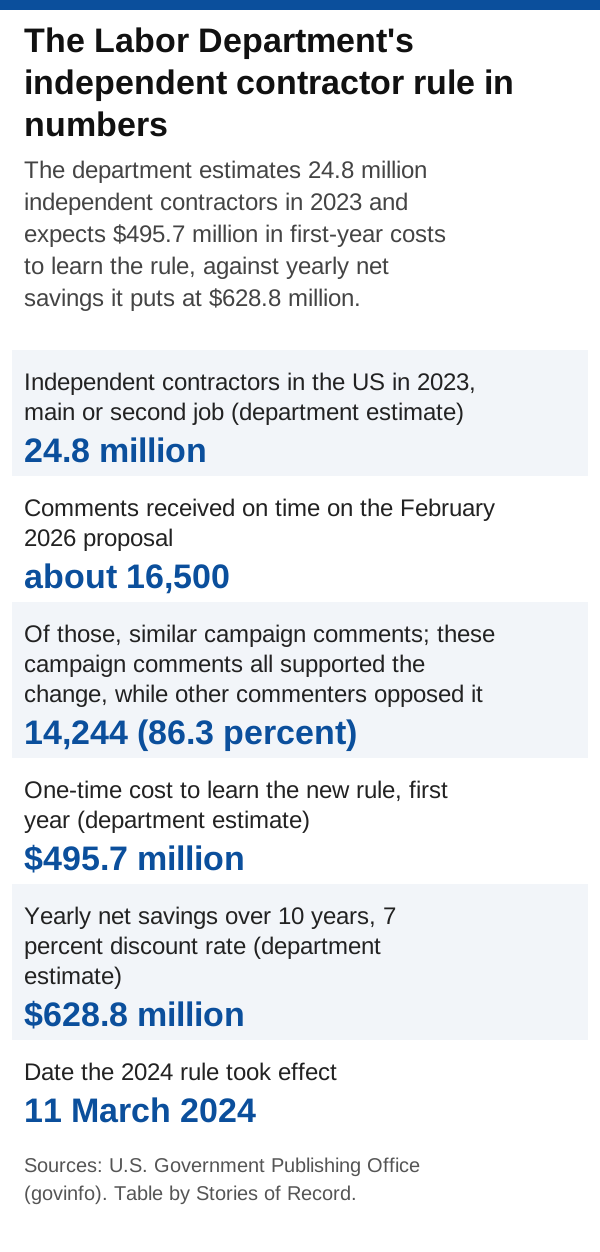
- The public comment period ran 60 days and closed on 28 April 2026. The department says it received about 16,500 comments on time. Of those, 14,244 (86.3 percent) were similar campaign comments from seven organized efforts, and those campaign comments all supported the change. Other commenters opposed it. [1]
- On 27 February 2026, the department proposed dropping the 2024 rule and returning to an approach similar to the 2021 rule. [1]
- On 10 January 2024, the department published the 2024 rule, which replaced the 2021 rule with a six-factor test in which no single factor or group of factors decides the outcome. It took effect on 11 March 2024. [1]
- The department tried in 2021 to delay and then withdraw that rule. On 14 March 2022, a federal district court in the Eastern District of Texas threw out the delay and withdrawal and said the 2021 rule had taken effect. The division then used it in enforcement for two years, the department says. [1]
- On 7 January 2021, the department published its 2021 rule. It set out five factors and made two of them, control and the chance of profit or loss, the core factors. [1]
What we know
- The basic question stays the same. A worker is an employee if, in economic reality, they depend on that employer for work, and an independent contractor if they are in business for themselves. The rule says this does not turn on how much the worker earns or whether they have other income. [1]
- Three other factors count for less: the skill the job needs, how lasting the relationship is, and whether the work is one piece of the business's own production process. Other points may be weighed only if they show whether the worker runs a business of their own. [1]
- On control, the rule says a business that requires a worker to follow the law, meet health and safety standards, carry insurance, or meet agreed deadlines or quality standards is not, by that alone, exercising employer-style control. Detailed instructions on how, when or where to do the work may still point to employment. [1]
- What the two sides actually do counts for more than what a contract says is possible. A right to work for rivals means little if the worker is in practice stopped from using it. [1]
- The same test will also decide worker status under the Family and Medical Leave Act (FMLA) and the Migrant and Seasonal Agricultural Worker Protection Act (MSPA), because both laws borrow the FLSA's definitions of employment. [1]
- After public comments, the department revised some worked examples in the rule and added six new ones covering digital platform workers, farm labor contractors and truck drivers. [1]
- The department says the 2024 test was not clear enough and could be read as setting a higher bar for independent contractor status than the law requires. It says some businesses avoided real independent contractors or hired them as employees because of that uncertainty. [1]
- The department's notice says commenters who opposed the proposal defended the 2024 rule as consistent with long-standing court precedent. It lists the United Brotherhood of Carpenters and Joiners of America among them. [1]
- Opponents also warned, according to the notice, that workers reclassified or misclassified as independent contractors because of the rule would lose protections such as the federal minimum wage, overtime pay and job-protected leave for serious medical conditions. [1]
- On 7 January 2021, the department published its 2021 rule. It set out five factors and made two of them, control and the chance of profit or loss, the core factors. [1]
- The department tried in 2021 to delay and then withdraw that rule. On 14 March 2022, a federal district court in the Eastern District of Texas threw out the delay and withdrawal and said the 2021 rule had taken effect. The division then used it in enforcement for two years, the department says. [1]
- On 10 January 2024, the department published the 2024 rule, which replaced the 2021 rule with a six-factor test in which no single factor or group of factors decides the outcome. It took effect on 11 March 2024. [1]
- Five lawsuits challenged the 2024 rule. The department says four are still pending, with proceedings paused by the courts. [1]
- On 1 May 2025, the Wage and Hour Division told its staff it would stop using the 2024 rule's test in its own investigations. That bulletin also said the 2024 rule stayed in effect for private lawsuits until further action. [1] [2]
- On 27 February 2026, the department proposed dropping the 2024 rule and returning to an approach similar to the 2021 rule. [1]
- The public comment period ran 60 days and closed on 28 April 2026. The department says it received about 16,500 comments on time. Of those, 14,244 (86.3 percent) were similar campaign comments from seven organized efforts, and those campaign comments all supported the change. Other commenters opposed it. [1]
- By the department's estimate, 24.8 million people in the US worked as independent contractors in 2023, as a main or a second job. [1]
- The department puts the one-time cost of learning the new rule at $495.7 million in the first year. Over 10 years it estimates yearly net savings of $628.8 million at a 7 percent discount rate. [1]
What we don't know yet
- How many new independent contractor jobs the rule will create is not known. The department's central estimate is 0.5 million more contractor relationships, within a range of 0.25 million to 0.75 million, and it says these estimates are subject to significant uncertainty. [1]
Why it matters
Whether you count as an employee decides whether federal law guarantees you the minimum wage and overtime pay. Under the Fair Labor Standards Act (FLSA), a business owes those to its employees but not to independent contractors. The new rule changes how the Labor Department's Wage and Hour Division weighs a working relationship. It puts the most weight on two questions: who controls the work, and whether you can make a profit or a loss through your own choices. The same test will also apply under the Family and Medical Leave Act (FMLA) and a federal law that protects farmworkers. The department says the rule gives workers and businesses a clearer test, and it estimates the change could add contractor work, while calling those estimates very uncertain. Opponents of the change, the department's notice says, warned that workers moved into contractor status would lose minimum wage, overtime and job-protected leave.
Questions
When does the new independent contractor rule take effect?
On 22 January 2027. It is scheduled to appear in the Federal Register on 23 November 2026.
What test does the rule use?
An economic reality test that asks whether you depend on the business for work or run a business of your own. Two core factors carry the most weight: control over the work and your chance of profit or loss. The skill needed, how lasting the relationship is and whether your work is one piece of the business's own production process count for less.
What does it replace?
The 2024 rule, a six-factor test in which no single factor or group of factors decides the outcome. The new rule is close to the 2021 rule, with changes and more worked examples.
Does the rule change my pay rights if I am an employee?
No. Employees are still owed the minimum wage and overtime under the FLSA. The rule changes how the department decides who counts as an employee in the first place.
Did anyone oppose the rule?
Yes. The department's notice says opponents, including the United Brotherhood of Carpenters and Joiners of America, defended the 2024 rule as consistent with court precedent. Opponents also warned that workers moved into contractor status would lose protections such as the minimum wage, overtime and job-protected leave.
Does a contract calling me an independent contractor settle it?
No. The rule says what the two sides actually do counts for more than what a contract says is possible.
Does it cover family leave and farm workers too?
Yes. The same test will decide worker status under the Family and Medical Leave Act and the Migrant and Seasonal Agricultural Worker Protection Act.
Updates
- First published.
Every version of this story, as first published.
Sources
- U.S. Government Publishing Office (govinfo) Original documentRetrieved: 21 November 2026
- U.S. Department of Labor Official (government)Retrieved: 21 November 2026
About the picture: this is an illustration made for this story with an AI image tool and checked against it. It is not a picture of the real people, places or events.
People, places and organizations
- Organization
- United States Department of Labor
- Organization
- Wage and Hour Division
- Topic
- Fair Labor Standards Act
- Topic
- Family and Medical Leave Act
Follow us on Facebook
We post new records on our Facebook Page.
Follow on Facebook