
Economy · Bank of England · Financial regulation · Banking · Insurance · Credit unions
Bank of England's PRA proposes tying 128 regulatory thresholds to UK GDP
 Illustration
The PRA is consulting on automatic, GDP-linked increases to 128 regulatory thresholds.
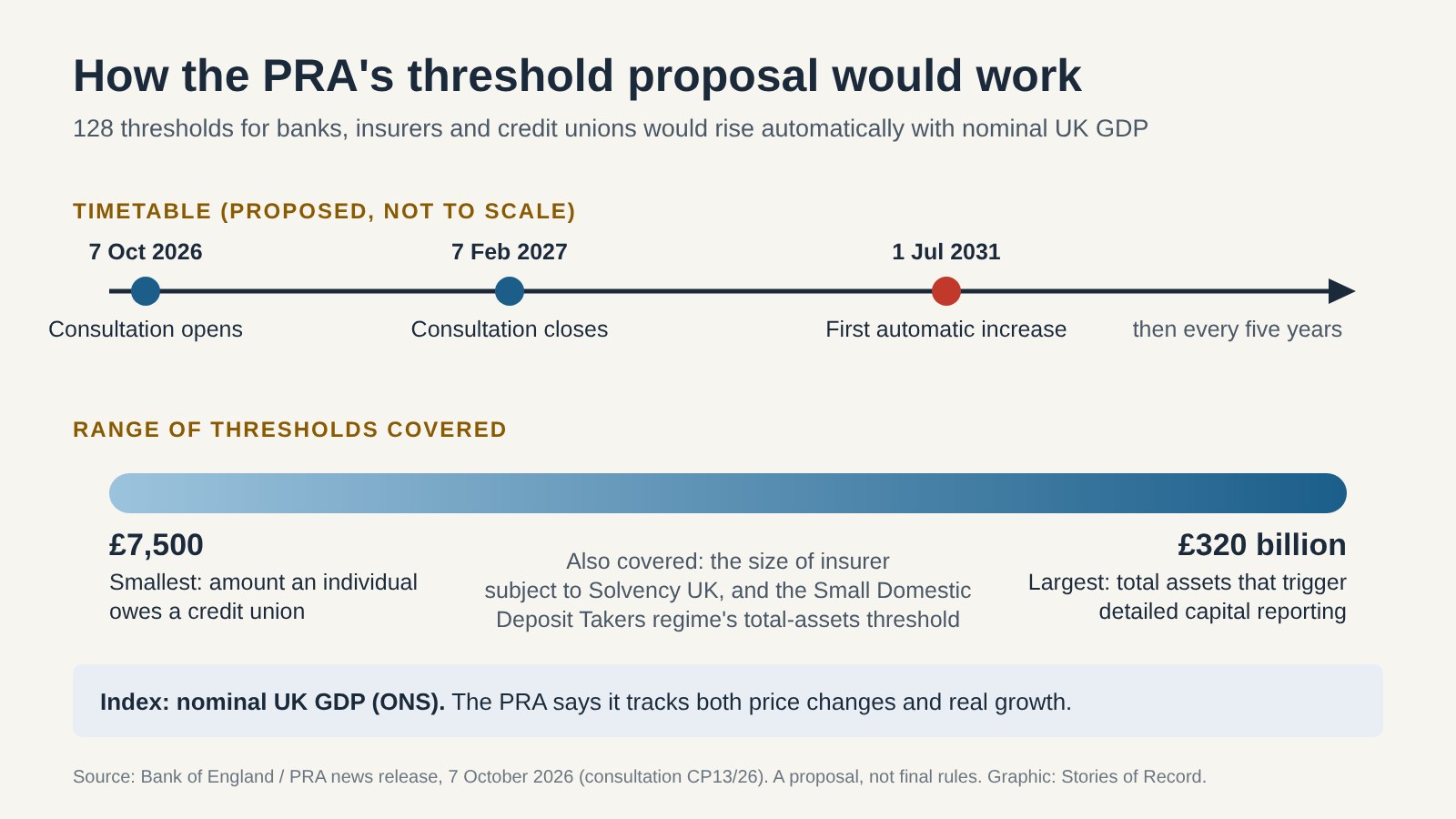
The Bank of England's Prudential Regulation Authority (PRA) proposed on Wednesday that 128 thresholds across banking, insurance and credit unions rise automatically in line with nominal UK GDP. The thresholds decide which rules apply to firms and what they must report. The first increase would take effect on 1 July 2031 and then every five years. The consultation is open until 7 February 2027.
Latest update
The PRA proposed tying 128 regulatory thresholds to nominal UK GDP, with the first increase in July 2031.
What changed in this version
Version 1, : Story created.
Key facts
- The PRA proposed that 128 regulatory thresholds for banks, insurers and credit unions should rise automatically with nominal GDP. [1]
- The first automatic increase would take effect on 1 July 2031, with further increases every five years. [1]
- Existing thresholds would not get a one-off catch-up increase. The PRA says it is not proposing a blanket, backdated uplift; indexation would start from a single fixed base year of 2026. [2]
Timeline
- The PRA proposed that 128 regulatory thresholds for banks, insurers and credit unions should rise automatically with nominal GDP. [1]
- The Bank of England took a similar approach for the total-assets thresholds in its MREL policy, published on 15 July 2025, with updates every three years and the first due in the first half of 2028. [2] [3]
What is confirmed
- The thresholds decide which regulatory rules apply to a firm, how they apply, and what the firm has to report to the PRA. [1]
- The automatic increases would replace the manual, ad hoc updates the PRA makes now. The PRA says this would make the rules more proportionate and cut compliance costs for many firms. [1]
- The largest threshold covered is £320 billion of total assets, which triggers detailed capital reporting. The smallest is a £7,500 limit on what an individual owes a credit union. [1]
- Other thresholds covered include the size at which an insurer falls under Solvency UK and the total-assets threshold for the Small Domestic Deposit Takers regime. [1]
- The PRA picked nominal UK GDP, an Office for National Statistics measure, because it moves with both prices and real growth. It says neither the Consumer Price Index nor real GDP growth reflects both. [1]
- The PRA says a five-year cycle balances the cost to firms of repeated changes against keeping thresholds in step with the economy. [1]
- The PRA expects all firms to benefit, especially small and medium-sized firms sitting just below a threshold. [1]
- Katharine Braddick, the Bank's Deputy Governor for Prudential Regulation and PRA chief executive, said the change would prevent "out of date thresholds becoming restrictive barriers to growth". [1]
- Some thresholds are left out of the proposal. Some of those, mainly ones where the PRA wants more industry views and ones it shares with the Financial Conduct Authority, are covered in a discussion paper within CP13/26 on whether they should also be indexed. [1]
- The consultation, CP13/26, opened on 7 October 2026 and closes on 7 February 2027. [1]
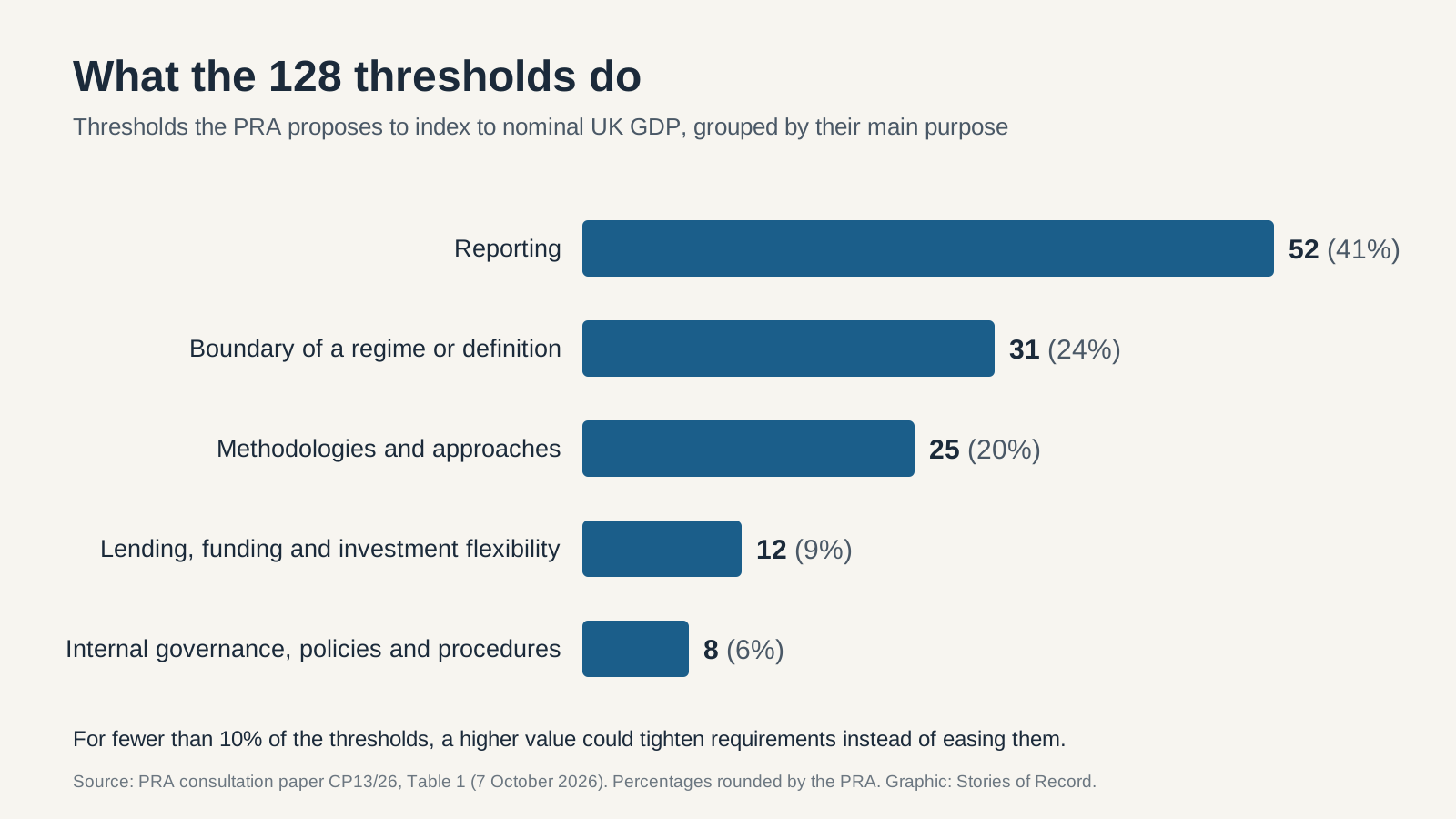
- By main purpose, the 128 thresholds break down as: 52 (41%) for reporting, 31 (24%) setting the boundary of a regime or a definition, 25 (20%) for methodologies and approaches, 12 (9%) for lending, funding and investment flexibility, and 8 (6%) for internal governance, policies and procedures. [2]
- After an initial one-off three-year indexation period, updates would recur every five years. The PRA would announce new values in advance, and firms would get six months to prepare before they take effect. [2]
- For fewer than 10% of the thresholds, raising the value could tighten requirements rather than ease them. One example is some thresholds in the UK Solvency II standard formula, where an increase could raise an insurer's Solvency Capital Requirement. [2]
- UK nominal GDP grew 85.4% in total between 2009 and 2024. The PRA found that this sat in the middle of the asset growth seen at banks and life insurers over the same period. [2]
- Using past PRA estimates, a firm that no longer has to file a whole reporting template because of indexation could save around £80 thousand a year per template. [2]
- The Bank of England took a similar approach for the total-assets thresholds in its MREL policy, published on 15 July 2025, with updates every three years and the first due in the first half of 2028. [2] [3]
What remains unconfirmed
No open questions are being tracked.
Why it matters
Fixed thresholds that are not updated pull growing firms into tougher rules even when they have only kept pace with the economy. Automatic indexation would change when banks, insurers and credit unions cross into stricter capital, reporting and solvency regimes.
What happens next
- : The PRA's consultation closes on 7 February 2027. [1]
Questions
What is the PRA proposing?
That 128 thresholds across banking, insurance and credit unions rise automatically with nominal UK GDP, instead of being updated by hand from time to time.
When would thresholds first change?
On 1 July 2031, and every five years after that, if the proposal goes ahead.
Will existing thresholds jump to catch up with past growth?
No. The PRA is not proposing a blanket, backdated uplift. Indexation would start from a fixed base year of 2026.
Could any requirements get stricter?
For fewer than 10% of the thresholds, a higher value could tighten requirements, for example some Solvency II standard formula thresholds for insurers.
Why GDP rather than inflation?
The PRA says nominal GDP captures both price changes and real growth, which the Consumer Price Index or real GDP alone would not.
Can firms respond?
Yes. The consultation is open until 7 February 2027.
Sources
- Regulatory thresholds set to shift to automatic increases, Bank of EnglandOfficial (government)Accessed 7 October 2026.
- CP13/26 – Updating regulatory thresholds: An autopilot approach, Bank of EnglandOfficial (government)Accessed 7 October 2026.
- Statement of policy: The Bank of England’s approach to setting a minimum requirement for own funds and eligible liabilities (MREL), Bank of EnglandOfficial (government)Accessed 7 October 2026.
People, places and organizations
- organization
- Prudential Regulation Authority
- organization
- Bank of England
- person
- Katharine Braddick