Transportation Department watchdog opens audit of how the FAA oversees aircraft suppliers
The Transportation Department's watchdog is starting an audit of how the FAA checks the way aircraft makers control the quality of their suppliers' parts.
The Transportation Department's inspector general opened an audit on 20 November 2026 of how the Federal Aviation Administration (FAA) oversees aircraft makers and their suppliers. It will test whether the FAA's checks on manufacturers' supplier quality systems work, for parts made in the United States and abroad. The watchdog pointed to the January 2024 Boeing 737-9 door plug incident. Its last report on this topic came out in 2008.
Key facts
- The Office of Inspector General (OIG) at the US Department of Transportation said on 20 November 2026 that it is starting an audit of how the Federal Aviation Administration (FAA) oversees aircraft makers and their suppliers. [1] [2]
- The audit will judge how well the FAA checks the quality systems that manufacturers use for their suppliers, both in the United States and abroad. [2]
- The OIG last reported on how the FAA oversees aircraft makers' suppliers on 26 February 2008, in an assessment of the agency's risk-based system for that work. [1]
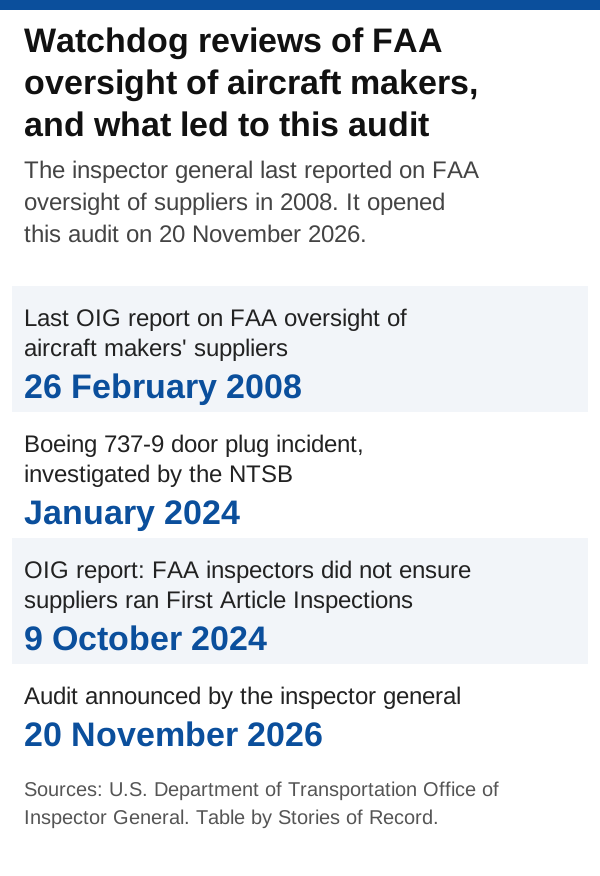
Timeline
- An earlier OIG report, dated 9 October 2024, found that FAA inspectors did not make sure suppliers carried out First Article Inspections. Those checks show whether a supplier can make parts that meet the design from the start. [1]
- In January 2024 the cabin of a Boeing 737-9 suddenly lost pressure in flight after a mid-exit door plug came off, the OIG memo says. The National Transportation Safety Board (NTSB) investigated the incident. [1]
- The OIG last reported on how the FAA oversees aircraft makers' suppliers on 26 February 2008, in an assessment of the agency's risk-based system for that work. [1]
What we know
- The watchdog started the audit on its own initiative, not at the request of Congress or the department. Its project number is 27A3003A000. [2]
- In January 2024 the cabin of a Boeing 737-9 suddenly lost pressure in flight after a mid-exit door plug came off, the OIG memo says. The National Transportation Safety Board (NTSB) investigated the incident. [1]
- According to the OIG memo, the NTSB found weaknesses in Boeing's quality assurance processes. It also found that FAA oversight of Boeing's work instructions for removing parts was not effective. [1]
- An earlier OIG report, dated 9 October 2024, found that FAA inspectors did not make sure suppliers carried out First Article Inspections. Those checks show whether a supplier can make parts that meet the design from the start. [1]
- The OIG says the FAA has recently changed how it assesses risk at manufacturers, started a new system to track its oversight, and plans to revise the model it uses to rate each manufacturer's risk. Those changes are one reason for the audit. [1]
- Under FAA rules, a manufacturer must have a quality control system for its suppliers that the FAA has approved. Companies holding FAA production approvals must make sure supplied parts and services meet their requirements, and the FAA checks that they do. [1]
- Auditors will work at FAA headquarters, at its regional offices and at other places they will pick during the audit. The memo is signed by Marshall E. Jackson, the OIG's Assistant Inspector General for Aviation Audits. [1]
What we don't know yet
- Reuters reported that the plane in the January 2024 incident was an Alaska Airlines Boeing 737. The OIG pages we read do not name the airline. [3]
Why it matters
Under FAA rules, each aircraft manufacturer must make sure that parts and services from its suppliers meet its own requirements, and the FAA is responsible for overseeing that. When that chain of checks is weak, problems can reach the planes you fly on. The watchdog says several recent reports found gaps in this oversight. They include the safety board's findings on the door plug incident and its own finding that FAA inspectors did not make sure suppliers ran first-article checks. Its last report on supplier oversight came out in 2008. This audit will look at how well the FAA does the job today, for suppliers in the United States and abroad.
Questions
What is the inspector general auditing?
How well the FAA oversees the quality systems aircraft manufacturers use for their suppliers, both in the United States and abroad.
Why now?
The watchdog cites recent reports of weak oversight, including the NTSB's findings on the January 2024 door plug incident, recent changes in how the FAA assesses manufacturers, and the fact that its last report on supplier oversight was in 2008.
Is this about Boeing only?
No. The audit covers FAA oversight of aircraft manufacturers in general. The memo names Boeing when it describes the earlier NTSB and OIG findings.
When does the audit start?
The OIG says it plans to begin in the month after the announcement, starting with an opening meeting with the FAA. It has not given an end date.
What has the FAA said?
The OIG pages we read do not include an FAA response, and we have not seen one we can cite yet.
What is still unknown?
When the audit will end, which sites and suppliers the auditors will visit, and what they will find. The OIG says some locations will be chosen during the audit.
Updates
- First published.
Every version of this story, as first published.
Sources
- U.S. Department of Transportation Office of Inspector General Official (government)Retrieved: 21 November 2026
- U.S. Department of Transportation Office of Inspector General Official (government)Retrieved: 21 November 2026
- Reuters News organizationPublished: 20 November 2026Reported by Reuters; credited as reported, not opened by us
About the picture: this is a stock photo from Storyblocks. It does not show the people, places or events in this story.
People, places and organizations
- Organization
- U.S. Department of Transportation Office of Inspector General
- Organization
- Federal Aviation Administration
- Organization
- National Transportation Safety Board
- Organization
- Boeing
Follow us on Facebook
We post new records on our Facebook Page.
Follow on Facebook