House version of the college sports bill would let top conferences grow to 22 schools, not 20
The House has published its own version of the Senate-passed college sports bill, with a higher size limit and a lower revenue line for the top conferences.

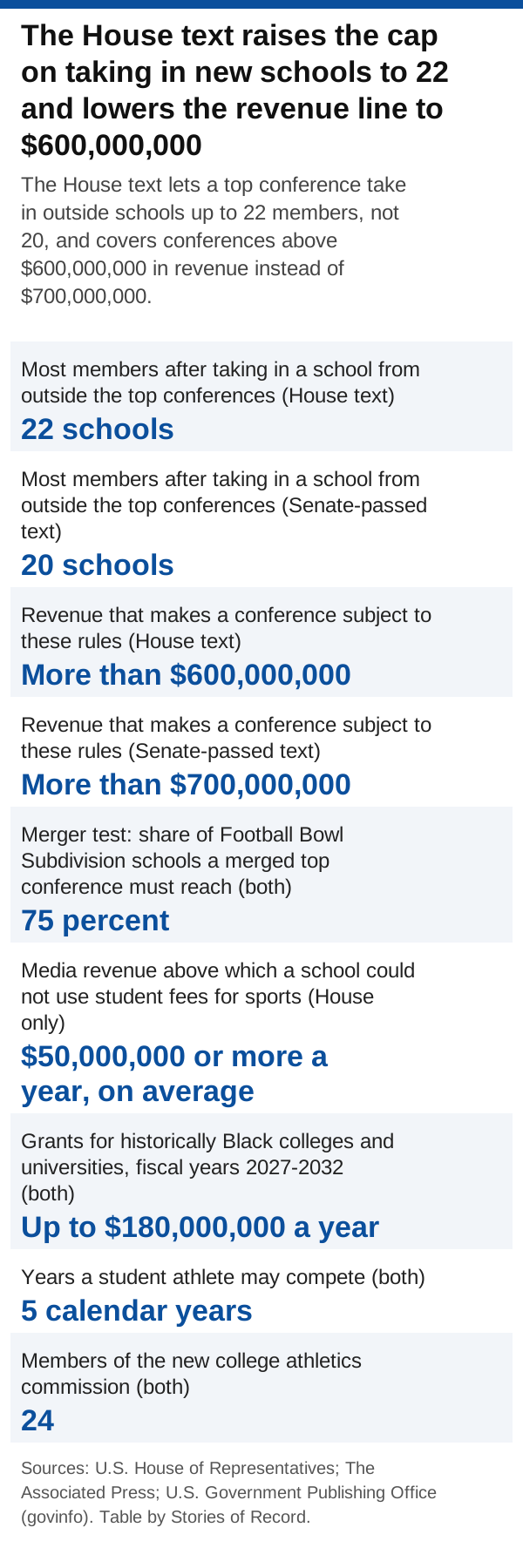
House lawmakers have released their version of the Protect College Sports Act, which the Senate passed on 28 September 2026. Under the House text, published on 20 November 2026, a top football conference could take in schools from outside the top conferences until it reached 22 members. The Senate version sets that limit at 20. Mergers between top conferences fall under a separate rule. The bill is not law yet.
Key facts
- On 20 November 2026 the House Rules Committee published Rules Committee Print 119-42, the full text the House would put in place of the Senate bill S. 4668. AP reported that House lawmakers released the revised bill that day. [1] [2]
- Under the House text, a football conference that reported more than $600,000,000 in revenue on its 2025 tax return, or any later one, could take in a school from outside the top conferences only if it still had no more than 22 members afterwards. AP also reported the House limit of 22 schools. [1] [2]
- The Senate-passed version sets that limit at 20 members and applies it to conferences that reported more than $700,000,000 in revenue on their 2025 tax return or a later one. AP reported the 20-school limit in the Senate version. [3] [2]
Timeline
- The Senate passed the bill on 28 September 2026, according to the text it sent to the House. [3]
- Senator Cruz introduced the bill on 2 June 2026, with Senators Cantwell, Schmitt and Coons, and it went to the Senate Committee on Commerce, Science, and Transportation. [4]
What we know
- The House text lowers the revenue line that decides which conferences these rules cover, from more than $700,000,000 in the Senate-passed version to more than $600,000,000. More conferences could fall under the rules as a result. [3] [1]
- Mergers between top conferences fall under a separate rule in both versions. A top conference may not merge with, or buy the assets or media rights of, another top conference or one of its schools if it would then have fewer members than 75 percent of the schools in the Football Bowl Subdivision, the top level of college football. [1] [3]
- Both versions would also make it unlawful under antitrust law for anyone to combine schools from the richest conferences to create a new conference. A deal that breaks these rules would be void, and the parties could not defend it by pointing to efficiencies or other benefits to competition. [3] [1]
- The House text adds a section on student athletic fees that the Senate bill does not have. Colleges would have to publish, every year, how much they charge students in fees for sports and what the money pays for. That duty would start on 1 July 2027 if the bill becomes law. [1] [3]
- Under the same House section, a school whose media rights revenue averages $50,000,000 or more could not use student fees to pay for its sports programs. Schools would first work out that average in the academic year starting in 2029. [1]
- Both versions would set aside up to $180,000,000 a year, in fiscal years 2027 through 2032, for grants to historically Black colleges and universities (HBCUs) to improve broadband, media and sports broadcast facilities. [3] [1]
- Both versions would limit a student athlete in Division I or Division II to 5 calendar years of competition, with some periods of absence not counted. [1] [3]
- Both versions would set up a Congressional Commission on the Future of College Athletics with 24 members to make recommendations on the future of college sports. [1] [3]
- The Senate passed the bill on 28 September 2026, according to the text it sent to the House. [3]
- Senator Cruz introduced the bill on 2 June 2026, with Senators Cantwell, Schmitt and Coons, and it went to the Senate Committee on Commerce, Science, and Transportation. [4]
What we don't know yet
- AP described the conferences the cap would cover as the major college sports conferences. Neither bill text names any conference; the cap turns on reported revenue, and we have not seen the tax returns that would show which conferences are above the line. [2]
Why it matters
Conference size decides which schools play each other, share television money and compete for the top football places. A cap written into federal law would limit how far the biggest conferences can grow, and the House and Senate now disagree on where that limit sits. If you are a student at a school with large media deals, the House text could also change your fees. It would make colleges show how much of those fees pays for sports, and it would stop the highest-earning schools from using them for sports at all.
Questions
What is the difference between the House and Senate limits on conference size?
Both limit how far a top football conference can grow by taking in schools from outside the top conferences. The House text sets that limit at 22 members; the Senate-passed version sets it at 20. Mergers between top conferences fall under a separate rule.
Which conferences does the limit apply to?
Under the House text, football conferences that reported more than $600,000,000 in revenue on their 2025 tax return or a later one. The Senate-passed text uses a higher line: more than $700,000,000.
Is the Protect College Sports Act law yet?
No. The Senate passed its version on 28 September 2026. The House has published its own text but has not voted on it, and both chambers would have to agree on the same text before it could become law.
What else is new in the House version?
A section on student athletic fees. Colleges would have to publish what they charge students for sports and how the money is used, and schools with media rights revenue averaging $50,000,000 or more could not use student fees for sports.
What happens next?
The House Rules Committee has set noon on 25 November 2026 as the deadline for amendments. It has not announced a date for a House vote.
Updates
- First published.
Every version of this story, as first published.
Sources
- U.S. House of Representatives Official (government)Retrieved: 21 November 2026
- The Associated Press News organizationPublished: 20 November 2026Reported by The Associated Press; credited as reported, not opened by us
- U.S. Government Publishing Office (govinfo) Original documentRetrieved: 21 November 2026
- U.S. Government Publishing Office (govinfo) Original documentRetrieved: 21 November 2026
- U.S. House of Representatives Official (government)Published: 19 November 2026Retrieved: 21 November 2026
About the picture: this is a stock photo from Storyblocks. It does not show the people, places or events in this story.
People, places and organizations
- Organization
- United States Congress
- Organization
- House Committee on Rules
- Organization
- United States Senate
- Topic
- Protect College Sports Act of 2026 (S. 4668)
Follow us on Facebook
We post new records on our Facebook Page.
Follow on Facebook