Fifth Circuit rules House proxy quorum unconstitutional, keeps Pregnant Workers Fairness Act blocked for Texas
The full Fifth Circuit has kept federal agencies from enforcing the Pregnant Workers Fairness Act against Texas, ruling that the House's December 2022 proxy quorum was unconstitutional.

The full Fifth Circuit appeals court ruled 9–8 on 20 November that the House broke the Constitution by counting absent members as present by proxy when it passed a 2022 spending law. As a result, the federal government still cannot enforce the Pregnant Workers Fairness Act (PWFA) against the State of Texas. The court said its order covers that one law and Texas alone.
Key facts
- On 20 November 2026 the full U.S. Court of Appeals for the Fifth Circuit held that the House broke the Constitution's Quorum Clause when it passed the Consolidated Appropriations Act of 2023 by counting absent members as present through proxies. [1]
- The court upheld a lower-court order that bars the federal government from enforcing the Pregnant Workers Fairness Act (PWFA) against the State of Texas. [1] [2] [3]
- The majority stressed that the order is narrow. It blocks only enforcement of the PWFA, only against Texas, and the court said its decision goes no further than upholding that relief. [1]
Timeline
- On 20 November 2026 the full U.S. Court of Appeals for the Fifth Circuit held that the House broke the Constitution's Quorum Clause when it passed the Consolidated Appropriations Act of 2023 by counting absent members as present through proxies. [1]
- In 2026 the full Fifth Circuit agreed to rehear the case and set aside the panel's opinion. [1]
- In 2025 a divided panel of the Fifth Circuit reversed that ruling and lifted the order, finding that the Quorum Clause does not require members to be physically present. [1]
- In 2024 the federal trial court in the Northern District of Texas ruled for Texas after a bench trial and issued a permanent order against enforcing the PWFA against the State. It did not block the rest of the act. [1]
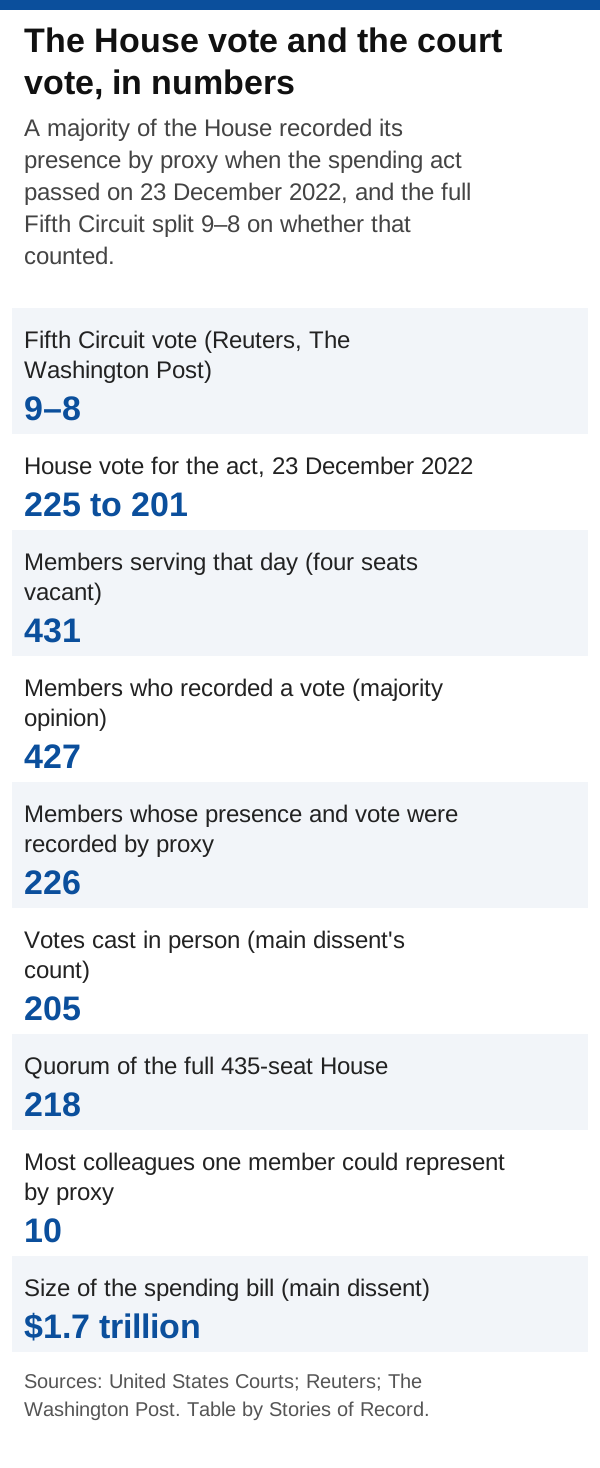
- The House passed the spending act on 23 December 2022 by 225 votes to 201, with one member voting present and four not voting. There were 431 members serving that day because of four vacancies. [1]
- The House kept the proxy rule for the 117th Congress in 2021. [1]
- On 15 May 2020, early in the COVID-19 pandemic, the House adopted House Resolution 965. It let a member act as proxy for an absent colleague, casting that colleague's vote or recording their presence, and counted those members toward a quorum. No member could hold proxies for more than 10 colleagues at once. [1]
What we know
- The judges split 9–8, Reuters and The Washington Post reported. The opinion lists Judge Cory T. Wilson as its author, joined by Chief Judge Elrod and seven other judges, with eight judges dissenting. [2] [3] [1]
- Texas is affected as an employer. The trial court found the law harmed the State through compliance costs as a regulated employer, the cost of defending federal investigations and lawsuits, and the loss of its immunity from suit. [1]
- On 15 May 2020, early in the COVID-19 pandemic, the House adopted House Resolution 965. It let a member act as proxy for an absent colleague, casting that colleague's vote or recording their presence, and counted those members toward a quorum. No member could hold proxies for more than 10 colleagues at once. [1]
- The House kept the proxy rule for the 117th Congress in 2021. [1]
- The House passed the spending act on 23 December 2022 by 225 votes to 201, with one member voting present and four not voting. There were 431 members serving that day because of four vacancies. [1]
- Of the 427 members who recorded a vote, 226 did so by proxy, a majority of the House, so fewer than half were physically in the chamber. The opinion says neither side disputes that a quorum existed only because proxies were counted. [1]
- The main dissent counts the same vote differently: 431 votes, 205 cast in person and 226 by proxy, against a quorum of 218 in a House of 435. [1]
- During the vote, Representative Chip Roy said no physical quorum was present and reserved the right to object. The presiding officer, Representative G.K. Butterfield, answered that under House rules a quorum was present, the opinion records. [1]
- After the Senate approved it too, the bill became law with the President's signature in 2022. The main dissent calls it a funding bill worth $1.7 trillion. [1]
- Texas sued to block two parts of the act: the PWFA and a $20 million payment to a Department of Homeland Security pilot program on alternatives to detention. The trial court found Texas had standing to challenge only the PWFA. [1]
- In 2024 the federal trial court in the Northern District of Texas ruled for Texas after a bench trial and issued a permanent order against enforcing the PWFA against the State. It did not block the rest of the act. [1]
- In 2025 a divided panel of the Fifth Circuit reversed that ruling and lifted the order, finding that the Quorum Clause does not require members to be physically present. [1]
- In 2026 the full Fifth Circuit agreed to rehear the case and set aside the panel's opinion. [1]
- The federal government argued that courts could not review the vote at all because of the enrolled-bill rule. Under that rule, a bill signed by the presiding officers of both chambers is treated as conclusive proof that it is genuine. As a fallback, it argued that the Quorum Clause allows presence by proxy, and it warned that a ruling for Texas would put the whole act at risk. [1]
- The majority rejected the enrolled-bill argument because Texas did not dispute any facts about how the bill passed, only what the Constitution requires. The main dissent agreed on that point. [1]
- The majority said the Constitution's text and history, and a Supreme Court ruling from 1892, show that members must actually be present to make up a quorum. In its words, "“Proxy presence” does not count." [1]
- Judge James E. Graves Jr. wrote the main dissent, joined by six judges. He argued that the Constitution's text, past practice and the framers' intent do not support a physical-presence rule, and that Congress used its power to set its own procedures during a pandemic. He called the majority's decision "illogical, inexplicable, and invalid." [1]
- The dissent also asked why, if the whole act was passed unconstitutionally, the judgment should cover only one small part of it. [1]
- Judge Haynes dissented in a short separate note, saying she did not think it right to throw out the House's action in this area. [1]
What we don't know yet
- The dissenting judges say Texas accepted millions of dollars under the same spending act while challenging one part of it. That is their description; the majority opinion does not make a finding on it. [1]
Why it matters
If you work for the State of Texas, federal agencies cannot enforce the PWFA against your employer while this order stands. The federal defendants include the Equal Employment Opportunity Commission (EEOC) and the Justice Department. For everyone else, the order itself does not apply. The court said it covers only enforcement of that one law, and only against Texas, and that its decision goes no further. The ruling also touches how Congress works. The majority said members must be physically present to count toward a quorum. The dissenting judges said the Constitution leaves that to each chamber's own rules.
Questions
What did the Fifth Circuit decide?
That the House could not count absent members as present by proxy to reach a quorum, so its passage of the Consolidated Appropriations Act of 2023 broke the Constitution's Quorum Clause. It upheld the trial court's order for Texas.
Who is covered by the order?
Only the State of Texas. The federal government may not enforce the Pregnant Workers Fairness Act against Texas, which the trial court found was harmed as a regulated employer.
Does this change the law for private employers or other states?
The order does not reach them. The court said the relief covers only enforcement of the PWFA against Texas and that its decision goes no further than upholding that relief.
What was the proxy rule?
House Resolution 965, adopted on 15 May 2020 during the COVID-19 pandemic. It let one member cast the vote or record the presence of an absent colleague, and counted those absent members toward a quorum.
How many members voted by proxy on the spending act?
226, according to the Congressional Record as cited in the opinion. The House passed the act 225 to 201 on 23 December 2022.
What was the government's main argument?
That the enrolled-bill rule kept courts from reviewing how the bill passed, and, failing that, that the Quorum Clause allows presence by proxy. The majority rejected both, and the main dissent agreed that the court could review the case.
Who dissented?
Eight judges. Judge James E. Graves Jr. wrote the main dissent, joined by six colleagues, and Judge Haynes added a short note of her own.
Is the whole spending law now void?
The majority held that the House passed it in violation of the Quorum Clause, but it said its decision goes no further than the Texas order. The dissent asked why, on that reasoning, only one small part of the law was affected.
What happens next?
Neither the opinion nor the reports we cite name a next step or a date. We will add one here if it is announced.
Updates
- First published.
Every version of this story, as first published.
Sources
- United States Courts Court documentRetrieved: 21 November 2026
- Reuters News organizationPublished: 21 November 2026Reported by Reuters; credited as reported, not opened by us
- The Washington Post News organizationPublished: 21 November 2026Reported by The Washington Post; credited as reported, not opened by us
About the picture: this is a stock photo from Storyblocks. It does not show the people, places or events in this story.
People, places and organizations
- Organization
- U.S. Court of Appeals for the Fifth Circuit
- Organization
- State of Texas
- Organization
- U.S. House of Representatives
- Organization
- U.S. Equal Employment Opportunity Commission
- Topic
- Pregnant Workers Fairness Act
- Person
- Cory T. Wilson
- Person
- James E. Graves Jr.
Follow us on Facebook
We post new records on our Facebook Page.
Follow on Facebook