US AI chip export licences for China: House records, and Huang back at Nvidia
Nvidia's board has reinstated Jensen Huang as chief executive, while Treasury Secretary Scott Bessent says officials have contacted the company about its AI chip sales to China.
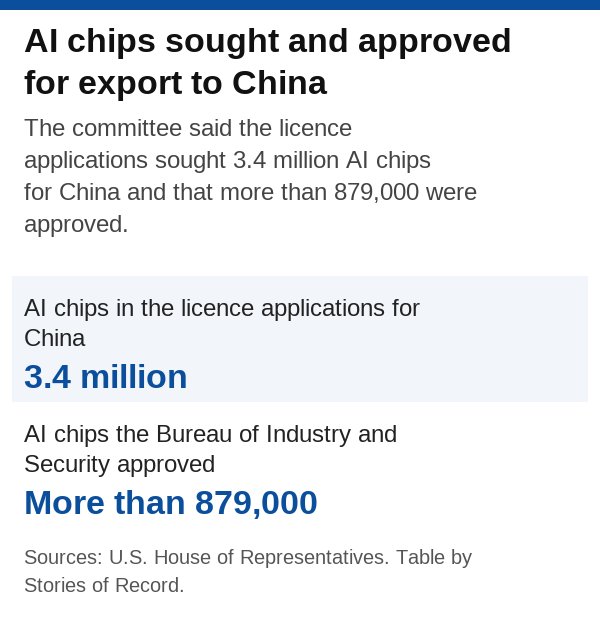
On 19 November, the House Foreign Affairs Committee made public licence records for artificial intelligence (AI) chips made by Nvidia and Advanced Micro Devices (AMD) and bound for China. The committee said the applications sought to sell 3.4 million chips, and that the Commerce Department approved more than 879,000. The Washington Post and Reuters reported that approved buyers included companies the Pentagon links to China's military.
Latest
Nvidia's board reinstated Jensen Huang as president and chief executive on 22 November, the company said in a filing with the Securities and Exchange Commission. Colette Kress stays on as chief financial officer, the filing says. She had been interim chief executive, as The Associated Press (AP) and Reuters reported. President Donald Trump said the US government had no reason to think Huang's return was a risk to national security, AP and Reuters reported. None of this establishes that Huang or anyone else at Nvidia was responsible for any compliance failure.
Key facts
- On 19 November, Representative Brian Mast, who chairs the House Foreign Affairs Committee, used his powers under the Export Control Reform Act to make public licence application records for Nvidia and Advanced Micro Devices (AMD) AI chips bound for China, the committee said. The Washington Post and Reuters also reported the release. [1] [2] [3]
- The committee said the applications sought to sell 3.4 million AI chips to China, and that the Commerce Department's Bureau of Industry and Security (BIS) approved more than 879,000 of them. [1]
Timeline
- On 22 November, Treasury Secretary Scott Bessent said the administration has contacted Nvidia's "interim management", directors and lawyers over the company's chip sales to China, as reported by CBS News and Reuters. Officials still want to learn who at Nvidia is in charge of compliance, he said. This is Bessent's own account. It does not establish that Nvidia did anything improper. [7] [8]
- On 22 November, Treasury Secretary Scott Bessent was asked whether Jensen Huang should return to lead Nvidia. In reply, he said he wanted to learn who at Nvidia had been in charge of compliance, CBS News and Reuters reported. Both outlets also reported that President Donald Trump has said he would like Huang to come back. These are Bessent's and Trump's own comments. They do not establish that Huang or anyone else at Nvidia was responsible for any compliance failure. [7] [8]NEW
- On 22 November, Nvidia's board reinstated Jensen Huang as president and chief executive, and as a board member, with immediate effect, the company said in a filing with the Securities and Exchange Commission (SEC). The Associated Press (AP) and Reuters reported his return on 23 November. [9] [10] [11]
- On 20 November, Treasury Secretary Scott Bessent told CNBC he expected US policy on Nvidia H200 sales to China to stay as it is, and said he saw the current restrictions as enough, AP reported. [4]
- On 19 November, Representative Brian Mast, who chairs the House Foreign Affairs Committee, used his powers under the Export Control Reform Act to make public licence application records for Nvidia and Advanced Micro Devices (AMD) AI chips bound for China, the committee said. The Washington Post and Reuters also reported the release. [1] [2] [3]
- On 19 November, two Democrats on the House Foreign Affairs Committee, Representatives Gregory Meeks and Sydney Kamlager-Dove, wrote to Commerce Secretary Howard Lutnick. They asked how his department handled an inquiry into Megaspeed, a data centre company in Singapore, and about Nvidia's contact with the investigators. Meeks is the committee's ranking member, its most senior minority-party member. Reuters also reported the letter. [5] [6]
What we know
- The approvals included Chinese companies that the Pentagon has listed as tied to China's military, according to the committee, The Washington Post and Reuters. The committee named Alibaba and Tencent as two such companies. [1] [2] [3]
- On 19 November, two Democrats on the House Foreign Affairs Committee, Representatives Gregory Meeks and Sydney Kamlager-Dove, wrote to Commerce Secretary Howard Lutnick. They asked how his department handled an inquiry into Megaspeed, a data centre company in Singapore, and about Nvidia's contact with the investigators. Meeks is the committee's ranking member, its most senior minority-party member. Reuters also reported the letter. [5] [6]
- The lawmakers said they were writing after a New York Times report on 9 November about the way the department dealt with the Megaspeed inquiry. [5]
- The letter lists 10 questions. Among them, the lawmakers ask whether Jeffrey Kessler, the Under Secretary for Industry and Security, authorised Nvidia to contact the investigators directly, whether Nvidia was given any non-public information about the inquiry, and whether the bureau halted or suspended it. They also ask whether Lutnick himself had any contact with Nvidia's leaders or representatives about the inquiry. [5] [6]
- The two lawmakers asked the department to send written answers and the relevant documents by 1 December 2026. [5] [6]
- On 22 November, Treasury Secretary Scott Bessent said the administration has been in touch with Nvidia's interim leadership, its directors and its lawyers over the company's chip sales to China, as reported by CBS News and Reuters. Officials still want to learn who at Nvidia is in charge of compliance, he said. This is Bessent's own account. It does not establish that Nvidia did anything improper. [7] [8]
- On 22 November, Nvidia's board reinstated Jensen Huang as president and chief executive, and as a board member, with immediate effect, the company said in a filing with the Securities and Exchange Commission (SEC). The Associated Press (AP) and Reuters reported his return on 23 November. [9] [10] [11]
- Colette Kress stays on as Nvidia's executive vice president and chief financial officer, the filing says. She had been interim chief executive, AP and Reuters reported. [9] [10] [11]
- President Donald Trump said the US government had no reason to think Huang's return was a risk to national security, AP and Reuters reported. This is Trump's own statement. [10] [11]
What we don't know yet
- The Washington Post reported that the records cover export licences and do not show how many chips reached each buyer. [2]
- Nvidia said it had stopped sending its H200 chips to China, The Washington Post reported. [2]
- On 20 November, Treasury Secretary Scott Bessent told CNBC he expected US policy on Nvidia H200 sales to China to stay as it is, and said he saw the current restrictions as enough, AP reported. [4]
Earlier reports we have updated
- Updated 23 November 2026: Nvidia's board reinstated Huang as chief executive on 22 November, its filing says. Bessent's answer stays in the timeline. See What we know.Earlier we wrote:
On 22 November, Treasury Secretary Scott Bessent was asked whether Jensen Huang should return to lead Nvidia. In reply, he said he wanted to learn who at Nvidia had been in charge of compliance, CBS News and Reuters reported. Both outlets also reported that President Donald Trump has said he would like Huang to come back. These are Bessent's and Trump's own comments. They do not establish that Huang or anyone else at Nvidia was responsible for any compliance failure.[7] [8]
Why it matters
The US government decides through export licences which foreign buyers may get its most advanced AI chips. These licence decisions are usually kept private. The committee's release gives the public a rare look at how many chips US officials cleared for China, and for which kinds of buyers. The records cover approvals, not shipments. The Washington Post reported that they do not show how many chips each buyer actually received. Licences decide who may buy the chips. Enforcement checks that the rules are kept. The letter from the committee's Democrats asks how the Commerce Department handled one such inquiry and what part Nvidia played in it. It asks questions; it does not establish that anyone acted improperly.
Questions
What did the House committee release?
Licence application records for Nvidia and Advanced Micro Devices (AMD) AI chips bound for China. The committee's chairman, Representative Brian Mast, released them on 19 November under the Export Control Reform Act, the committee said.
How many chips did the US approve for China?
The committee said the applications sought to sell 3.4 million AI chips to China and that the Bureau of Industry and Security (BIS) approved more than 879,000.
Did all of the approved chips reach China?
That is not known. The Washington Post reported that the records cover licences and do not show how many chips reached each buyer.
Which buyers were approved?
The committee, The Washington Post and Reuters said the approvals included Chinese companies the Pentagon links to China's military. The committee named Alibaba and Tencent.
Is Nvidia still shipping H200 chips to China?
Nvidia said it had stopped, The Washington Post reported. On 20 November, Treasury Secretary Scott Bessent told CNBC he expected US policy on those sales to stay as it is, AP reported.
Has the administration contacted Nvidia about its sales to China?
Yes, according to Treasury Secretary Scott Bessent. On 22 November he said the administration had been in touch with the company's interim leadership, its directors and its lawyers. He said officials also wanted to find out who at Nvidia is in charge of compliance, CBS News and Reuters reported. This is his account. It does not establish that Nvidia did anything improper.
What are House Democrats asking the Commerce Department about Nvidia?
On 19 November, Representatives Gregory Meeks and Sydney Kamlager-Dove asked Commerce Secretary Howard Lutnick whether a department official let Nvidia contact the investigators in an inquiry into Megaspeed, a data centre company in Singapore. They asked for answers by 1 December. Their letter asks questions. It does not establish that anything improper happened.
Is Jensen Huang back in charge of Nvidia?
Yes. Nvidia's board reinstated him as president and chief executive on 22 November, the company said in a filing with the Securities and Exchange Commission. Colette Kress stays on as chief financial officer, the filing says. She had been interim chief executive, as AP and Reuters reported.
What did Bessent and Trump say about Huang's return?
On 22 November, Treasury Secretary Scott Bessent was asked whether Huang should come back to lead Nvidia. He answered that he wanted to learn who at Nvidia had been in charge of compliance, CBS News and Reuters reported. Separately, President Donald Trump said the US government had no reason to think his return was a risk to national security, AP and Reuters reported. These are their own comments. They do not establish that Huang or anyone else at Nvidia was responsible for any compliance failure.
Updates
- Adds Nvidia's decision to reinstate Jensen Huang as chief executive on 22 November, and President Donald Trump's reported remark on his return.
- Adds Treasury Secretary Scott Bessent's 22 November answer on whether Jensen Huang should return to lead Nvidia, and President Donald Trump's reported wish for Huang to come back.
- Adds Treasury Secretary Scott Bessent's account of the administration's contact with Nvidia over chip sales to China.
- Adds a letter from two House Democrats asking the Commerce Department about Nvidia's contact with investigators in an export inquiry.
- First published.
What earlier versions said
- No longer listed as confirmedRead that version
Before: On 22 November, Treasury Secretary Scott Bessent was asked whether Jensen Huang should return to lead Nvidia. In reply, he said he wanted to learn who at Nvidia had been in charge of compliance, CBS News and Reuters reported. Both outlets also reported that President Donald Trump has said he would like Huang to come back. These are Bessent's and Trump's own comments. They do not establish that Huang or anyone else at Nvidia was responsible for any compliance failure.
Every version of this story, as first published.
Sources
- U.S. House of Representatives Official (government)Published: 19 November 2026Retrieved: 21 November 2026
- The Washington Post News organizationPublished: 20 November 2026Reported by The Washington Post; credited as reported, not opened by us
- Reuters News organizationPublished: 19 November 2026Reported by Reuters; credited as reported, not opened by us
- The Associated Press News organizationPublished: 20 November 2026Reported by The Associated Press; credited as reported, not opened by us
- U.S. House of Representatives Official (government)Retrieved: 22 November 2026
- Reuters News organizationPublished: 20 November 2026Reported by Reuters; credited as reported, not opened by us
- CBS News News organizationPublished: 22 November 2026Reported by CBS News; credited as reported, not opened by us
- Reuters News organizationPublished: 22 November 2026Reported by Reuters; credited as reported, not opened by us
- U.S. Securities and Exchange Commission Official (government)Retrieved: 23 November 2026
- The Associated Press News organizationPublished: 23 November 2026Reported by The Associated Press; credited as reported, not opened by us
- Reuters News organizationPublished: 23 November 2026Reported by Reuters; credited as reported, not opened by us
About the picture: this is an illustration made for this story with an AI image tool and checked against it. It is not a picture of the real people, places or events.
People, places and organizations
- Organization
- House Foreign Affairs Committee
- Organization
- United States Department of Commerce
- Organization
- Bureau of Industry and Security
- Organization
- Nvidia
- Organization
- AMD
- Person
- Brian Mast
- Person
- Scott Bessent
Related stories
Follow us on Facebook
We post new records on our Facebook Page.
Follow on Facebook