Germany's minimum apprentice pay: 764 euros a month for 2027 starters, and why the start year decides
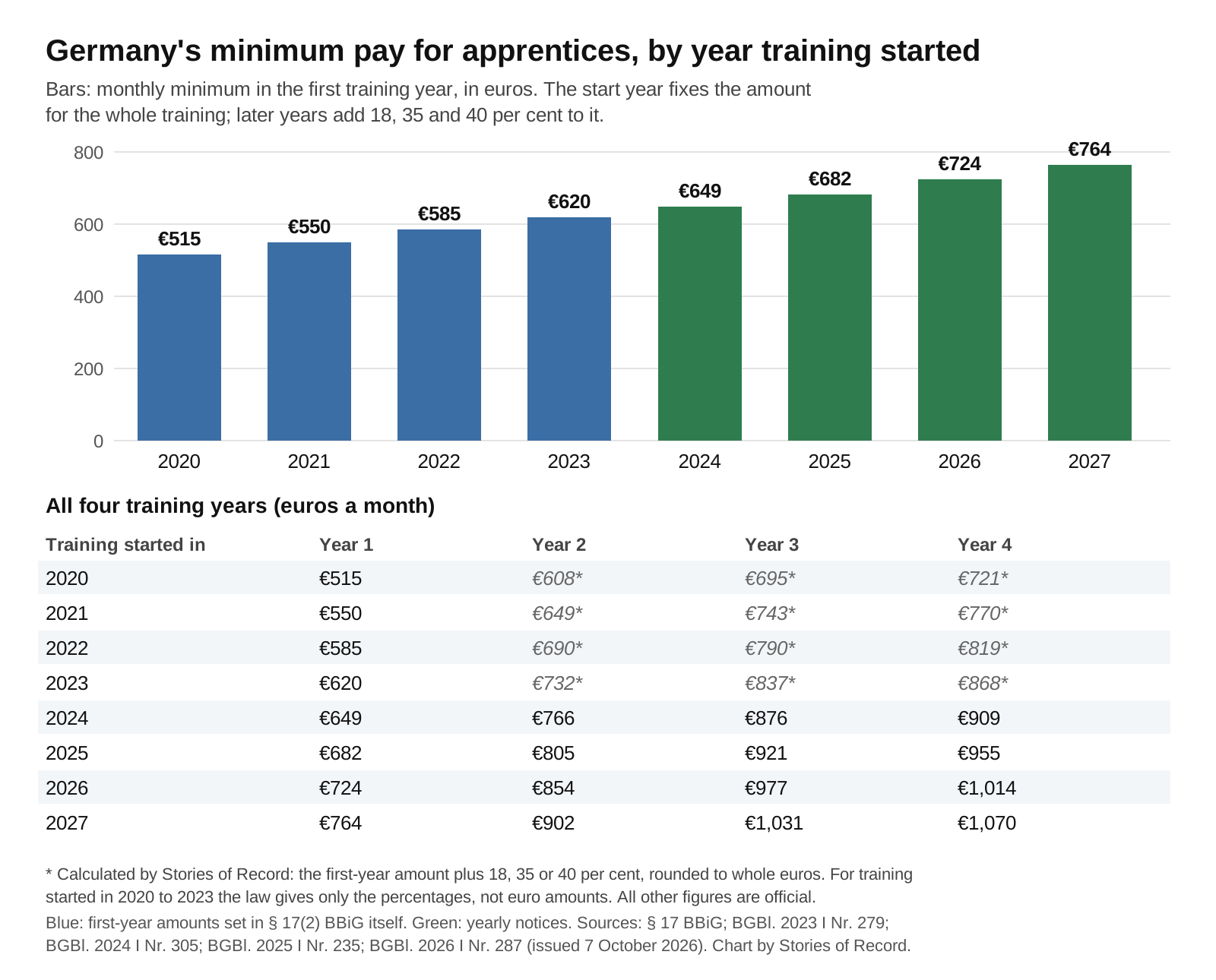
Germany's Vocational Training Act sets a minimum monthly allowance for apprentices, and the amount is fixed by the year the training started. For 2027 starters it is 764 euros in the first year, up from 724 euros for 2026 starters and 515 euros for 2020 starters. The second, third and fourth years add 18, 35 and 40 per cent to the start-year amount, so a trainee keeps the figures of the year they began.
 Illustration
Apprentices who start training in 2027 must be paid at least 764 euros a month in their first year, under a notice issued on 7 October 2026.
- Last changed:
Work out the minimum monthly training allowance
This calculator has not been re-verified recently, so it is switched off rather than risk showing an old amount. Read § 17 of the Vocational Training Act (BBiG).
| Training year | Euro a month | How it is set |
|---|
The minimum depends on the year the training started, not on the current year: a trainee who started in 2025 keeps the 2025 amounts in every later training year. Years 2, 3 and 4 are the first-year amount plus 18%, 35% and 40% (§ 17(2) BBiG).
- Collective agreements (§ 17(3)): a collective agreement that binds the employer may set pay below the minimum, and after it expires it still counts for existing trainees until a new agreement replaces it.
- The 20% rule (§ 17(4)): even above the minimum, pay is normally not appropriate if it is more than 20% below a collective agreement covering the training that the employer is not bound by.
- Part-time training (§ 17(5)): pay may be lower, but not cut by a larger percentage than the daily or weekly hours.
First-year amounts for 2020–2023 from § 17(2) BBiG, which does not itself round years 2 to 4 for those start years; they are shown worked out and rounded as the law requires from 2024 (below 50 cents down, from 50 cents up). Amounts for later start years as stated in the yearly notices in the Federal Law Gazette, cited on this page. Rule version: § 17 BBiG and the yearly notices up to BGBl. 2026 I Nr. 287 of 30 September 2026 (training started in 2027). Amounts checked against the law and the notices on 11 October 2026; values from version 1 of this record, last verified 11 October 2026. Information, not legal advice.
Latest update
On 7 October 2026 the Federal Law Gazette published the 2027 figures: at least 764 euros a month in the first year for training that starts in 2027, up from 724 euros for 2026 starters.
What changed in this version
Version 1, : Story created.
Key facts
- For training that starts between 1 January and 31 December 2027, the monthly minimum is 764 euros in the first year, 902 euros in the second, 1 031 euros in the third and 1 070 euros in the fourth. [1]
- Each year's first-year minimum applies to training that begins in that year. The second, third and fourth years add 18, 35 and 40 per cent to the first-year amount of the year in which the training began. [2]
- So an apprentice who began in 2025 and is in the second year during 2026 is owed at least 805 euros under the 2025 notice, not the 854 euros set for the second year of training that starts in 2026. [2] [3] [4]
Record history (timeline)
- For training that starts between 1 January and 31 December 2027, the monthly minimum is 764 euros in the first year, 902 euros in the second, 1 031 euros in the third and 1 070 euros in the fourth. [1]
- For training that starts in 2026, the monthly minimum is 724 euros in the first year, 854 euros in the second, 977 euros in the third and 1 014 euros in the fourth. The notice was dated 7 October 2025 and issued on 10 October 2025. [4]
- Since 2024 the first-year minimum has been updated every 1 January. It moves by the average change in reported training pay between the two calendar years before the year of the announcement, and the result is rounded to whole euros (below half a euro down, from half a euro up). [2]
- For training that started in 2024, the monthly minimum is 649 euros in the first year, 766 euros in the second, 876 euros in the third and 909 euros in the fourth. The notice was dated 16 October 2023 and issued on 18 October 2023. [6]
- For training that started in 2020, 2021, 2022 and 2023, the law itself set the first-year minimum at 515, 550, 585 and 620 euros a month. [2]
What is confirmed
- The 2027 figures were published in the Federal Law Gazette as No. 287, in a notice dated 30 September 2026 and issued on 7 October 2026. It was signed for the Federal Ministry of Education, Family, Senior Citizens, Women and Youth. [1] [2]
- For training that starts in 2026, the monthly minimum is 724 euros in the first year, 854 euros in the second, 977 euros in the third and 1 014 euros in the fourth. The notice was dated 7 October 2025 and issued on 10 October 2025. [4]
- For training that started in 2025, the monthly minimum is 682 euros in the first year, 805 euros in the second, 921 euros in the third and 955 euros in the fourth, under a notice dated 8 October 2024 and issued on 14 October 2024. [3] [5]
- For training that started in 2024, the monthly minimum is 649 euros in the first year, 766 euros in the second, 876 euros in the third and 909 euros in the fourth. The notice was dated 16 October 2023 and issued on 18 October 2023. [6]
- Since 2024 the first-year minimum has been updated every 1 January. It moves by the average change in reported training pay between the two calendar years before the year of the announcement, and the result is rounded to whole euros (below half a euro down, from half a euro up). [2]
- The responsible federal ministry must publish the amounts for all four training years in the Federal Law Gazette by 1 November of the year before they apply. [2]
- Apprentices must receive appropriate pay, and it must rise as the training progresses, at least once a year. [2]
- An employer bound by a collective agreement may pay the rates that agreement sets, even where they are below the statutory minimum. After the agreement expires, its pay terms still count as appropriate for apprenticeships already under way until a new agreement replaces them. [2]
- Pay that meets the minimum is still normally not appropriate if it is more than 20 per cent below the rates of a collective agreement that covers the apprenticeship but does not bind the employer. [2]
- In part-time training, pay may fall below these amounts, but the percentage cut in pay may not be larger than the percentage cut in daily or weekly training time. Where part-time training is extended, pay does not have to rise further for the extra period. [2]
- For training that started in 2020, 2021, 2022 and 2023, the law itself set the first-year minimum at 515, 550, 585 and 620 euros a month. [2]
- These rules come from the Vocational Training Act (BBiG), which covers vocational training outside the vocational schools run under state school laws. It does not cover training in degree courses at universities, training in a public-service employment relationship, or training on most German-flagged merchant ships. For training in craft trades (Handwerksordnung), the Act lists the sections that the Handwerksordnung replaces, and the pay rules are not among them, so the same minimum applies. [7]
- For training that started in 2020 to 2023, the law gives the second, third and fourth year only as the start-year amount plus 18, 35 and 40 per cent. It sets no euro amounts or rounding rule for those years, so any euro figures for them are calculations, not official amounts. [2]
What remains unconfirmed
No open questions are being tracked.
Why it matters
Apprentices, including people who come to Germany for vocational training, and the companies that train them use these figures to check pay. The floor depends on when the training began, not on the current calendar year, so the newest notice can overstate what an earlier starter is owed. Employers bound by a collective agreement and part-time training can lawfully go below it, while pay far under a non-binding agreement can be unlawful even above it. This is not legal advice.
Questions
What is the minimum monthly pay for an apprentice who starts in 2026?
At least 724 euros in the first year, then 854, 977 and 1 014 euros in the second to fourth years. These figures apply only if the training began in 2026.
What is the minimum for apprentices who start in 2027?
At least 764 euros in the first year, 902 in the second, 1 031 in the third and 1 070 in the fourth. The notice was dated 30 September 2026 and issued on 7 October 2026.
I started in 2025 and am in my second year now. Which figure applies to me?
The figure for your start year. Under the 2025 notice the second-year minimum is 805 euros, not the 854 euros set for people who start in 2026.
How has the first-year minimum changed since 2020?
By start year: 515 euros for 2020, 550 for 2021, 585 for 2022, 620 for 2023, 649 for 2024, 682 for 2025, 724 for 2026 and 764 for 2027.
Can an employer pay less than the minimum?
In two cases. An employer bound by a collective agreement may pay that agreement's rates even if they are lower, and those rates keep applying to existing apprenticeships after it expires until a new agreement replaces it. In part-time training pay may be lower, but the percentage cut in pay may not exceed the percentage cut in daily or weekly hours.
Is pay above the minimum always lawful?
Not always. If a collective agreement covers the apprenticeship but does not bind the employer, pay more than 20 per cent below its rates is normally not appropriate, even when it meets the minimum.
Who sets the amount, and when is the next one announced?
The law updates the first-year amount every 1 January, using official training pay statistics, and the federal ministry must publish all four years' amounts in the Federal Law Gazette by 1 November. The next notice is due by 1 November 2027.
Sources
- Bundesgesetzblatt (Federal Law Gazette) Original documentRetrieved: 11 October 2026
- Gesetze im Internet (Federal Ministry of Justice) Original documentRetrieved: 11 October 2026
- Gesetze im Internet (Federal Ministry of Justice) Original documentRetrieved: 11 October 2026
- Bundesgesetzblatt (Federal Law Gazette) Original documentRetrieved: 11 October 2026
- Bundesgesetzblatt (Federal Law Gazette) Original documentRetrieved: 11 October 2026
- Bundesgesetzblatt (Federal Law Gazette) Original documentRetrieved: 11 October 2026
- Gesetze im Internet (Federal Ministry of Justice) Original documentRetrieved: 11 October 2026
People, places and organizations
- location
- Germany
- topic
- Vocational Training Act (Berufsbildungsgesetz, BBiG)
- organization
- Federal Law Gazette (Bundesgesetzblatt)
- organization
- Federal Ministry of Education, Family, Senior Citizens, Women and Youth
Related stories
- Germany's blocked account (Sperrkonto) for students: 992 Euro a month in 2027, and what the BAföG bill could change
- Working while studying in Germany: the 140-day limit, how a week counts, and the official page that still says 120
- Germany's Chancenkarte (opportunity card): the points, the rules and how to score six