Germany's minimum wage: €13.90 an hour, €14.60 from 2027, and the €603 Minijob limit it sets
Germany's general minimum wage has been €13.90 gross an hour since 1 January 2026 and rises to €14.60 on 1 January 2027, under the Fifth Adjustment Ordinance. The Minijob earnings ceiling is not a separate figure: the law derives it from the hourly rate, and it stands at €603 a month in 2026. Employers must pay in money, keep time records for Minijobbers and listed sectors, and customs checks compliance. An independent commission decides on each new rate every two years.
 Illustration
The minimum wage is €13.90 gross an hour and rises to €14.60 on 1 January 2027.
- Last changed:
How many hours a month can a Minijob have?
This calculator has not been re-verified recently, so it is switched off rather than risk showing an old limit. Read § 8 SGB IV and the minimum wage ordinance.
| Year | Minimum wage an hour | Minijob ceiling a month |
|---|
The ceiling (Geringfügigkeitsgrenze) is the minimum wage × 130 ÷ 3, rounded up to whole euros (§ 8(1a) SGB IV). A ceiling marked "worked out" has not yet been published officially; it is the law's formula applied to the minimum wage already set for that year.
Rule version: § 8(1a) SGB IV and the Fifth Minimum Wage Adjustment Ordinance (MiLoV5), rates for 2026 and 2027. Checked against the law on 17 October 2026; values from version 1 of this record, last verified 17 October 2026. Information, not legal advice.
Latest update
The Fifth Adjustment Ordinance raised the rate to €13.90 from January 2026, which lifted the Minijob ceiling to €603, and fixes €14.60 from January 2027.
What changed in this version
Version 1, : Story created.
Key facts
- The Fifth Minimum Wage Adjustment Ordinance sets the rate at €13.90 gross an hour from 1 January 2026 and €14.60 gross an hour from 1 January 2027. [1] [2]
- Since January 2026 the Minijob earnings ceiling is €603 a month. Pay from €603.01 to €2,000 falls in the transition band (Übergangsbereich), formerly the sliding zone. The Federal Employment Agency links both changes to the higher minimum wage. [4]
- The law defines the Minijob ceiling as the monthly pay for ten hours a week at the minimum wage. It is found by multiplying the hourly rate by 130, dividing by three and rounding up to whole euros. [5]
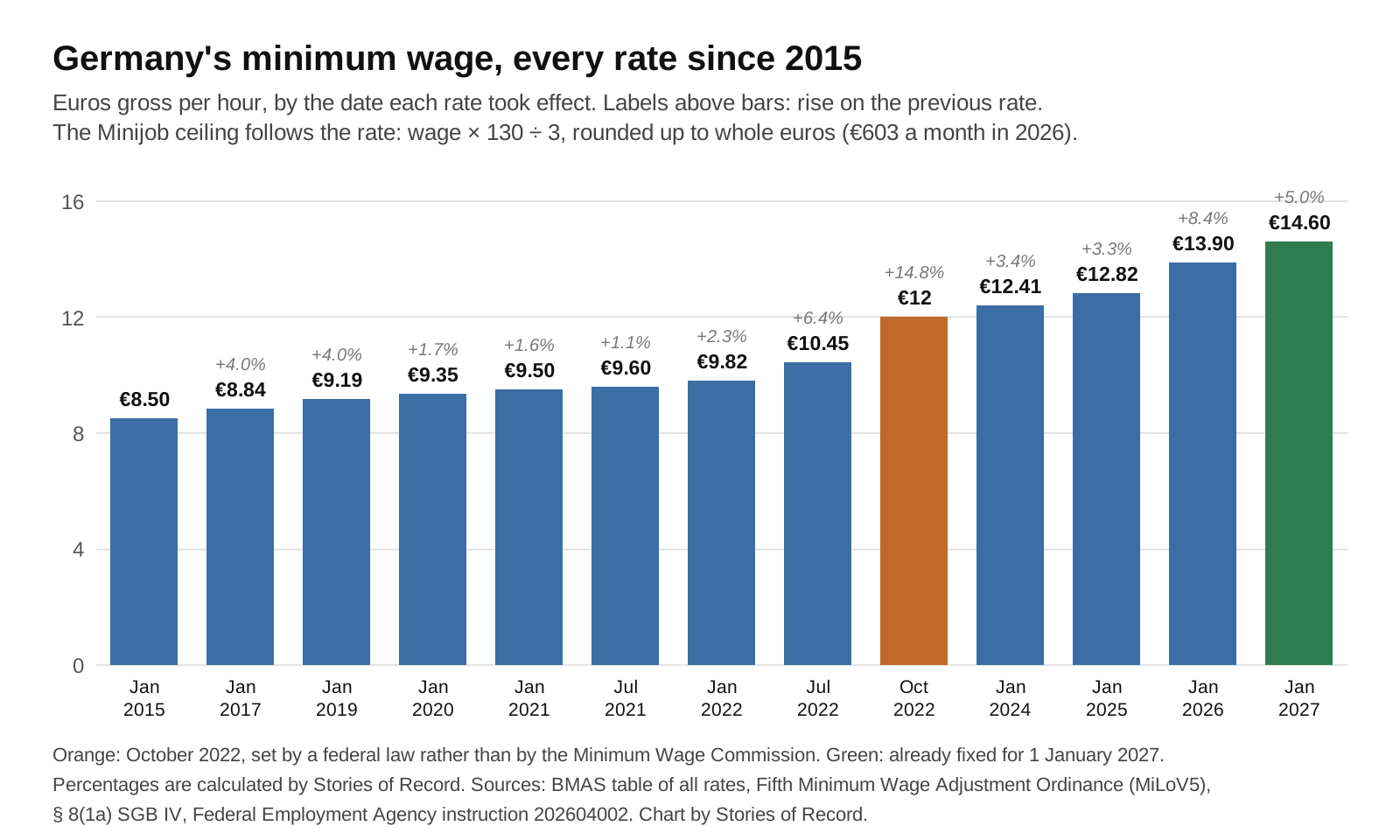
Record history (timeline)
- Since January 2026 the Minijob earnings ceiling is €603 a month. Pay from €603.01 to €2,000 falls in the transition band (Übergangsbereich), formerly the sliding zone. The Federal Employment Agency links both changes to the higher minimum wage. [4]
- The ordinance behind both rates is dated 5 November 2025 and appears in the Federal Law Gazette as BGBl. 2025 I Nr. 268. [3]
- The rate then rose to €12.82 an hour in January 2025. [3]
- The fourth adjustment ordinance, dated 24 November 2023, set €12.41 an hour from January 2024. [3]
- A one-off amendment to the Minimum Wage Act raised the rate to €12 an hour from 1 October 2022. The same law, dated 30 June 2022, also changed the rules on marginal employment such as Minijobs. Later adjustments stayed with the commission. [3]
- The rate reached €10.45 an hour in July 2022. [3]
- The rate rose to €9.82 an hour in January 2022. [3]
- A further step took the rate to €9.60 an hour in July 2021. [3]
- The third adjustment ordinance, dated November 2020, set €9.50 an hour from January 2021. [3]
- The rate rose to €9.35 an hour in January 2020. [3]
- The second adjustment ordinance, dated November 2018, set €9.19 an hour from January 2019. [3]
- The first adjustment ordinance, dated November 2016, raised the rate to €8.84 an hour from January 2017. [3]
- Germany's general statutory minimum wage began on 1 January 2015 at €8.50 an hour, set directly in the Minimum Wage Act. [3]
What is confirmed
- The ordinance behind both rates is dated 5 November 2025 and appears in the Federal Law Gazette as BGBl. 2025 I Nr. 268. [3]
- Germany's general statutory minimum wage began on 1 January 2015 at €8.50 an hour, set directly in the Minimum Wage Act. [3]
- The first adjustment ordinance, dated November 2016, raised the rate to €8.84 an hour from January 2017. [3]
- The second adjustment ordinance, dated November 2018, set €9.19 an hour from January 2019. [3]
- The rate rose to €9.35 an hour in January 2020. [3]
- The third adjustment ordinance, dated November 2020, set €9.50 an hour from January 2021. [3]
- A further step took the rate to €9.60 an hour in July 2021. [3]
- The rate rose to €9.82 an hour in January 2022. [3]
- The rate reached €10.45 an hour in July 2022. [3]
- A one-off amendment to the Minimum Wage Act raised the rate to €12 an hour from 1 October 2022. The same law, dated 30 June 2022, also changed the rules on marginal employment such as Minijobs. Later adjustments stayed with the commission. [3]
- The fourth adjustment ordinance, dated 24 November 2023, set €12.41 an hour from January 2024. [3]
- The rate then rose to €12.82 an hour in January 2025. [3]
- A job also counts as marginal if, within a calendar year, it is limited by its nature or by contract to three months or 70 working days at most, unless it is done professionally and pays above the ceiling. [5]
- The minimum wage applies whatever the hours or nationality, so it covers Minijobbers, seasonal workers and foreign employees working in Germany, whether their employer is German or based abroad. [2]
- The entitlement covers every hour actually worked in the pay period, usually the calendar month, and that includes overtime. [2]
- Employers must pay no later than the last bank working day of the month after the work was done. A written working-time account allows only limited exceptions. [2]
- The minimum wage must be paid in money and cannot be replaced by benefits in kind. Only for seasonal workers may board and lodging be counted, and then within narrow limits. [2]
- Employers must record working time for all Minijobbers, except those in private households, and for staff in listed sectors such as construction, restaurants and lodging, building cleaning, forestry, meat processing, and haulage and logistics. [2]
- The record must show when each day's work started and ended and how long it lasted, made within a week of the working day. Handwritten notes are enough, and the duty can lapse above certain pay thresholds. [2]
- Customs checks that employers pay the minimum wage, through its Finanzkontrolle Schwarzarbeit unit, which deals with undeclared work. [2]
- An independent commission of employer associations and trade unions decides on adjustments to the rate every two years, as the Minimum Wage Act requires. [3] [6]
- The government can only adopt the commission's proposal unchanged. It makes the proposed rate binding on all employers and employees by ordinance. [3]
- In an overall assessment, the commission weighs adequate minimum protection for workers, fair competition and not putting jobs at risk, and it follows collective pay trends with a lag. It must give written reasons for its decision. [6]
- The Act does not treat young people covered by the Youth Employment Protection Act as employees if they lack a completed vocational training. The labour ministry describes this group as workers under 18. [7] [2]
- The Act does not govern the pay of people employed for their vocational training, or of volunteers. [7]
- For people who were long-term unemployed immediately before starting a job, the minimum wage does not apply during the first six months of that job. [7]
- Interns count as employees under the Act unless the internship is compulsory under school, training or university rules, or lasts up to three months to help choose a training course or degree. Also excluded are internships of up to three months alongside training or study, if there was none before with the same training provider, and entry qualification or vocational preparation schemes. [7]
What remains unconfirmed
No open questions are being tracked.
Why it matters
Students, skilled workers and anyone in a Minijob in Germany are owed at least this rate for every hour worked, including overtime. Because the Minijob ceiling follows the hourly rate, each rise also changes how many hours fit under it. This page is not legal advice; check your own contract and status.
Questions
What is Germany's minimum wage per hour now, and in 2027?
It has been €13.90 gross an hour since 1 January 2026 and rises to €14.60 gross an hour on 1 January 2027, under the Fifth Minimum Wage Adjustment Ordinance.
How is the Minijob limit linked to the minimum wage?
By law it is the monthly pay for ten hours a week at the minimum wage: the hourly rate times 130, divided by three, rounded up to whole euros. For 2026 that is €603 a month. The figure for the new rate will be added when an official source publishes it.
Who is not covered by the minimum wage?
Young people under 18 without completed vocational training, people employed for their vocational training, volunteers, certain interns, and people who were long-term unemployed, for their first six months in a new job.
Can my employer count food or accommodation towards the minimum wage?
No. It must be paid in money and cannot be replaced by benefits in kind. Only for seasonal workers may board and lodging be counted, within narrow limits.
Does my employer have to record my working hours?
Yes, for every Minijob outside private households and in listed sectors such as construction and hospitality. Start, end and length of each day's work must be recorded within a week, and handwritten records are allowed. The duty can lapse above certain pay thresholds.
Who decides the next rise, and who checks that employers pay?
An independent commission of employers and unions decides on adjustments every two years, and the government can only adopt its proposal unchanged. The sources do not give a date for the decision after the next rise. Customs checks compliance through its Finanzkontrolle Schwarzarbeit unit.
Do international students and foreign workers get the minimum wage?
Yes. It applies regardless of nationality, hours worked or whether the employer is based in Germany or abroad, and covers Minijobbers and seasonal workers. The exclusions for interns and the other groups above still apply.
Sources
- Gesetze im Internet (Federal Ministry of Justice) Original documentRetrieved: 17 October 2026
- Federal Ministry of Labour and Social Affairs (BMAS) Official (government)Retrieved: 17 October 2026
- Federal Ministry of Labour and Social Affairs (BMAS) Official (government)Retrieved: 17 October 2026
- Federal Employment Agency (Bundesagentur für Arbeit) Official (government)Retrieved: 17 October 2026
- Gesetze im Internet (Federal Ministry of Justice) Original documentRetrieved: 17 October 2026
- Gesetze im Internet (Federal Ministry of Justice) Original documentRetrieved: 17 October 2026
- Gesetze im Internet (Federal Ministry of Justice) Original documentRetrieved: 17 October 2026
People, places and organizations
- organization
- Federal Ministry of Labour and Social Affairs (BMAS)
- organization
- Minimum Wage Commission (Mindestlohnkommission)
- organization
- Federal Employment Agency (Bundesagentur für Arbeit)
- organization
- Finanzkontrolle Schwarzarbeit (German customs)
- location
- Germany
Related stories
- Germany's minimum apprentice pay: 764 euros a month for 2027 starters, and why the start year decides
- Working while studying in Germany: the 140-day limit, how a week counts, and the official page that still says 120
- Germany EU Blue Card salary threshold 2026: 50,700 euros, or 45,934.20 euros reduced, with 2024 and 2025