US AI chip export licences for China: House records, and Huang back at Nvidia
Jensen Huang is due before Congress on 1 and 3 December. A Commerce Department rule adds 7 companies, Megaspeed and Apex among them, to its Entity List.
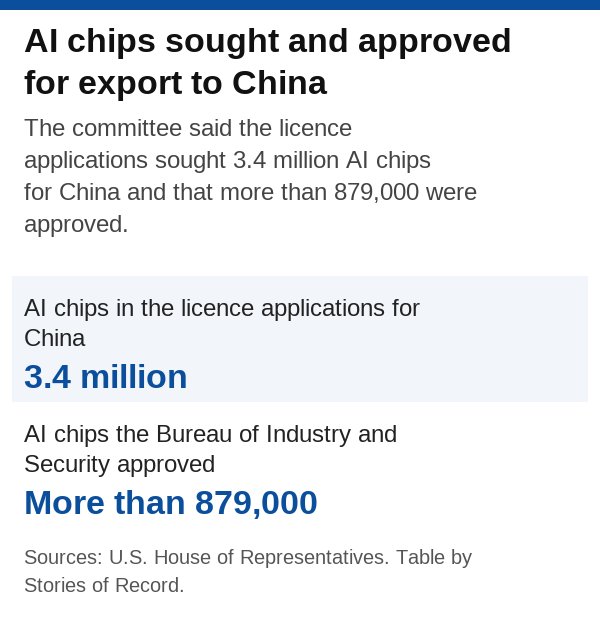
On 19 November, the House Foreign Affairs Committee made public licence records for artificial intelligence (AI) chips made by Nvidia and Advanced Micro Devices (AMD) and bound for China. The committee said the applications sought to sell 3.4 million chips, and that the Commerce Department approved more than 879,000. The Washington Post and Reuters reported that approved buyers included companies the Pentagon links to China's military.
Latest
The Commerce Department's rule also lists Apex Enterprise Solutions, a Singapore company that Reuters reported is owned by Alibaba. Alibaba disputed the listing, denied that Apex had diverted chips and said it would seek legal remedies, Reuters reported. On 24 November, Singapore's Prime Minister, Lawrence Wong, said Singapore is still looking into whether Megaspeed broke its laws, Reuters reported.
Key facts
- On 19 November, Representative Brian Mast, who chairs the House Foreign Affairs Committee, used his powers under the Export Control Reform Act to make public licence application records for Nvidia and Advanced Micro Devices (AMD) AI chips bound for China, the committee said. The Washington Post and Reuters also reported the release. [1] [2] [3]
- The committee said the applications sought to sell 3.4 million AI chips to China, and that the Commerce Department's Bureau of Industry and Security (BIS) approved more than 879,000 of them. [1]
Timeline
- On 24 November, Singapore's Prime Minister, Lawrence Wong, said in Canberra that his country is still looking into whether Megaspeed broke Singapore's laws, Reuters reported. He said Singapore's authorities were staying in contact with US officials. This is Wong's account. [28]
- On 23 November, Senator Elizabeth Warren, the senior Democrat on the Senate Banking Committee, said the Trump administration must tell Congress which senior officials gave input in support of Huang's reinstatement, and what that input was. She also said Huang, other Nvidia executives and the board still owe Congress answers on the company's compliance with US export controls. The committee's Democrats posted her statement, and Reuters and Axios reported it. [16] [17] [18]
- On 23 November, Representatives Mast, Moolenaar and Crawford, who chair three House committees, said Jensen Huang and Tim Teter, Nvidia's general counsel, had confirmed they would sit for transcribed interviews on 1 and 2 December, as planned. In their statement, the chairs said the board's decision to bring Huang back does not settle the national security questions they want answered. CBS News and Reuters also reported the plans. [21] [22] [23]
- The Commerce Department's Bureau of Industry and Security (BIS) has added 7 companies in Malaysia, Singapore and Thailand to its Entity List, its official rule says. The list names foreign firms that face extra US licence requirements. The 7 include Megaspeed International in Singapore, the company named in the House Democrats' letter, and Megaspeed companies in Malaysia and Thailand. The rule takes effect on the day it goes on public inspection, and the Federal Register record shows that day was 23 November. It is due to be printed in the Federal Register on 25 November. [26] [27]NEW
- On 22 November, Treasury Secretary Scott Bessent said the administration has contacted Nvidia's "interim management", directors and lawyers over the company's chip sales to China, as reported by CBS News and Reuters. Officials still want to learn who at Nvidia is in charge of compliance, he said. This is Bessent's own account. It does not establish that Nvidia did anything improper. [7] [8]
- On 22 November, Treasury Secretary Scott Bessent was asked whether Jensen Huang should return to lead Nvidia. In reply, he said he wanted to learn who at Nvidia had been in charge of compliance, CBS News and Reuters reported. Both outlets also reported that President Donald Trump has said he would like Huang to come back. These are Bessent's and Trump's own comments. They do not establish that Huang or anyone else at Nvidia was responsible for any compliance failure. [7] [8]
- On 22 November, Nvidia's board reinstated Jensen Huang as president and chief executive, and as a board member, with immediate effect, the company said in a filing with the Securities and Exchange Commission (SEC). The Associated Press (AP) and Reuters reported his return on 23 November. [9] [10] [11]
- On 20 November, Treasury Secretary Scott Bessent told CNBC he expected US policy on Nvidia H200 sales to China to stay as it is, and said he saw the current restrictions as enough, AP reported. [4]
- On 19 November, Representative Brian Mast, who chairs the House Foreign Affairs Committee, used his powers under the Export Control Reform Act to make public licence application records for Nvidia and Advanced Micro Devices (AMD) AI chips bound for China, the committee said. The Washington Post and Reuters also reported the release. [1] [2] [3]
- On 19 November, two Democrats on the House Foreign Affairs Committee, Representatives Gregory Meeks and Sydney Kamlager-Dove, wrote to Commerce Secretary Howard Lutnick. They asked how his department handled an inquiry into Megaspeed, a data centre company in Singapore, and about Nvidia's contact with the investigators. Meeks is the committee's ranking member, its most senior minority-party member. Reuters also reported the letter. [5] [6]
What we know
- The approvals included Chinese companies that the Pentagon has listed as tied to China's military, according to the committee, The Washington Post and Reuters. The committee named Alibaba and Tencent as two such companies. [1] [2] [3]
- On 19 November, two Democrats on the House Foreign Affairs Committee, Representatives Gregory Meeks and Sydney Kamlager-Dove, wrote to Commerce Secretary Howard Lutnick. They asked how his department handled an inquiry into Megaspeed, a data centre company in Singapore, and about Nvidia's contact with the investigators. Meeks is the committee's ranking member, its most senior minority-party member. Reuters also reported the letter. [5] [6]
- The lawmakers said they were writing after a New York Times report on 9 November about the way the department dealt with the Megaspeed inquiry. [5]
- The letter lists 10 questions. Among them, the lawmakers ask whether Jeffrey Kessler, the Under Secretary for Industry and Security, authorised Nvidia to contact the investigators directly, whether Nvidia was given any non-public information about the inquiry, and whether the bureau halted or suspended it. They also ask whether Lutnick himself had any contact with Nvidia's leaders or representatives about the inquiry. [5] [6]
- The two lawmakers asked the department to send written answers and the relevant documents by 1 December 2026. [5] [6]
- On 22 November, Treasury Secretary Scott Bessent said the administration has been in touch with Nvidia's interim leadership, its directors and its lawyers over the company's chip sales to China, as reported by CBS News and Reuters. Officials still want to learn who at Nvidia is in charge of compliance, he said. This is Bessent's own account. It does not establish that Nvidia did anything improper. [7] [8]
- On 22 November, Nvidia's board reinstated Jensen Huang as president and chief executive, and as a board member, with immediate effect, the company said in a filing with the Securities and Exchange Commission (SEC). The Associated Press (AP) and Reuters reported his return on 23 November. [9] [10] [11]
- Colette Kress stays on as Nvidia's executive vice president and chief financial officer, the filing says. She had been interim chief executive, AP and Reuters reported. [9] [10] [11]
- President Donald Trump said the US government had no reason to think Huang's return was a risk to national security, AP and Reuters reported. This is Trump's own statement. [10] [11]
- On 23 November, Senate Democratic leader Chuck Schumer said Nvidia's choice to reinstate Huang strengthened the case for tighter limits on exporting advanced US technology to China, Reuters and Axios reported. This is Schumer's own view. [12] [13]
- The Senate Banking Committee has scheduled a public hearing on US export controls of AI technology for 3 December, with Jensen Huang, Nvidia's president and chief executive, as its only listed witness, the committee's website shows. The Wall Street Journal also reported the hearing. [14] [15]
- On 23 November, Senator Elizabeth Warren, the senior Democrat on the Senate Banking Committee, said the Trump administration must tell Congress which senior officials gave input in support of Huang's reinstatement, and what that input was. She also said Huang, other Nvidia executives and the board still owe Congress answers on the company's compliance with US export controls. The committee's Democrats posted her statement, and Reuters and Axios reported it. [16] [17] [18]
- On 23 November, Representatives Mast, Moolenaar and Crawford, who chair three House committees, said Jensen Huang and Tim Teter, Nvidia's general counsel, had confirmed they would sit for transcribed interviews on 1 and 2 December, as planned. In their statement, the chairs said the board's decision to bring Huang back does not settle the national security questions they want answered. CBS News and Reuters also reported the plans. [21] [22] [23]
- The Commerce Department's Bureau of Industry and Security (BIS) has added 7 companies in Malaysia, Singapore and Thailand to its Entity List, its official rule says. The list names foreign firms that face extra US licence requirements. The 7 include Megaspeed International in Singapore, the company named in the House Democrats' letter, and Megaspeed companies in Malaysia and Thailand. The rule takes effect on the day it goes on public inspection, and the Federal Register record shows that day was 23 November. It is due to be printed in the Federal Register on 25 November. [26] [27]
- BIS gave its reason in the rule: it sees a significant risk that these companies are or will become involved in diverting advanced computing goods to uses or users that are not authorised. Anyone sending them any item covered by the Export Administration Regulations, the main US export rules, now needs a licence. The rule says requests will be reviewed with a presumption of denial, which means the starting point is a refusal. [26]
- The same rule also adds Apex Enterprise Solutions (Singapore) Private Limited, a company in Singapore also known as Apex, to the Entity List, the rule shows. [26]
What we don't know yet
- The Washington Post reported that the records cover export licences and do not show how many chips reached each buyer. [2]
- Nvidia said it had stopped sending its H200 chips to China, The Washington Post reported. [2]
- On 20 November, Treasury Secretary Scott Bessent told CNBC he expected US policy on Nvidia H200 sales to China to stay as it is, and said he saw the current restrictions as enough, AP reported. [4]
- President Donald Trump and Vice President JD Vance supported Huang's return partly because they regarded him as a champion of American open-weight AI models, Reuters and Axios reported, citing people familiar with the discussions. Neither outlet named its sources. [19] [20]
- Reuters reported that Apex is a subsidiary of Alibaba, one of the Chinese companies the House committee named. The rule itself does not name Alibaba. [24]
- Alibaba disputed the decision to list Apex, Reuters reported. In its statement, the company denied that Apex had diverted chips covered by US export controls, and said it would seek legal remedies. This is Alibaba's own account. [24]
- On 24 November, Singapore's Prime Minister, Lawrence Wong, said in Canberra that his country is still looking into whether Megaspeed broke Singapore's laws, Reuters reported. He said Singapore's authorities were staying in contact with US officials. This is Wong's account. [28]
Earlier reports we have updated
- Updated 23 November 2026: Nvidia's board reinstated Huang as chief executive on 22 November, its filing says. Bessent's answer stays in the timeline. See What we know.Earlier we wrote:
On 22 November, Treasury Secretary Scott Bessent was asked whether Jensen Huang should return to lead Nvidia. In reply, he said he wanted to learn who at Nvidia had been in charge of compliance, CBS News and Reuters reported. Both outlets also reported that President Donald Trump has said he would like Huang to come back. These are Bessent's and Trump's own comments. They do not establish that Huang or anyone else at Nvidia was responsible for any compliance failure.[7] [8] - Updated 24 November 2026: The Commerce Department's official rule is now public. It lists 7 companies, including Megaspeed, and requires a licence for all goods covered by US export rules, not only advanced chips. See What we know.Earlier we wrote:
On 23 November, the Commerce Department put Megaspeed, the Singapore company named in the House Democrats' letter, on its export control list, Reuters and CBS News reported. Suppliers now need a US government licence to send it the advanced US chips that the rules cover.[24] [25]
Why it matters
The US government decides through export licences which foreign buyers may get its most advanced AI chips. These licence decisions are usually kept private. The committee's release gives the public a rare look at how many chips US officials cleared for China, and for which kinds of buyers. The records cover approvals, not shipments. The Washington Post reported that they do not show how many chips each buyer actually received. Licences decide who may buy the chips. Enforcement checks that the rules are kept. The letter from the committee's Democrats asks how the Commerce Department handled one such inquiry and what part Nvidia played in it. It asks questions; it does not establish that anyone acted improperly.
Questions
What did the House committee release?
Licence application records for Nvidia and Advanced Micro Devices (AMD) AI chips bound for China. The committee's chairman, Representative Brian Mast, released them on 19 November under the Export Control Reform Act, the committee said.
How many chips did the US approve for China?
The committee said the applications sought to sell 3.4 million AI chips to China and that the Bureau of Industry and Security (BIS) approved more than 879,000.
Did all of the approved chips reach China?
That is not known. The Washington Post reported that the records cover licences and do not show how many chips reached each buyer.
Which buyers were approved?
The committee, The Washington Post and Reuters said the approvals included Chinese companies the Pentagon links to China's military. The committee named Alibaba and Tencent.
Is Nvidia still shipping H200 chips to China?
Nvidia said it had stopped, The Washington Post reported. On 20 November, Treasury Secretary Scott Bessent told CNBC he expected US policy on those sales to stay as it is, AP reported.
Has the administration contacted Nvidia about its sales to China?
Yes, according to Treasury Secretary Scott Bessent. On 22 November he said the administration had been in touch with the company's interim leadership, its directors and its lawyers. He said officials also wanted to find out who at Nvidia is in charge of compliance, CBS News and Reuters reported. This is his account. It does not establish that Nvidia did anything improper.
What are House Democrats asking the Commerce Department about Nvidia?
On 19 November, Representatives Gregory Meeks and Sydney Kamlager-Dove asked Commerce Secretary Howard Lutnick whether a department official let Nvidia contact the investigators in an inquiry into Megaspeed, a data centre company in Singapore. They asked for answers by 1 December. Their letter asks questions. It does not establish that anything improper happened.
Is Jensen Huang back in charge of Nvidia?
Yes. Nvidia's board reinstated him as president and chief executive on 22 November, the company said in a filing with the Securities and Exchange Commission. Colette Kress stays on as chief financial officer, the filing says. She had been interim chief executive, as AP and Reuters reported.
What did Bessent and Trump say about Huang's return?
On 22 November, Treasury Secretary Scott Bessent was asked whether Huang should come back to lead Nvidia. He answered that he wanted to learn who at Nvidia had been in charge of compliance, CBS News and Reuters reported. Separately, President Donald Trump said the US government had no reason to think his return was a risk to national security, AP and Reuters reported. These are their own comments. They do not establish that Huang or anyone else at Nvidia was responsible for any compliance failure.
Will Jensen Huang appear before Congress?
Yes, he is due before Congress twice. Three House committee chairs said Huang will sit for a transcribed interview with their panels on 1 December, and Tim Teter, Nvidia's general counsel, on 2 December. The Senate Banking Committee lists Huang as the witness at a public hearing on US export controls on Thursday, 3 December, its website shows.
How have lawmakers reacted to Huang's return?
Senate Democratic leader Chuck Schumer said on 23 November that the decision made the case for tighter limits on exports of advanced US technology to China, Reuters and Axios reported. That is his own view.
Why did Trump and Vance back Huang's return?
Reuters and Axios reported that President Donald Trump and Vice President JD Vance supported it partly because they saw Huang as a champion of American open-weight AI models. Both outlets cited people familiar with the discussions. Neither the White House nor Nvidia has confirmed this account in the reports we cite, so we list it as not confirmed.
What is Congress asking about Huang's return?
Senator Elizabeth Warren, the senior Democrat on the Senate Banking Committee, said on 23 November that the administration must tell Congress which senior officials gave input in support of his reinstatement, and what that input was. She also said Huang, other Nvidia executives and the board still owe Congress answers on export control compliance. Her committee posted the statement, and Reuters and Axios reported it. Huang is due before the same committee on 3 December.
What happened to Megaspeed?
The Commerce Department has added Megaspeed International, a Singapore company, to its Entity List, its official rule says. The rule lists 7 companies in all, including Megaspeed firms in Malaysia and Thailand. Anyone sending them goods covered by US export rules now needs a licence, and requests start from a presumption of denial. The department said it saw a significant risk of advanced computing goods being diverted. On 24 November, Singapore's Prime Minister, Lawrence Wong, said Singapore is still looking into whether Megaspeed broke its laws, Reuters reported.
Is an Alibaba company on the list?
The rule lists Apex Enterprise Solutions (Singapore), a company in Singapore. The rule does not name Alibaba, but Reuters reported that Apex is an Alibaba subsidiary. Alibaba disputed the listing, Reuters reported. It denied that Apex had diverted chips covered by US export controls and said it would seek legal remedies. That is the company's own account.
Updates
- Adds Apex Enterprise Solutions, which Reuters reported is an Alibaba subsidiary, to the companies on the Entity List, Alibaba's response, and Singapore's own inquiry into Megaspeed.
- Adds the Commerce Department's official rule adding 7 companies, Megaspeed among them, to the Entity List, replacing the earlier news reports of the listing.
- Adds the House chairs' statement that Jensen Huang and Nvidia's general counsel will be interviewed on 1 and 2 December, and Reuters' and CBS News's reports that Commerce put Megaspeed on its export control list.
- Adds Senator Elizabeth Warren's demand that the administration name the officials who backed Huang's return (her statement; Reuters and Axios), and Reuters' and Axios's reports on why Trump and Vance supported it.
- Adds the Senate Banking Committee's 3 December hearing with Jensen Huang, and Senator Chuck Schumer's call for stronger export controls.
- Adds Nvidia's decision to reinstate Jensen Huang as chief executive on 22 November, and President Donald Trump's reported remark on his return.
- Adds Treasury Secretary Scott Bessent's 22 November answer on whether Jensen Huang should return to lead Nvidia, and President Donald Trump's reported wish for Huang to come back.
- Adds Treasury Secretary Scott Bessent's account of the administration's contact with Nvidia over chip sales to China.
- Adds a letter from two House Democrats asking the Commerce Department about Nvidia's contact with investigators in an export inquiry.
- First published.
What earlier versions said
- RevisedRead that version
Before: President Donald Trump and Vice President Vance supported Huang's return partly because they regarded him as a champion of American open-weight AI models, Reuters and Axios reported, citing people familiar with the discussions. Neither outlet named its sources.
Now: President Donald Trump and Vice President JD Vance supported Huang's return partly because they regarded him as a champion of American open-weight AI models, Reuters and Axios reported, citing people familiar with the discussions. Neither outlet named its sources.
- No longer listed as confirmedRead that version
Before: On 23 November, the Commerce Department put Megaspeed, the Singapore company named in the House Democrats' letter, on its export control list, Reuters and CBS News reported. Suppliers now need a US government licence to send it the advanced US chips that the rules cover.
- No longer listed as confirmedRead that version
Before: On 22 November, Treasury Secretary Scott Bessent was asked whether Jensen Huang should return to lead Nvidia. In reply, he said he wanted to learn who at Nvidia had been in charge of compliance, CBS News and Reuters reported. Both outlets also reported that President Donald Trump has said he would like Huang to come back. These are Bessent's and Trump's own comments. They do not establish that Huang or anyone else at Nvidia was responsible for any compliance failure.
Every version of this story, as first published.
Sources
- U.S. House of Representatives Official (government)Published: 19 November 2026Retrieved: 21 November 2026
- The Washington Post News organizationPublished: 20 November 2026Reported by The Washington Post; credited as reported, not opened by us
- Reuters News organizationPublished: 19 November 2026Reported by Reuters; credited as reported, not opened by us
- The Associated Press News organizationPublished: 20 November 2026Reported by The Associated Press; credited as reported, not opened by us
- U.S. House of Representatives Official (government)Retrieved: 22 November 2026
- Reuters News organizationPublished: 20 November 2026Reported by Reuters; credited as reported, not opened by us
- CBS News News organizationPublished: 22 November 2026Reported by CBS News; credited as reported, not opened by us
- Reuters News organizationPublished: 22 November 2026Reported by Reuters; credited as reported, not opened by us
- U.S. Securities and Exchange Commission Official (government)Retrieved: 23 November 2026
- The Associated Press News organizationPublished: 23 November 2026Reported by The Associated Press; credited as reported, not opened by us
- Reuters News organizationPublished: 23 November 2026Reported by Reuters; credited as reported, not opened by us
- Reuters News organizationPublished: 23 November 2026Reported by Reuters; credited as reported, not opened by us
- Axios News organizationPublished: 23 November 2026Reported by Axios; credited as reported, not opened by us
- U.S. Senate Official (government)Retrieved: 23 November 2026
- The Wall Street Journal News organizationPublished: 23 November 2026Reported by The Wall Street Journal; credited as reported, not opened by us
- U.S. Senate Official (government)Retrieved: 23 November 2026
- Reuters News organizationPublished: 23 November 2026Reported by Reuters; credited as reported, not opened by us
- Axios News organizationPublished: 23 November 2026Reported by Axios; credited as reported, not opened by us
- Reuters News organizationPublished: 23 November 2026Reported by Reuters; credited as reported, not opened by us
- Axios News organizationPublished: 23 November 2026Reported by Axios; credited as reported, not opened by us
- U.S. House of Representatives Official (government)Published: 23 November 2026Retrieved: 24 November 2026
- CBS News News organizationPublished: 23 November 2026Reported by CBS News; credited as reported, not opened by us
- Reuters News organizationPublished: 24 November 2026Reported by Reuters; credited as reported, not opened by us
- Reuters News organizationPublished: 23 November 2026Reported by Reuters; credited as reported, not opened by us
- CBS News News organizationPublished: 23 November 2026Reported by CBS News; credited as reported, not opened by us
- Federal Register (FederalRegister.gov) Original documentRetrieved: 24 November 2026
- Federal Register (FederalRegister.gov) Original documentRetrieved: 24 November 2026
- Reuters News organizationPublished: 24 November 2026Reported by Reuters; credited as reported, not opened by us
About the picture: this is an illustration made for this story with an AI image tool and checked against it. It is not a picture of the real people, places or events.
People, places and organizations
- Organization
- House Foreign Affairs Committee
- Organization
- United States Department of Commerce
- Organization
- Bureau of Industry and Security
- Organization
- Nvidia
- Organization
- AMD
- Person
- Brian Mast
- Person
- Scott Bessent
Related stories
Follow us on Facebook
We post new records on our Facebook Page.
Follow on Facebook