Permanent residence in Germany: from 21 months to five years, every route to a settlement permit
Five years under the general rule, or 21 months on an EU Blue Card with German at B1, per BAMF's settlement guide dated 1 March 2024.

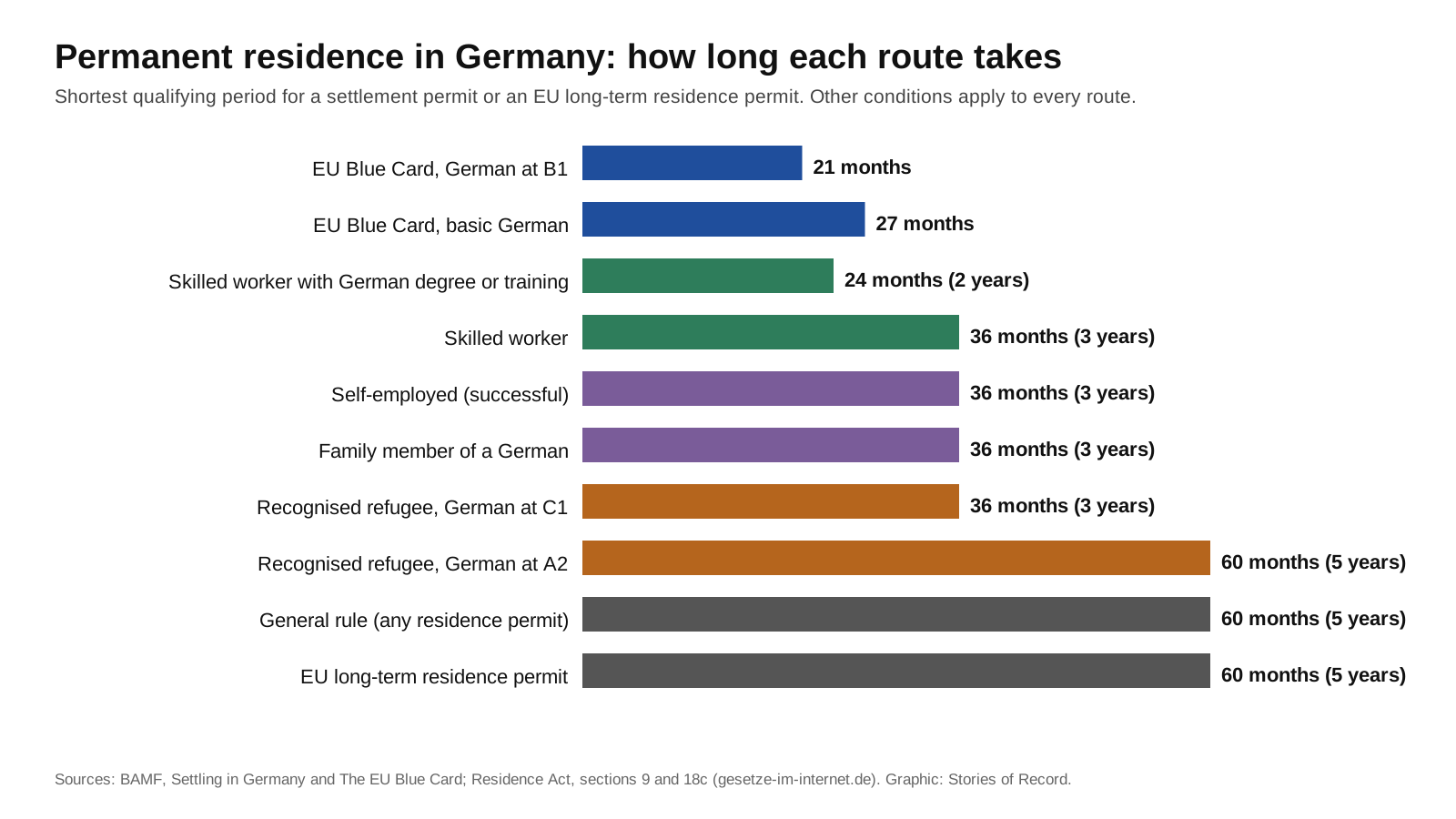
Under BAMF's settlement guide dated 1 March 2024 and the current Residence Act, a settlement permit takes five years with 60 months of pension contributions under the general rule. EU Blue Card holders can qualify after 21 or 27 months, depending on their German. Skilled workers need three years, or two after training or a degree in Germany. The self-employed, family members of Germans and civil servants need three. People with subsidiary protection follow the five-year general rule. The skilled-worker and Blue Card periods were last cut on 1 March 2024, from four years and 33 months, values set in 2020 and 2012.
Latest
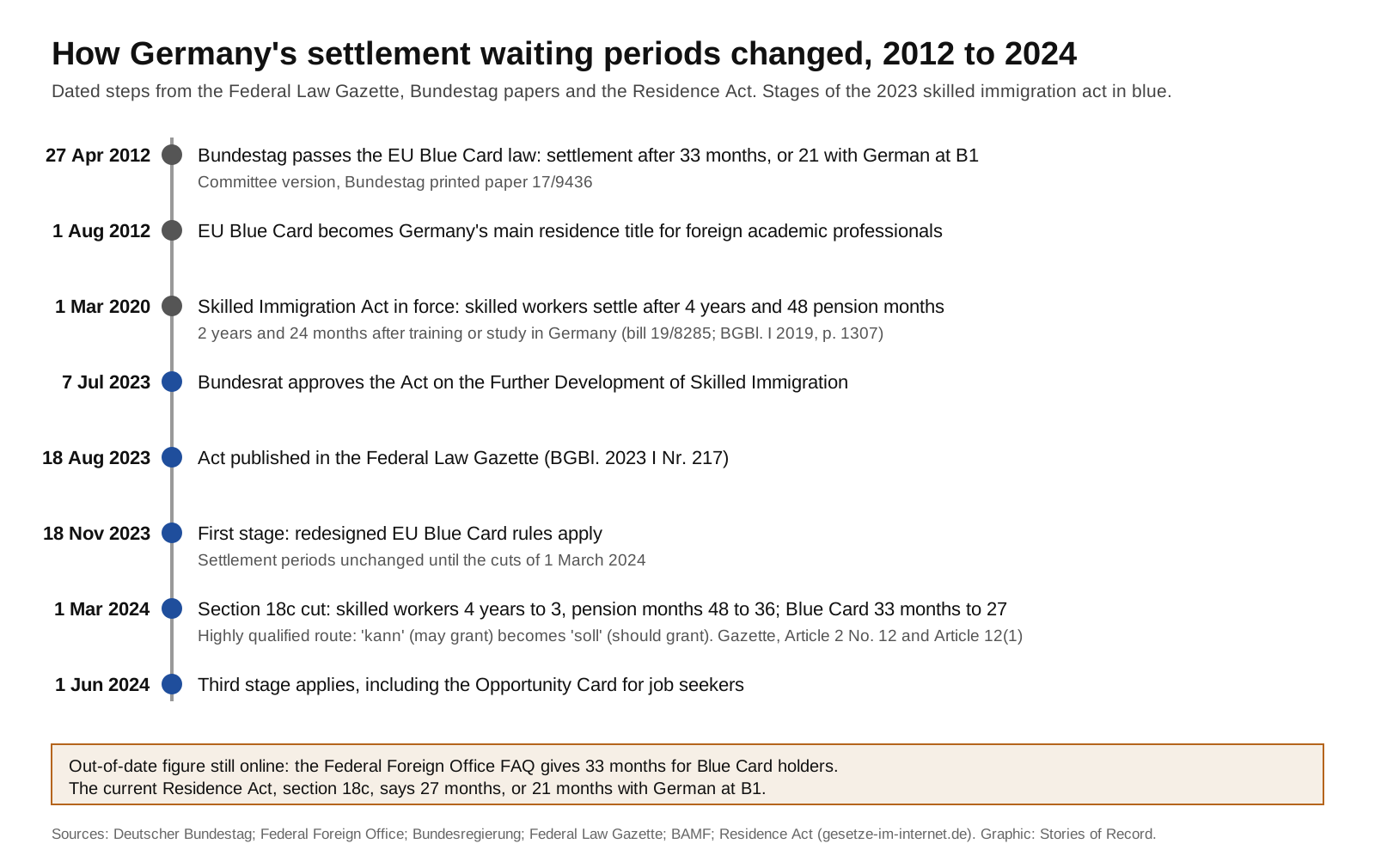
This version adds the dated history of each waiting period. The 2012 Blue Card law set 33 months, or 21 with B1, and the 2020 Skilled Immigration Act set four years and 48 months. The Federal Law Gazette dates the cuts to 1 March 2024. It adds the subsidiary protection route and the change from "may" to "should" for the highly qualified. It flags that the Federal Foreign Office FAQ still says 33 months.
Key facts
- Under the general rule, a settlement permit is granted after five years with a residence permit, with at least 60 months of pension contributions, secure income, German at level B1, basic knowledge of the legal and social order, and adequate housing. [1] [2]
- EU Blue Card holders get a settlement permit after 27 months of Blue Card employment with pension contributions and basic German, or after 21 months with German at level B1. [3] [4]
- Skilled workers with vocational or academic training get a settlement permit after three years with a skilled-worker residence title, if they hold a job, have paid 36 months of pension contributions and have sufficient German. [2] [3]
- The current skilled-worker rules come from a reform passed by the Bundesrat on 7 July 2023. The government says it took effect in stages: the new Blue Card rules from 18 November 2023, further parts from 1 March 2024 and 1 June 2024. [7]
- People with subsidiary protection or another humanitarian residence permit can be granted a settlement permit at the authority's discretion. They must meet the general rule: five years, 60 months of pension contributions and German at B1. Time in the asylum procedure counts. [10] [1] [2]
Timeline
- Third stage of the reform applies, including the points-based Opportunity Card for job seekers. [7]
- BAMF's English guide to settling in Germany is dated March 2024. We checked its periods against the current text of the Residence Act. [2]
- The skilled-worker rules in force today come from the Act on the Further Development of Skilled Immigration, published in the Federal Law Gazette in August 2023. [6]
- The Bundesrat approves the Act on the Further Development of Skilled Immigration. [7]
- The EU Blue Card becomes Germany's main residence title for foreign academic professionals. [8]
What we know
- Time out of work for childcare or caring for a relative at home is credited towards the 60 months of pension contributions. [1]
- For skilled workers who completed vocational training or a degree in Germany, the periods shrink to two years and 24 months of contributions. [3]
- Successful self-employed people who can support themselves and their dependants may get a settlement permit after three years. [2] [9]
- Family members of a German national get a settlement permit after three years with a residence permit, if the family unit continues in Germany and they have sufficient German. [2] [11]
- Foreign nationals who are tenured civil servants of a German public employer get a settlement permit after three years, without the 60-month pension requirement. [2]
- People granted asylum or refugee protection can get a settlement permit after five years, counting the asylum procedure, with German at level A2; with German at level C1 and largely self-supporting, after three years. [2] [10]
- The EU long-term residence permit is also open-ended and lets the holder settle in another EU country under that country's rules. It normally requires five years with a residence title, regular income and German at level B1. [2]
- For the EU long-term residence permit, Blue Card holders can count time spent with a Blue Card in other EU countries, not only time in Germany. [5]
- A settlement permit is valid indefinitely and allows stays in other Schengen countries of up to 90 days in any 180-day period. [2]
- The skilled-worker rules in force today come from the Act on the Further Development of Skilled Immigration, published in the Federal Law Gazette in August 2023. [6]
- BAMF's English guide to settling in Germany is dated 1 March 2024. We checked its periods against the current text of the Residence Act. [2]
- The Federal Foreign Office's Blue Card FAQ still says a settlement permit is possible after 33 months, or 21 with German at B1. The current Residence Act says 27 months, so the Foreign Office figure is out of date. [8] [3]
- BAMF's Blue Card guide is dated 18 November 2023, the first day of the reform, and gives 27 months with basic German and 21 months with German at B1. The cut from 33 months itself took effect on 1 March 2024. [4]
- The EU Blue Card has been Germany's main residence title for foreign academic professionals since 1 August 2012. [8]
- Highly qualified people with an academic background, such as scientists with special expertise, should get a settlement permit in special cases without a waiting period, if their integration and income are assured. [3]
- A spouse of someone with a skilled-worker settlement permit can get one after three years if they work at least 20 hours a week. [2]
- A child of a foreign national gets a settlement permit if they have held a residence permit for at least five years on turning 16. [2]
- Former German nationals get a settlement permit if they had lived in Germany for at least five years when they lost German nationality. [2]
- The Federal Law Gazette text cut the skilled-worker period from four years to three and the pension months from 48 to 36. It cut the Blue Card period from 33 months to 27. These changes sit in Article 2, which took effect on 1 March 2024, not 18 November 2023. [12]
- The 2023 law did not change the 21-month period for Blue Card holders with German at B1. The Foreign Office FAQ gives 21 months alongside the old 33, and the current Residence Act still says 21. [12] [8] [3]
- The faster three- and five-year refugee routes cover only people granted asylum or refugee status. Subsidiary protection is granted under a separate sentence of the Residence Act, so it falls under the discretionary general route. [10] [13]
- Since 1 March 2024 the highly qualified route says authorities "should" grant the settlement permit. Before, the Act said they "could". The Federal Law Gazette replaced the word "kann" with "soll" in section 18c(3). [12] [3]
- The 33-month Blue Card rule, and 21 months with German at B1, date from the 2012 Blue Card law. The Bundestag passed it on 27 April 2012 in the Interior Committee's version, which set both periods. It applied from 1 August 2012. [14] [15] [8]
- The four-year, 48-month skilled-worker rule came from the Skilled Immigration Act of 15 August 2019, in force from 1 March 2020. The government bill of 13 March 2019 also set two years and 24 months after training or study in Germany. [16] [17]
Why it matters
The route you are on decides whether you can settle in under two years or need five, and each route counts pension months and German level differently. Older official and private pages still give pre-reform periods, so check the date of any page you rely on.
Questions
How long until I can get permanent residence in Germany?
Five years under the general rule. It can be 21 or 27 months on an EU Blue Card, two years for skilled workers who trained or studied in Germany, and three years for other skilled workers, the successful self-employed and family members of Germans.
Is there a route with no waiting period?
Yes, in special cases. The Residence Act says highly qualified people with an academic background, such as scientists with special expertise, should get a settlement permit if their integration and income are assured. Until 1 March 2024 the Act only said they could.
Why does a government page say 33 months for the Blue Card?
The Federal Foreign Office FAQ still gives 33 months, or 21 with German at B1. The current Residence Act and BAMF give 27 months, or 21 with B1.
When did the current periods take effect?
On 1 March 2024. The Federal Law Gazette text puts the cuts to section 18c in the part of the 2023 reform that took effect that day, not in the first stage of 18 November 2023.
What were the periods before 1 March 2024?
Skilled workers needed four years and 48 months of pension contributions, now three years and 36 months. Blue Card holders with basic German needed 33 months, now 27. The 21-month Blue Card route with German at B1 did not change. The 33 and 21 months date from the 2012 Blue Card law; the four years and 48 months from 1 March 2020.
Can people with subsidiary protection get a settlement permit?
Yes, but not on the faster refugee routes. They fall under the general rule, at the authority's discretion: five years, 60 months of pension contributions and German at B1. Time spent in the asylum procedure counts towards the five years.
What German level do I need?
B1 under the general rule and for the 21-month Blue Card route; basic German for the 27-month Blue Card route; A2 for recognised refugees on the five-year route, C1 on their three-year route.
How many months of pension contributions are needed?
60 months under the general rule, 36 months for skilled workers and 24 months for those who trained or studied in Germany. Blue Card holders need contributions for their 21 or 27 qualifying months.
What is the difference between a settlement permit and the EU long-term residence permit?
Both are open-ended. The EU long-term residence permit also lets you settle in another EU country under its rules, and Blue Card holders can count Blue Card time in other EU countries towards it.
Does a settlement permit let me travel in Europe?
BAMF says it allows stays in other Schengen countries of up to 90 days in any 180-day period.
Updates
- Added the subsidiary protection route, the 2024 change from "may" to "should" for the highly qualified, and the earlier history: the 2012 Blue Card law (33 or 21 months) and the 2020 Skilled Immigration Act (four years, 48 months).
- First published.
What earlier versions said
- RevisedRead that version
Before: BAMF's English guide to settling in Germany is dated March 2024. We checked its periods against the current text of the Residence Act.
Now: BAMF's English guide to settling in Germany is dated 1 March 2024. We checked its periods against the current text of the Residence Act.
Every version of this story, as first published.
Sources
- Gesetze im Internet (Federal Ministry of Justice) Original documentRetrieved: 8 October 2026
- Federal Office for Migration and Refugees (BAMF) Official (government)Published: 1 March 2024Retrieved: 8 October 2026
- Gesetze im Internet (Federal Ministry of Justice) Original documentRetrieved: 8 October 2026
- Federal Office for Migration and Refugees (BAMF) Official (government)Published: 18 November 2023Retrieved: 8 October 2026
- Federal Office for Migration and Refugees (BAMF) Official (government)Published: 18 November 2023Retrieved: 8 October 2026
- Bundesgesetzblatt (Federal Law Gazette) Original documentPublished: 18 August 2023Retrieved: 8 October 2026
- Federal Government of Germany (Bundesregierung) Official (government)Retrieved: 8 October 2026
- Federal Foreign Office (Auswärtiges Amt) Official (government)Retrieved: 8 October 2026
- Gesetze im Internet (Federal Ministry of Justice) Original documentRetrieved: 8 October 2026
- Gesetze im Internet (Federal Ministry of Justice) Original documentRetrieved: 8 October 2026
- Gesetze im Internet (Federal Ministry of Justice) Original documentRetrieved: 8 October 2026
- Bundesgesetzblatt (Federal Law Gazette) Original documentPublished: 18 August 2023Retrieved: 8 October 2026
- Gesetze im Internet (Federal Ministry of Justice) Original documentRetrieved: 8 October 2026
- Deutscher Bundestag Original documentPublished: 25 April 2012Retrieved: 8 October 2026
- Deutscher Bundestag Official (government)Retrieved: 8 October 2026
- Deutscher Bundestag Original documentDrucksache 19/8285: Gesetzentwurf der Bundesregierung, Entwurf eines FachkräfteeinwanderungsgesetzesPublished: 13 March 2019Retrieved: 8 October 2026
- Deutscher Bundestag Official (government)Published: 22 July 2020Retrieved: 8 October 2026
About the picture: this is a stock photo from Storyblocks. It does not show the people, places or events in this story.
People, places and organizations
- Organization
- Federal Office for Migration and Refugees
Related stories
- Germany EU Blue Card salary threshold 2026: 50,700 euros, or 45,934.20 euros reduced, with 2024 and 2025
- German citizenship: five years of residence since 27 June 2024, and the three-year route removed on 30 October 2025
Follow us on Facebook
We post new records on our Facebook Page.
Follow on Facebook